In the mythic past Durgasur (Durgama / Durgamasura) appears as a powerful asura whose actions caused disorder and suffering, prompting a divine martial manifestation. Multiple sources state that Durga slew a demon named Durgasur and that this victory is tied to the goddess receiving the name Durga; one encyclopedic note links Durgamasura specifically to the origin of the goddess Shakambhari, while other retellings place the episode in local temple lore such as Varanasi. In at least one variant Kalaratri is sent as a messenger associated with the episode (sources indicate Kalaratri warned Durgasur of war and then assumed a gigantic form when resisted). The basic motif across accounts is that the asura’s menace necessitates the appearance of a mother‑goddess who restores peace and welfare (Sources: Wikipedia Durgamasura; Kalaratri page; The Statesman; PhilSTAR Life; Rudraksha‑ratna).
The surveyed sources do not provide a stable physical description or iconography for Durgasur himself. Secondary and popular accounts emphasize the goddess’s iconography—Durga mounted on a lion—as the visual focus of the narrative of his defeat. The existence of a Bengali dramatic text titled Durgasur (early 20th century) indicates that regional literary and performative traditions retell and dramatize the encounter, though the available metadata does not record an on‑stage depiction of the adversary (Sources: archival play metadata; The Statesman; Wikipedia; Rudraksha‑ratna).
Primary sources characterize Durgasur as an especially formidable asura whose deeds produced such disorder that the goddess must intervene; descriptions stress his role as a powerful adversary rather than listing specific supernatural powers. Modern summaries frame him as representing grave or 'insurmountable' challenges that are overcome by Durga’s martial potency, but explicit catalogues of his magical abilities, methods of rule, or tactical behavior are not provided in the cited materials (Sources: Wikipedia; The Statesman; Rudraksha‑ratna; PhilSTAR Life).
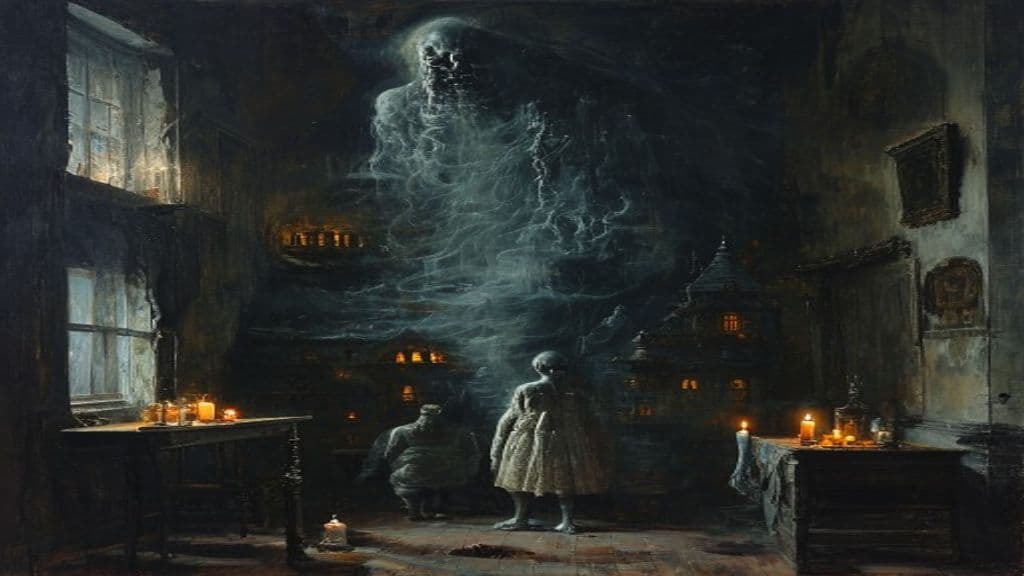
Mahapreta
The 'great ghost' — in Bihar and UP folk classification, a Mahapreta is a preta of exceptional power, born from a death involving multiple injustices simultaneously: wrongful killing, incomplete rites, and unresolved family debt combined. It commands lesser spirits and can cause harm across an entire lineage.

Kalaratri
Kālarātri is a fearsome form of the Great Goddess (Mahādevī) counted among the Navadurga; a personification of night and the devouring power of time who destroys demons and negative forces while granting protection and auspicious results to devotees.
Community Record
- [1]Durgamasura (Wikipedia). Wikipedia contributors, 'Durgamasura,' Wikipedia, The Free Encyclopedia.wiki
- [2]Kalaratri (Wikipedia). Wikipedia contributors, 'Kalaratri,' Wikipedia, The Free Encyclopedia.wiki
- [3]Durgasur - 2th ed. (archive listing). Durgasur. 2nd ed. (Bengali play) — archive metadata entry.literary
- [4]Pouranik Natak (archive listing). Pouranik Natak — archive metadata referencing dramatic literature including Durgasur.literary
- [5]The ever‑so‑enticing legend of Mother Goddess Durga (The Statesman). The Statesman, 'The ever‑so‑enticing legend of Mother Goddess Durga.'folk
- [6]In Varanasi, India, it’s a matter of faith (PhilSTAR Life). PhilSTAR Life, 'In Varanasi, India, it’s a matter of faith.'folk
- [7]Navratri 2026: Dates, Puja Vidhi, Vrat, 9 Devis of Navratri (Rudraksha‑ratna). Rudraksha‑ratna, 'Navratri 2026: Dates, Puja Vidhi, Vrat, 9 Devis of Navratri.'folk