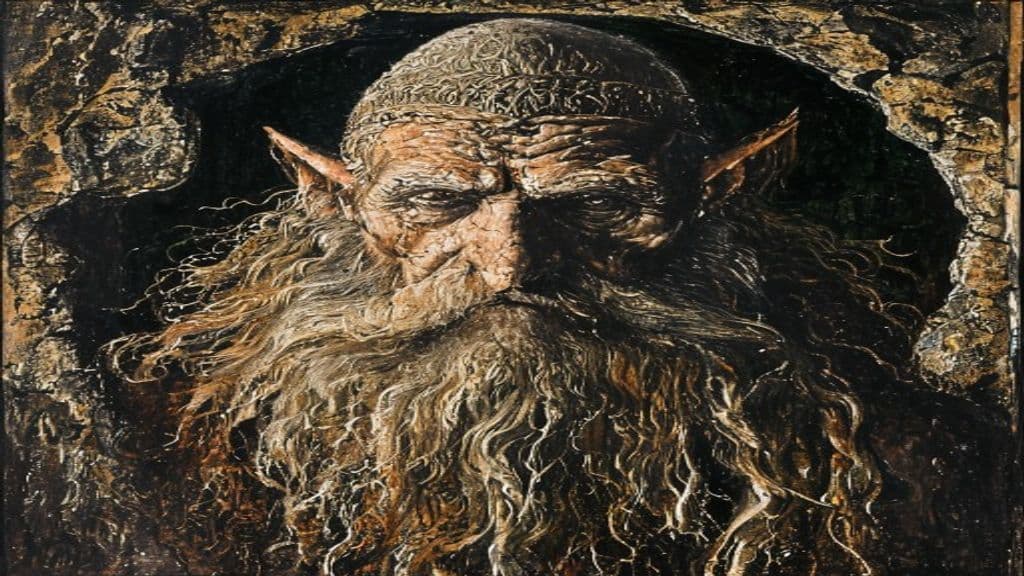
Dvalinn appears across Old Norse literary sources in multiple roles rather than a single origin narrative. As a named dwarf he is listed among the mountain/stone-dwelling dwarf-kind in Poetic Edda name-lists and appears in saga material (Hervarar saga) paired with Durinn as a craftsman who forged the sword later known as Tyrfing. Hávamál is cited in secondary summaries as attributing to Dvalinn the introduction of runes to the dwarfs. Separately, Grímnismál (Poetic Edda) names Dvalinn as one of four harts (alongside Dáinn, Duneyrr, and Duraþrór) that feed on the branches of Yggdrasill. The sources provided do not offer a unified account explaining whether these attestations refer to one being manifesting different roles or to different beings sharing a name.
The primary attestations supply categorical identifications rather than detailed physical descriptions. In dwarf-attestations Dvalinn is presented as one of the named dwarf-people—implied to be a mountain/stone-dwelling, craft-oriented figure typical of Old Norse dwarf portrayals—but the supplied texts do not record an explicit portrait. In the cosmological stanza of Grímnismál Dvalinn is explicitly named as a hart/stag feeding among the branches of the world-tree Yggdrasill; beyond the label 'hart' (male red deer) no further morphological detail is given in the materials provided.
In the literary corpus Dvalinn is associated with activities typical of dwarfs: craftsmanship and the making of enchanted objects (Hervarar saga recounts Dvalinn and Durinn forging a beautiful, fateful sword later called Tyrfing) and with lore concerning runes (secondary summaries attribute to Dvalinn the introduction of runes to dwarfs, per Hávamál). Poetic and skaldic usage embeds the name in kennings that link Dvalinn to dwarf‑craft (e.g., kennings such as 'Dvalinn's drink' for poetic mead) and to motifs about dwarfs' relationships to sunlight (kenning explanations treat the sun as a 'deceiver of Dvalinn,' reflecting the motif that sunlight affects dwarfs). As a hart on Yggdrasill Dvalinn participates in the cosmological image of stags feeding on the world-tree's foliage—an emblematic behavior in the poetic cosmology—rather than being described performing smithcraft in that role. Leadership/migration motifs also appear in Völuspá where a Dvalinn-figure leads a host of dwarfs seeking a new dwelling.
Weaknesses
- conditionvulnerability implied by skaldic/kenning tradition (sunlight petrifying dwarfs)
Wards
None recorded.

Agnarr Geirröðsson
Agnarr Geirröðsson is a mortal prince attested only in the Poetic Edda poem Grímnismál; he aids Odin (disguised as Grímnir) during Geirröðr's torture and, after Odin reveals himself and King Geirröðr dies, Agnarr succeeds as king.
Alvaldi
Alvaldi (Old Norse: Alvaldi / Ölvaldi) is a jötunn in Norse mythic genealogies, attested chiefly as the father of the notable jötunn Þjazi and described in one source as exceedingly rich in gold. He survives in the record mainly as a familial antecedent and an etiological figure rather than as an active participant in preserved narratives.
Andhrímnir
Andhrímnir is the named cook of the Æsir and the einherjar in Old Norse myth, responsible for slaughtering and preparing the beast Sæhrímnir daily in Valhalla and for producing the gods' mead from Heiðrún's milk. He is attested in the Poetic Edda and summarized in modern reference works.
Austri, Vestri, Norðri and Suðri
A quartet of named dwarfs in Old Norse cosmology positioned at the four cardinal points who are described in medieval sources as holding up the sky after the gods made heaven from Ymir’s skull. They function as structural/cosmogonic supports and are attested in the Prose Edda and the Dvergatal of Völuspá, with echoes in skaldic kennings and in later scholarly interpretation linking their role to roof-beam terminology.
Beli's bane
A kenning-style epithet from the Old Norse poetic corpus, rendered from Old Norse bani Belia (with an adjectival bjart = 'bright' in some transmissions). It functions as 'the slayer (bane) of Beli' within the prophetic catalogue of Ragnarök in Völuspá rather than as a fully independent named being with its own cult or origin story.
Bestla
Bestla is a jötunn (giantess) in Old Norse mythic genealogies, attested as the mother of Odin, Vili, and Vé by the giant Borr. She functions primarily as a maternal progenitor in the medieval Icelandic corpus (Poetic Edda, Prose Edda, and skaldic verse), and surviving references to her are sparse and fragmentary.
Brimir
In Old Norse mythic tradition the name Brimir appears in two closely related roles: as a name applied to a primordial jötunn (often equated with Ymir/Aurgelmir) whose body supplies the material of the world, and as the name of a beer‑hall or hall of plenty that Snorri interprets as an afterlife dwelling for virtuous survivors after Ragnarök.
Búri
Búri is an Old Norse primordial divinity attested in the Prose Edda and a skaldic verse as an early ancestor of the Æsir. He is presented as a first-born godlike figure who is freed from salty rime by the primeval cow Auðumbla and is genealogically prior to later gods such as Borr and, by descent, the Æsir.
Býleistr
Býleistr is an Old Norse mythic name attested as a brother of Loki. He appears only as a kin-term in skaldic and Eddic contexts and in Snorri Sturluson's prose lists; no independent deeds or narratives are preserved for him in the cited sources.
Dagr
Dagr is the Old Norse personification of the day: a luminous being who rides across the sky on the horse Skinfaxi, bringing daylight in the mythic cosmology preserved in the Poetic Edda and Prose Edda. The lexical item Dagr functions both as the common noun for 'day' and as a proper name for this mythic actor.
Durinn
Durinn is an early named dwarf (Old Norse: dvergr) attested in the medieval Norse corpus; counted as the second-created dwarf after Mótsognir and associated in saga tradition with exceptional smithcraft, including a role in forging the magic sword Tyrfing.
Eitri
Eitri (also attested as Sindri) is an Old Norse dwarf smith celebrated in the Skáldskaparmál episode for forging three famous artifacts — Gullinbursti, Draupnir, and Mjöllnir — while working with his brother Brokkr. He is presented as a master craftsman whose work directly affects the gods, not as a deity.
Community Record
- [1]Dvalinn - Wikipedia. Wikipedia article 'Dvalinn' (summary of Poetic Edda and saga attestations)wiki
- [2]Dáinn, Dvalinn, Duneyrr and Duraþrór - Wikipedia. Wikipedia article summarizing the four harts named in Grímnismálwiki
- [3]Grímnismál (Poetic Edda) – stanza naming the four harts. Grímnismál, Poetic Edda (English translation page; stanza naming Dáinn, Dvalinn, Duneyrr and Duraþrór)literary
- [4]Völuspá (Poetic Edda) – dwarf lists / migration motif. Völuspá, Poetic Edda (dwarf lists and migration imagery)literary
- [5]Hervarar saga (saga account of Durinn and Dvalinn forging Tyrfing). Hervarar saga (saga narrative summarized in secondary sources describing Durinn and Dvalinn forging a cursed sword)literary
- [6]Poetic references (Hávamál, Alvíssmál) summarized in secondary material. Secondary summaries cite Hávamál for runic attributions and Alvíssmál/skaldic kennings for poetic usages involving Dvalinnwiki
- [7]Archive audio and supplementary materials referencing Grímnismál lines. Archive item referencing Norse cosmogonic materials including Grímnismál excerptsother