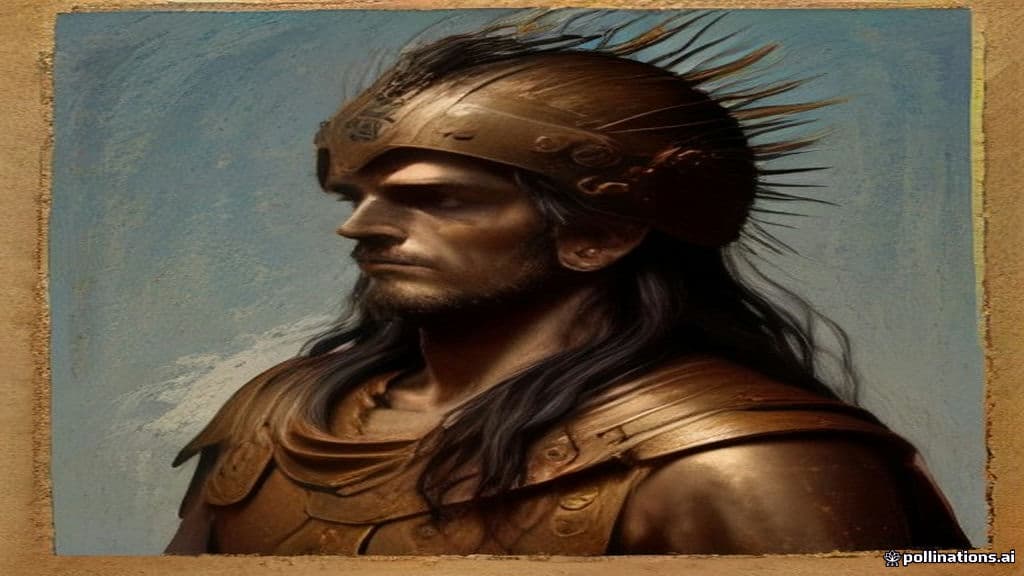
Echepolus appears within the narrative world of Homeric epic as a Trojan warrior who takes part in the fighting when the truce is broken in Book IV of the Iliad. The sources do not provide a mythic birth-story or cultic origin for him; rather, he is introduced as one of the many named combatants whose brief fates are narrated by the poet to punctuate the violence of the battlefield. Modern summary sources sometimes cite a patronymic, identifying him as son of Thalysios (son of Lord Thalysius), but primary-text citation for that patronymic is not present in the provided extracts and alternative, conflicting brief attributions (e.g., a passing line in an ancillary collection) make the parentage uncertain.
The surviving attestations give only battle-related imagery rather than a full portrait. Homeric phrasing describing his death emphasizes martial panoply: he wears a helmet with a high (horsehair) crest which is shattered when struck, and a bronze weapon drives through the helmet into his head. Other sources call him a 'Trojan captain' or 'valiant Trojan,' but no extended physical description or individualizing features are provided beyond the helmet, crest, and the fatal wound.
No supernatural powers or extraordinary abilities are attributed to Echepolus in the sources. His 'abilities' are those of a mortal Homeric warrior: he stands on the front line, leads or commands in battle (referred to as a captain in some summaries), and, like other named fighters in the epic, his presence and death serve dramatic and ethical functions in the poem. The tradition records him as being slain by Antilochus; subsequent combat around his corpse (attempts to strip armor) also feature in related passages.
Weaknesses
- conditionmortal vulnerability
Wards
None recorded.

Antilochus
Antilochus is a princely warrior of Pylos in the Homeric epic tradition, son of Nestor and a youthful Achaean fighter at Troy. He is famed for his swiftness, beauty, charioteering skill, close companionship with Achilles, role in the funeral games for Patroclus, and for dying in later epic-cycle accounts while saving his father.
Elephenor
Elephenor (Ancient Greek: Ἐλεφήνωρ) is a mortal king of the Abantes of Euboea in Greek mythic-historical tradition, known as a captain of a contingent to the Trojan War, a purifying figure in one homicide episode, and as the subject of variant local foundation or exile traditions after the war.
Community Record
- [1]The Iliad, Book IV (translation/excerpts). Homer, Iliad, Book IV (passage describing Antilochus killing a Trojan captain and the detail of the helmet-crushing blow).literary
- [2]Iliad Book 4 - Summary. Summary and notes on Book IV noting Antilochus as the slayer of Echepolus and describing battlefield events.literary
- [3]Echepolus | Facts, Information, and Mythology (Pantheon). Modern summary entry noting Echepolus as a Trojan killed by Antilochus; places him among named Homeric warriors.other
- [4]Elephenor (Wikipedia). Entry referencing the episode in which Elephenor is killed by Agenor while attempting to drag off the body of Echepolus, linking that event to Echepolus' corpse.wiki
- [5]Wikidata: Q3718502 (Echepolus). Wikidata entry listing Echepolus and giving a patronymic in some summaries ('son of Thalysios'); used as a modern attestation of the name and brief identifications.other
- [6]Polytropy commentary on Chapman’s Homer—Iliad Book IV. Commentary and notes on the Book IV combat scenes referencing named victims and killers such as Antilochus and the Trojan captain Echepolus.other
- [7]12 Deaths from The Iliad, as Translated by Emily Wilson. Modern selection of Homeric death-scenes that includes the passage describing the helmet-piercing blow and identifies the combatants involved.other
- [8]Ancilla to the Pre-Socratic Philosophers (ancillary collection). Contains a brief, ambiguous line in collected materials that elsewhere in the research notes is cited as giving an alternative or conflicting patronymic (an uncertain attestation).literary