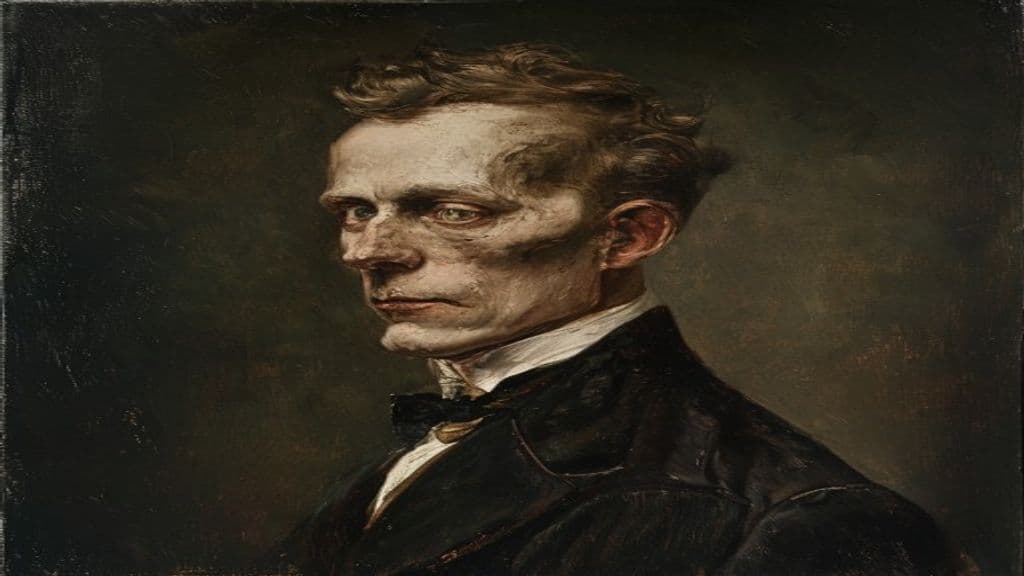
The earliest known published account of Edward Mordake appears in an 1895 Boston Post article by fiction writer Charles Lotin Hildreth; that sensational item presented Mordake as an example among 'human freaks.' The story was reproduced and elaborated in the 1896 miscellany Anomalies and Curiosities of Medicine, which supplied the most widely circulated picturesque details (the second face female, malignant, whispering of hellish things, Mordake heir to an English peerage). The narrative claims doctors refused to remove the face, that Mordake begged that the face be destroyed before burial 'lest it continues its dreadful whisperings in my grave,' and that he died young (accounts vary between age 22 and 23). Modern archival and critical treatments classify the tale as apocryphal or a hoax, note the lack of corroborating civil or medical records, and observe that some institutional details in the original retellings (for example references to a 'Royal Scientific Society') were likely fictional or fabricated.
In the sensational accounts reproduced in late-19th-century print, Edward Mordake is described as a handsome, well-educated young English gentleman whose natural face is attractive and whose back-of-head anomaly is 'another face' occupying part of the posterior skull. That second face is variously described as female in aspect—'lovely as a dream, hideous as a devil'—with eyes and lips that could express emotions independently (sneering while Mordake was happy, smiling while he wept). The printed narrative reports that the posterior face's eyes tracked observers and its lips 'gibbered without ceasing.' The story presents this morphology as congenital; later commentators note medical conditions such as craniopagus parasiticus, diprosopus, or a parasitic twin only as modern retrospective hypotheses rather than claims documented by the original sources.
The capacities attributed to the posterior face are narrative attributions from the sensational sources: it reportedly made independent facial expressions, its eyes followed onlookers, its lips moved or 'gibbered,' and, critically in the tale, it whispered to Mordake at night 'of such things as they only speak of in Hell,' depriving him of rest and driving him to seclusion and eventual suicide. The accounts also state Mordake sought surgical removal but that 'no doctor would attempt it.' There is no empirical documentation beyond the published anecdote to substantiate literal agency or supernatural capacities.
Weaknesses
- othermedical/surgical removal (narrative request)
- otherdestruction of the face before burial (Mordake's request)
Wards
- otherpre-burial destruction or concealment (individual request)
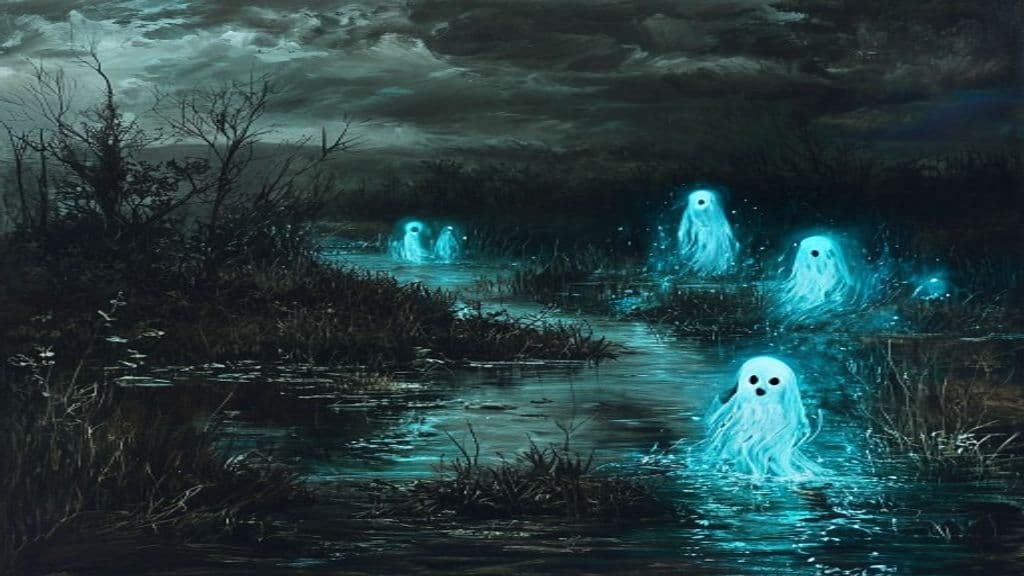
Will-o'-the-Wisp
A wandering light seen over marshy ground at night, leading travellers astray into bogs and fens. Possibly a spirit, possibly the soul of the unbaptised dead, possibly the devil himself.
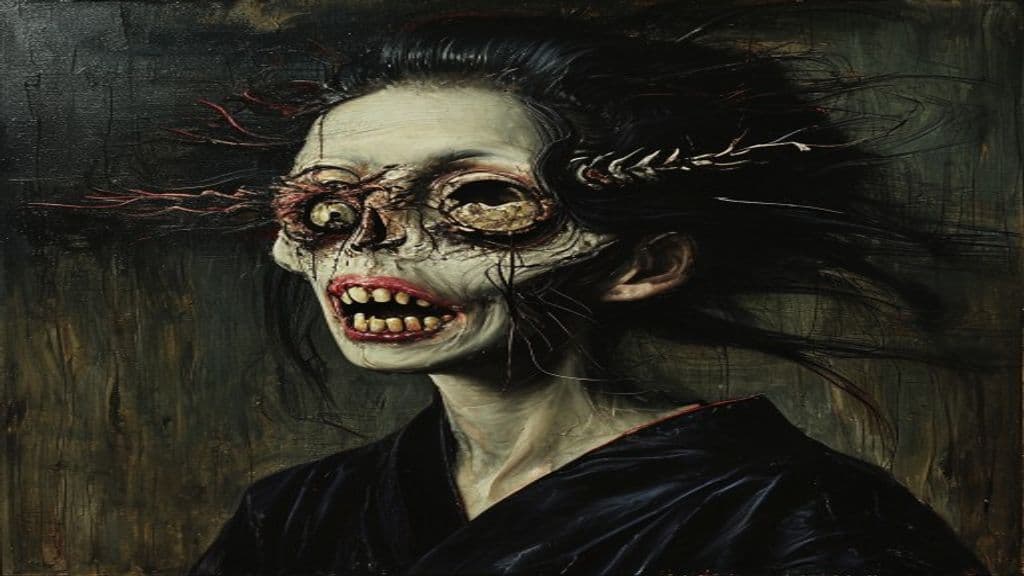
Futakuchi-onna
Futakuchi-onna (二口女, ふたくちおんな; "two-mouthed woman") is a Japanese yōkai characterized in folktales by an otherwise ordinary woman who bears a second, functional mouth on the back of her head beneath her hair. Stories commonly present the second mouth as a supernatural condition associated in narrative causation with stinginess, neglect, or injury.
Ector
Ector (also Hector, Ectorius) is a named human noble and knight in the Arthurian tradition, best known as the foster (adoptive) father of King Arthur and the father of Sir Kay. Portrayed across medieval and later retellings as the head of a knightly household responsible for raising Arthur in concealment at Merlin's arrangement, he functions as a social guardian and narrative caretaker rather than a supernatural being.
Edain (Men)
The Edain, rendered in sources as Man or Men, are the human peoples of J. R. R. Tolkien's Middle-earth. They are the 'second' or younger people, created after the Elves and distinguished chiefly by their mortality; they are counted among the 'free peoples' of Middle-earth alongside other autonomous races.
Edda (Norse Tradition)
The Edda is a collection of literary works containing Norse mythology and traditional sources, preserving the cultural heritage and mythological traditions of the Norse people. (Note: 1. Power tier: Downgrade to Ancient (Edda is a collection of literary works, not a mythological figure with Primordial power). 2. Summary: Expand to include the fact that it's a medieval Icelandic tex)
Edern ap Nudd
Edern ap Nudd is a Welsh medieval literary figure presented as a noble warrior and member of King Arthur's retinue. Presented in native Welsh romances and in continental Arthurian adaptations under variant names, he is described as a son of Nudd and brother of figures such as Gwyn ap Nudd; later medieval/local tradition also attests a Saint Edern with church dedications in Wales.
Edimmu
In Mesopotamian religious tradition the edimmu are a type of utukku — restless, wind-like spirits of the improperly buried who can be vengeful, possessive, and life-draining; later popular media reinterprets them as vampire- or undead-styled monsters in games and fiction.
Edmund Pevensie
Edmund Pevensie is a fictional English schoolboy created by C. S. Lewis who appears as a principal human character in The Chronicles of Narnia. He begins as a spiteful, selfish child, betrays his siblings under the influence of the White Witch, is redeemed through Aslan's sacrificial intervention, and later reigns as King Edmund the Just in Narnia before returning to England.
Edward Tregear
Historical figure, not considered a supernatural entity in Māori tradition. (Note: * The Power tier should be "Primordial" as Edward Tregear is a historical figure, implying no supernatural abilities or powers. * The Appearance section should indicate that there is no physical descr)
Eeyeekalduk
Eeyeekalduk is identified in multiple compiled references as an Inuit supernatural figure associated with medicine, healing, and good health. The available sources list the name among Inuit deities or pantheons but provide no primary ethnographic detail about myths, rituals, or iconography.
Efnisien
Efnisien (also spelled Efnysien or Efnissien) is a human royal figure in the medieval Welsh Second Branch of the Mabinogi (Branwen ferch Llŷr). Presented as an explosively violent and disruptive kin whose cruelty precipitates international war, he ends the tale by sacrificing himself to destroy a magical cauldron used by the Irish to revive the dead.
Egbere
Malevolent humanoid supernatural beings in Yoruba mythology, residing in woods and active only at night. (Note: 1. Power tier should be Greater (powerful regional) based on the description as malevolent beings residing in woods. 2. Abilities need more specific information, such as their connection to darkness o)
Egeria
Egeria is a Roman nymph of springs and sacred groves, cast in legend as the divine consort and counselor of Numa Pompilius who imparted laws and ritual forms to Rome's foundational king. She functions as a local tutelary female deity associated with the origin of Roman rites rather than as a cosmic power or a hostile spirit.
Egg Ghost (Korean Tradition)
In Korean folklore, the Egg ghost is a malevolent entity that resembles an egg in appearance and serves as a harbinger of death. (Note: - The draft states "malevolent entity", but Source 1 doesn't explicitly state this. - Power tier: Based on the ability to determine a person's death upon sighting, it seems more likely that the Egg gh)
Community Record
- [1]Edward Mordake. Wikipedia: 'Edward Mordake' entry (summarizing the 1895 Boston Post article and the 1896 Anomalies and Curiosities of Medicine reproduction; discusses hoax status)wiki
- [2]Wikidata: Edward Mordake. Wikidata item for Edward Mordake (authority/identifier record linking related resources)other
- [3]Archive: Short Stuff — Edward Mordake. Archive summary and audio discussing Edward Mordake and the persistence of the tale as an urban legendother
- [4]Hoaxilla #303 – Edward Mordrake. Podcast episode analyzing the Edward Mordake story and treating it as a hoax/urban legendother
- [5]Desmistificando - Edward Mordake. Archive program discussing and debunking the Edward Mordake narrativeother
- [6]Anomalies and Curiosities of Medicine (1896) — entry reproduced from contemporary press. Reproduction/summary of the 1896 miscellany entry that popularized the detailed version of the Mordake anecdoteliterary