Mythographic register: In the Hyginus genealogical listing cited, Emphytus appears as one of the Giants enumerated among the beings produced 'From Earth and Tartarus.' The source is a catalogue entry and provides no narrative, deeds, or further cosmogonic role beyond placement in that list. Scientific register: Emphytus is a Latinized genus name established in entomological taxonomy (appearing in literature as Emphytus Klug, 1816) used to classify a group of sawfly species; the taxonomic literature and checklists record the genus in modern faunas and in fossil deposits (Upper Miocene France), but the provided sources do not state why the name was chosen or an origin story for the taxon beyond standard Linnaean naming practice.
Mythographic register: The Hyginus passage names Emphytus among the Gigantes but supplies no individual physical description; any characterization as a large or chthonic giant is a general inference from membership in the Gigantes, not a detail preserved for Emphytus in the cited text. Scientific register: Emphytus is treated as a genus of sawflies (family Tenthredinidae) in checklists and species accounts; the supplied sources list species names (e.g., Emphytus basalis, Emphytus carpini, Emphytus coryli) and note occurrence records, but do not provide diagnostic morphological descriptions in the excerpts provided.
Mythographic register: The Hyginus genealogical list attributes no specific actions, powers, or behaviors to Emphytus; the entry is nominal only. Scientific register: As a sawfly genus, species placed in Emphytus would be biological insects with life stages typical of Tenthredinidae, but the provided materials only present taxonomic, checklist, and fossil occurrence information and do not supply species-specific behavioral or ecological data for Emphytus beyond placement within the sawfly family.
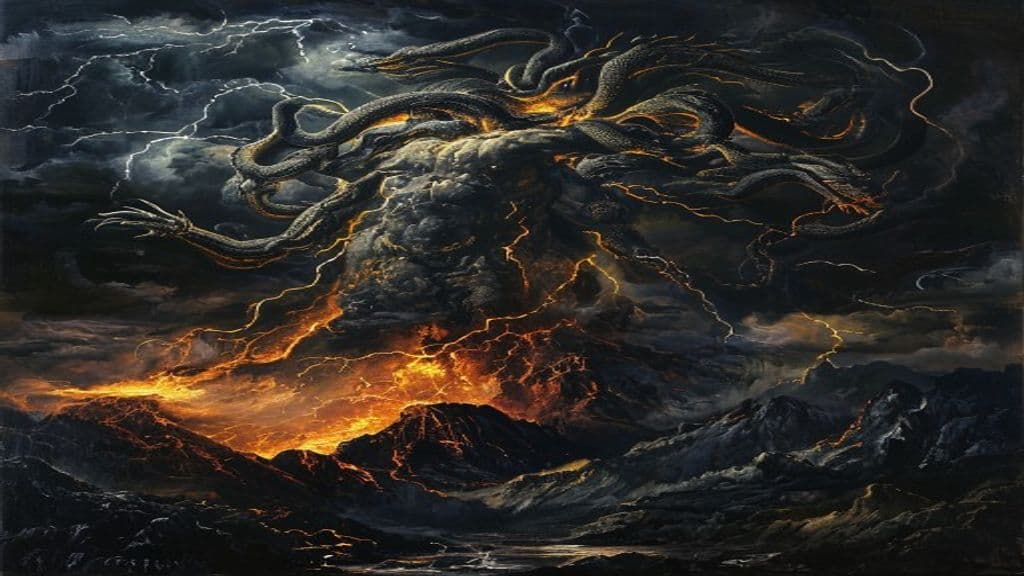
Typhon
The last great monster of Greek mythology — a vast, fire-breathing giant whose shoulders sprouted a hundred serpent heads, nearly toppling Zeus from Olympus.
Gigantes
In Greek myth the Gigantes (Gigantes) are a race associated with great strength and aggression who wage war against the Olympian gods in the Gigantomachy. Classical summaries (via Hesiod as reported in standard reference summaries) present them as offspring of Gaia born from the blood of Uranus after his castration by Cronus and as cosmological antagonists whose defeat helps establish Olympian order.
Community Record
- [1]LP0076 -II ARGONAUTS- Ino & Phrixus, from the Fables of Hyginus (genealogical listing). Hyginus, Fabulae (genealogical lists) as transmitted in archive transcription; excerpt lists 'Emphytus' among Giants born from Earth and Tartarus.literary
- [2]Gaia. Wikipedia entry on Gaia (reference used for context regarding Earth/Tartarus genealogical traditions).wiki
- [3]Fauna Italia — Tenthredinidae checklist. FaunaItalia checklist showing Emphytus Klug, 1816 among Tenthredinidae listings.academic
- [4]Checklist of British and Irish Hymenoptera - Sawflies, ‘Symphyta’. British and Irish sawfly checklist listing species and genera, including Emphytus taxa in regional faunas.academic
- [5]The first fossil representatives of the sawfly genera Emphytus and Empria from the upper Miocene of France. Palaeoentomology article reporting Upper Miocene fossil occurrences assigned to Emphytus and Empria.academic
- [6]Emphytus basalis (Klug) and some other interesting British sawflies (Hym., Symphyta).. Article discussing Emphytus basalis among British sawflies; used as an example of the genus' appearance in entomological literature.academic
- [7]Insects of Britain and Ireland: Hymenoptera families - Tenthredinidae (delta-intkey). Family-level reference for Tenthredinidae used to contextualize biological traits of sawflies referenced in the sources.academic