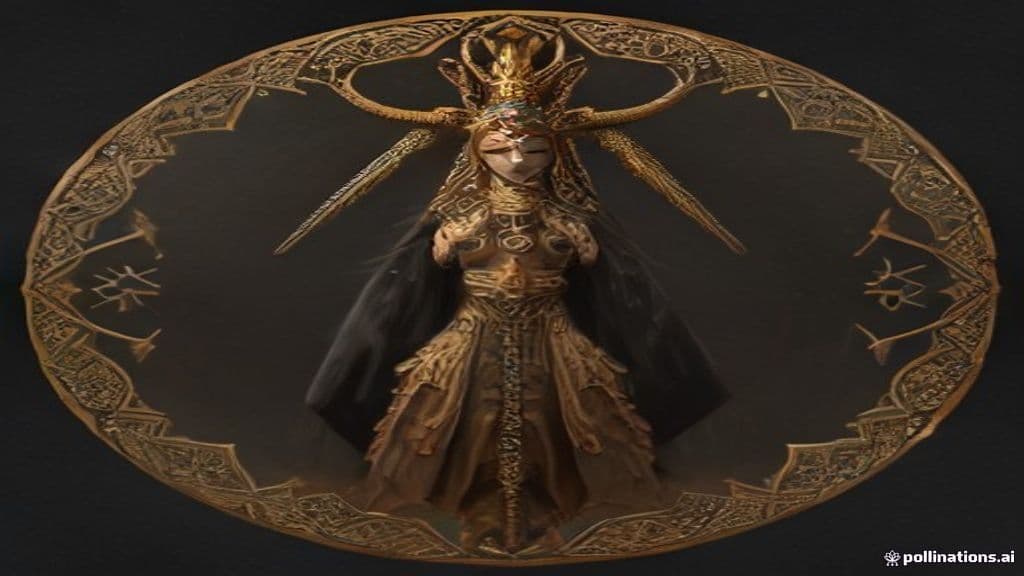
Classical Greek authors record the Enarei (Greek Ἐνάρεες, variant Ἀναριεῖς) as a group of male‑assigned persons who had undergone a religiously framed sex/gender transformation and thereafter lived and acted as women in service of certain Scythian cults. Modern linguistic reconstruction posits an Iranian/Scythian form anarya (a- + narya 'man') glossed in summaries as ‘not‑man’ or ‘unmanly’; the surviving Greek forms reflect outsider transcription and interpretation, and the exact self‑designation used within Scythian communities is not directly preserved in the sources.
Greek descriptions emphasize that the Enarei wore female clothing and adopted women’s mannerisms. Iconographic and archaeological material associated with the relevant cults suggests ritual regalia in the milieu—ornate sceptres or pole tops (stag, ibex, goddess and griffin motifs) often incorporating rattles or bells, and occasional depictions of attendants serving wine — but direct assignment of every suggested item to Enarei is inferential. Comparative shamanic burials from Saka contexts have been used to suggest possible additional accoutrements (e.g., drums, antlered headdresses), though those associations are suggested by analogy in the archaeological record rather than explicitly named in the primary Greek textual descriptions.
The Enarei functioned as seers and shamanic ritual specialists. A distinctive, well‑attested divinatory technique used by Enarei employed the inner bark of the linden tree: the inner linden bark was cut into three pieces and plaited and unplaited around the fingers to obtain answers, a practice contrasted in sources with other Scythian soothsayers who used willow withies. They appear in contexts of altered‑state ritual practice within Scythian religion (archaeological evidence and Herodotus attest to cannabis fumigation in funerary priestly tents), served roles in funerary and cultic rites (an ornamental panel shows a figure identified as an Enaree serving wine beside a chief priestess), and held recognized judicial/ritual authority—Enarei divinatory findings could trigger multi‑soothsayer corroboration procedures in cases such as accusations linked to the king’s illness, with severe ritual‑legal consequences if findings were upheld or later overturned.
Weaknesses
- otherNo recorded vulnerabilities; not described as malevolent
- ritualPunitive ritual for failed accusation — classical accounts describe that soothsayers whose accusations failed in corroboration might be executed in a ritual burning alongside their sons (women spared), indicating institutional risk to accusing seers
Wards
- otherNone recorded specifically — sources do not present Enarei as beings to be warded off; they are institutional religious figures

Community Record
- [1]Enaree. Wikipedia: Enaree (summary of classical and archaeological sources)wiki
- [2]Enaree (Wikidata). Wikidata Q17001813 summarywiki
- [3]Eurasian nomads. Wikipedia: Eurasian nomads (summary noting Enaree as third gender)wiki
- [4]SCYTHIAN GODS: The Iron-Age Religion of the Steppe Horse Lords // DOCUMENTARY. Documentary and associated bibliographic material on Scythian religion and archaeological contextsother