
Daughter of Talaus of Argos and wife of the seer Amphiaraus, Eriphyle belongs to a royal Argive lineage (sister to Adrastus in the narrative frame). When Polynices sought allies to attack Thebes, he bribed Eriphyle with the Necklace (or peplos) of Harmonia. By invoking a household pledge or previously arranged authority over domestic disputes, she compelled Amphiaraus to join the expedition of the Seven against Thebes. After Amphiaraus died in the war, their son Alcmaeon killed Eriphyle in revenge; subsequent traditions record that this matricide brought haunting or pursuit by the Erinyes and required oracle guidance and purification for Alcmaeon.
Surviving sources provide no sustained physical portrait of Eriphyle in life beyond her social identity (daughter of Talaus; wife of Amphiaraus; mother of Alcmaeon and Amphilochus). Poetic and epic afterlife scenes portray her among the lamented or punished dead: Homer (Odyssey xi) places her in Hades with other 'misfortunate or malicious women,' and Virgil (Aeneid VI) pictures her in the 'Mourning Fields' where she 'still bears the wounds inflicted by her son' (i.e., visible marks of matricidal violence). Later epic treatment (e.g., Statius) treats the Necklace/peplos as the pivotal object tied to her narrative identity.
Eriphyle's chief agency is social and political: she exercises household authority and decision‑making by invoking an oath or preexisting pledge to compel Amphiaraus to go to war. She accepts Polynices' bribe (the Necklace or peplos of Harmonia), an act narrated as betrayal. After her murder by Alcmaeon, traditions diverge: some depict her as a furious ghost whose haunting drives Alcmaeon mad; others attribute his torment to the Erinyes. These posthumous functions locate her on the interface between human crime and the moral/ritual forces that punish or manifest guilt.
Weaknesses
- conditionMortal human status (primary role is a living woman rather than an autonomous supernatural force)
- otherNarrative containment by ritual and oracle: post‑murder effects are addressed by oracle counsel and purification (i.e., institutional remedies curb the consequences attributed to her)
Wards
- ritualOracle guidance and purification (not a ward against Eriphyle herself)
- otherNo attested apotropaic wards specifically directed at Eriphyle in the cited sources
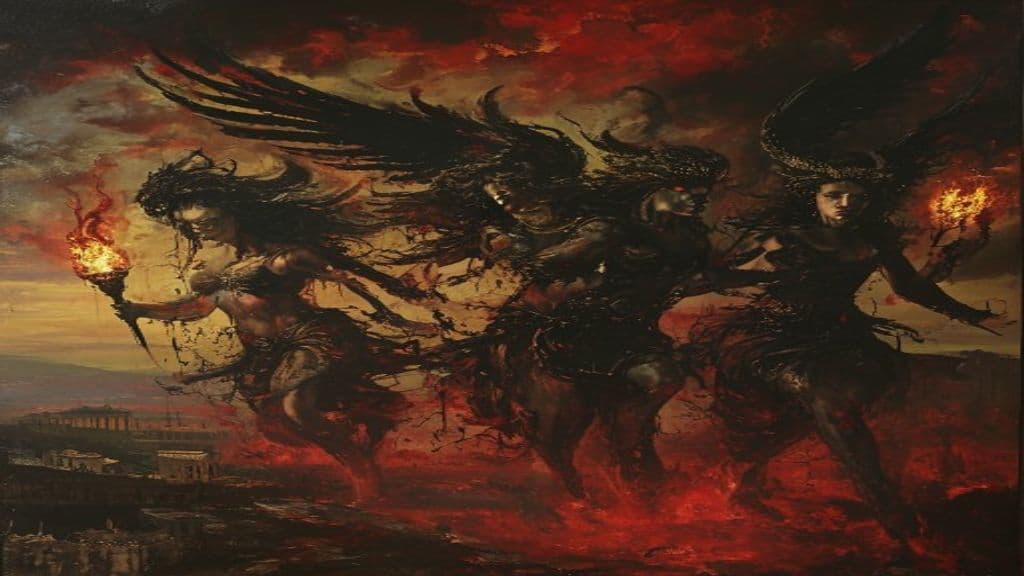
Erinyes
The three avenging Furies of Greek myth — Alecto, Megaera, and Tisiphone — who pursued and tormented those guilty of crimes against blood kin, especially murder of family members.

Amphiaraus
Amphiaraus is a legendary Greek seer and chthonic hero, famed as one of the Seven against Thebes. After his death—when the earth opened and swallowed him—he was venerated at the Amphiareion of Oropos as a healing and oracular figure whose sanctuary received petitioners seeking dream-delivered solutions.
Community Record
- [1]Eriphyle — Wikipedia article (summary of classical sources). Wikipedia, 'Eriphyle'wiki
- [2]Homer, Odyssey (book xi references to women in Hades). Homer, Odyssey, book xi (classical reference as cited in summaries)literary
- [3]Virgil, Aeneid, Book VI (Mourning Fields depiction). Virgil, Aeneid, Book VI (as summarized in source material)literary
- [4]Apollodorus, Bibliotheke (account of Eriphyle and Alcmaeon). Apollodorus, Bibliotheke iii.4.2 (as cited in summaries)literary
- [5]Pausanias, Description of Greece ix.41.2 (genealogical and local tradition notes). Pausanias, Description of Greece ix.41.2 (as cited in summaries)literary
- [6]Statius, Thebaid (role of the Necklace in epic tradition). Statius, Thebaid (as referenced in summaries)literary