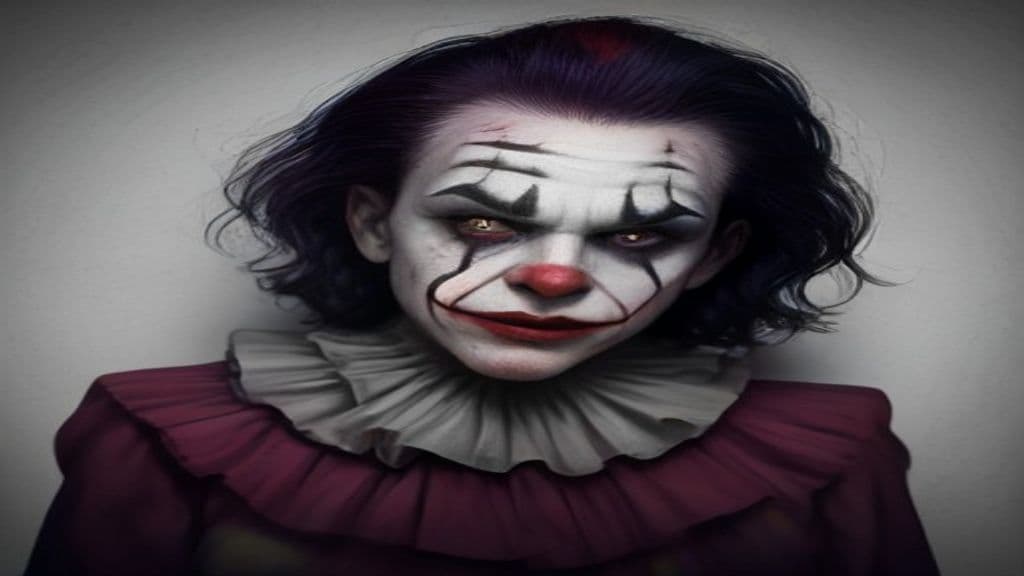
The evil‑clown archetype has no singular mythic origin; sources trace it as a cultural development from older fool/trickster figures (Harlequin, Mr. Punch, the king’s fool) and from literary antecedents such as Edgar Allan Poe's "Hop‑Frog" and 19th‑century murderous‑clown themes (Pagliacci). In the 20th century the trope consolidated within mass media: the Joker (DC Comics, first appearing 1940s) and Stephen King’s Pennywise (popularized in the 1980s) are cited as emblematic fictional exemplars, while the arrest of John Wayne Gacy in 1978 created a high‑profile real‑world association between clown performance and murder. Contemporary phenomena like roadside advertising figures (Evil Clown of Middletown) and episodic "phantom clown" sightings further shaped public perception.
Described through inversion of standard clown signifiers: exaggerated makeup that conceals identity, garish or anachronistic clown costume, and distorted or intensified traditional facial features used to provoke unease. Fictional exemplars (e.g., the Joker, Pennywise) supply concrete visual models; non‑animate objects such as large roadside clown signage can be read as uncanny in the same register.
Sources characterize abilities primarily as cultural and psychological rather than inherently supernatural: the capacity to unsettle or terrify (especially exploiting coulrophobia), to conceal identity via makeup, and to invert comedic performance into menace. In fictional narratives individual evil‑clown characters may be depicted as violent antagonists or murderers; in reported "phantom clown" incidents the behavior alleged is attempting to frighten or lure children. There is no consistent documentary record in the supplied material of a shared supernatural power set across all instances.
Weaknesses
- otherNo documented folkloric weaknesses
Wards
- otherProfessional distancing and media scrutiny
Evander of Pallantium
Evander of Pallantium (Greek Εὔανδρος) is a mythic Arcadian culture-hero and founder-figure credited in Roman and Greek traditions with bringing Greek laws, religious observances, and the alphabet to early Italy, founding a settlement called Pallantium on the site of Rome's Palatine Hill and instituting cultic practices later visible in Roman life.
Evander of Pallene
A Greek culture-hero in Roman mytho-historical tradition credited with founding Pallantium on the future site of Rome's Palatine Hill and with transmitting elements of Greek religion, law, and alphabetic culture to Italy; later reported to have been deified with an altar on the Aventine.
Evarete
Evarete is primarily attested in the provided sources as the scientific species name Junonia evarete, a South American/Neotropical butterfly commonly called the tropical or mangrove buckeye. A single brief non-entomological attestation lists Evarete as a personal name in Greek mythic genealogies, but no narrative, cult, or folklore of a supernatural Evarete is documented in the supplied materials.
Eve
In the Genesis tradition Eve (Hebrew Ḥawwāh) is the first woman created by God and the companion of Adam; as the progenitor of humankind she participates in the origin story that explains expulsion from the Garden of Eden and certain human conditions such as mortality and pain in childbirth.
Everes
Everes (also Eueres) is a personal name borne by one or more mortal figures in Greek mythic genealogies. In surviving summaries he functions primarily as a genealogical anchor — most notably as the father of the Theban seer Tiresias in some traditions — and in other traditions as a son of the Taphian king Pterelaus. He is presented as a mortal ancestor or princely son, not as a supernatural being.
Evil Star
Evil Star is a fictional supervillain identity from DC Comics. The name has been used for two distinct characters: Guy Pompton, a costumed crime lord from Earth, and an alien scientist from the planet Aoran who gains cosmic power through a device called the Starband/Starbrand.
Evil eye
A cross-cultural folkloric belief in a harmful influence cast by a person's gaze or look, usually motivated by envy or ill will. Treated as a transmissible curse or force rather than a corporeal being, it is countered by apotropaic objects, formulas, plants, and gestures in many traditions.
Evippus (Εὔιππος)
Evippus (Ancient Greek Εὔιππος, 'having good horses') is a recurring personal name in Greek myth borne by several mortal figures — princes, warriors, and local heroes — attested in varied narrative episodes (Calydonian cycle, the Trojan War, local Megarian and Arcadian tales). The name signals aristocratic/horsemanship status rather than a distinct supernatural class.
Ewiger Jäger
A spectral huntsman from German, Belgian and Pennsylvania Dutch folklore condemned to an unending hunt. Usually portrayed as a formerly human hunter bound by oath, curse, sacrilege, or a dying injunction to pursue quarry ceaselessly, the figure is a local variant of the European wild hunt motif.
Extinct Comet
A former cometary nucleus that has lost or sealed most of its near-surface volatile ices and therefore no longer displays a sustained coma or tail; observationally it can resemble a dark asteroid and is treated within planetary science as an end-state in cometary evolution.
Extraño
Extraño is a fictional Peruvian magician and superhero (Gregorio De La Vega) in DC Comics. Introduced in 1988, he is portrayed as a stage‑performer‑turned-sorcerer whose innate magical ability was heightened by a Guardians of the Universe experiment; later reintroductions present him as a powerful sorcerer and queer community leader based in Lima.
Eystein Halfdansson
Eystein Halfdansson (Old Norse: Eysteinn Hálfdansson) is presented in Norse king-list and saga tradition as a semi-legendary Norwegian petty king of the House of Yngling who ruled Romerike and acquired Vestfold by marriage. He is depicted as a dynastic ruler and Viking raider whose death is attributed in Snorri's Ynglinga saga to a magical act performed by King Skjöld of Varna.
Community Record
- [1]Evil clown — Wikipedia. Wikipedia contributors, 'Evil clown,' Wikipedia, https://en.wikipedia.org/wiki/Evil_clownwiki
- [2]Evil clown (Wikidata Q2979768). Wikidata: Q2979768 'evil clown' (pop culture trope and horror staple), http://www.wikidata.org/entity/Q2979768wiki
- [3]Evil Clown of Middletown — Wikipedia. Wikipedia contributors, 'Evil Clown of Middletown,' Wikipedia, https://en.wikipedia.org/wiki/Evil_Clown_of_Middletownwiki
- [4]Evil Clowns - The Latest Twist from the Dark Side — Fate Magazine (Guiley). Rosemary Ellen Guiley, 'Evil Clowns -The Latest Twist from the Dark Side,' Fate Magazine, https://www.fatemag.com/post/evil-clowns-the-latest-twist-from-the-dark-side-by-rosemary-ellen-guileyother