
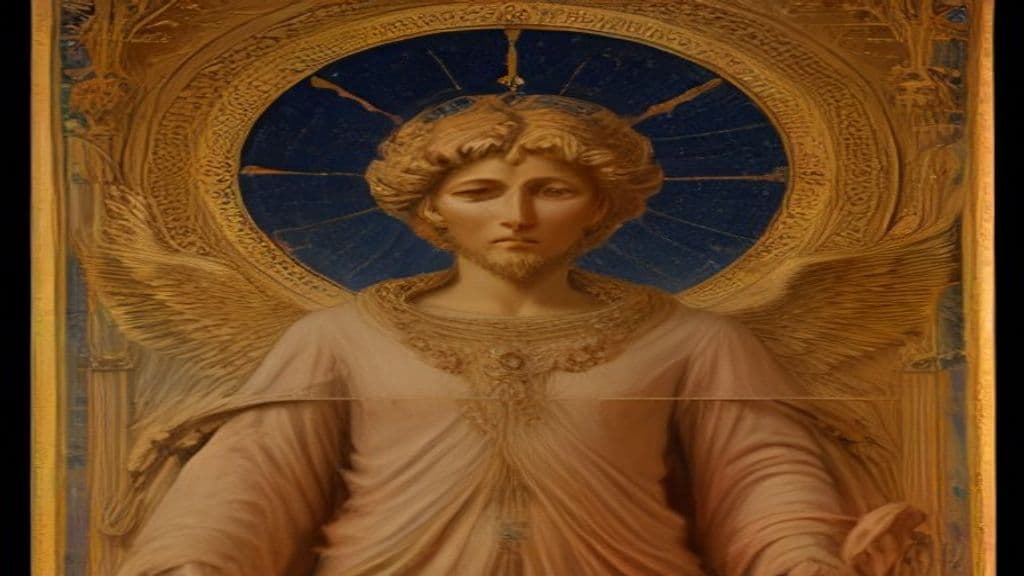
In the textual context of Ezekiel 28:13–14 the figure is presented as an "anointed cherub" placed in Eden or "the garden of God," endowed with an exalted status and protective/covering association within the divine precinct. The oracle uses Edenic language to portray a being whose condition is described as once perfect — paraphrased in the sources as "thou wast perfect in thy ways from the day that thou wast created, till iniquity was found in thee" — and who is subsequently removed or judged because of iniquity. Historically the Ezekiel passage functions rhetorically to address the King (or Prince) of Tyre (some translations and traditions link the speech to Ithobaal III, c. 591–573 BCE) by casting human political pride in Edenic, sanctuary-inflected terms; later Christian interpreters (for example Tertullian, Against Marcion 2:10, as cited in reception summaries) read the same language typologically as the fall of a rebellious celestial being, a reception that helped incorporate the figure into broader narratives of a fallen angel. The supplied sources emphasize this dual function — an original prophetic/political target and a later theological typology — without providing a narrative myth of cosmogonic origin beyond the Ezekiel imagery.
The provided materials do not furnish a detailed anatomical portrait of the Eden-cherub in Ezekiel 28. The text labels the figure with ritual and sanctified terms — "anointed cherub," placed in the "garden of God" — and mentions precious stones and a paradisal setting in the broader verse cluster, yet the supplied excerpts do not record consistent physical features (wings, faces, animal parts, etc.) for this particular Eden-figure. While Ezekiel elsewhere (e.g., Ezekiel 10) contains elaborate cherubim imagery and the Hebrew term כְּרוּב (kərūḇ) names a class of sanctuary-associated supernatural beings, the sources caution that applying detailed, later iconography or speculative anatomy to the Ezekiel 28 figure exceeds what the cited texts explicitly state.
Within the Ezekiel oracle the being's salient capacities are primarily moral and symbolic rather than catalogued supernatural powers: the figure is depicted as occupying a privileged, guardian-like position in Eden and as possessing an original state of "perfection" or ideal status. The passage implies a capacity for moral agency — the possibility of "iniquity" or pride — which leads to removal or judgment. In prophetic rhetoric the cherub functions ability-wise as a trope for regal splendour and as the theological locus for denunciation when that splendour is corrupted. Later theological reception attributes to the figure a cosmic-scale rebellion (linking it to the fall of Satan), but the supplied sources note that this interpretive move is secondary to the original prophetic application to a human ruler or his guardian.
Weaknesses
- conditionmoral failing (pride/iniquity)
- otherprophetic judgment (vulnerability to divine censure as per Ezekiel's oracle)
Wards
- othernone attested in supplied sources
Evippus (Εὔιππος)
Evippus (Ancient Greek Εὔιππος, 'having good horses') is a recurring personal name in Greek myth borne by several mortal figures — princes, warriors, and local heroes — attested in varied narrative episodes (Calydonian cycle, the Trojan War, local Megarian and Arcadian tales). The name signals aristocratic/horsemanship status rather than a distinct supernatural class.
Ewiger Jäger
A spectral huntsman from German, Belgian and Pennsylvania Dutch folklore condemned to an unending hunt. Usually portrayed as a formerly human hunter bound by oath, curse, sacrilege, or a dying injunction to pursue quarry ceaselessly, the figure is a local variant of the European wild hunt motif.
Extinct Comet
A former cometary nucleus that has lost or sealed most of its near-surface volatile ices and therefore no longer displays a sustained coma or tail; observationally it can resemble a dark asteroid and is treated within planetary science as an end-state in cometary evolution.
Extraño
Extraño is a fictional Peruvian magician and superhero (Gregorio De La Vega) in DC Comics. Introduced in 1988, he is portrayed as a stage‑performer‑turned-sorcerer whose innate magical ability was heightened by a Guardians of the Universe experiment; later reintroductions present him as a powerful sorcerer and queer community leader based in Lima.
Eystein Halfdansson
Eystein Halfdansson (Old Norse: Eysteinn Hálfdansson) is presented in Norse king-list and saga tradition as a semi-legendary Norwegian petty king of the House of Yngling who ruled Romerike and acquired Vestfold by marriage. He is depicted as a dynastic ruler and Viking raider whose death is attributed in Snorri's Ynglinga saga to a magical act performed by King Skjöld of Varna.
Ezekiel
Ezekiel is a human prophet and priest of the Hebrew Bible whose recorded prophetic activity during the Babylonian exile includes vivid visionary encounters (notably the merkabah or chariot-throne and four living creatures) and symbolic enacted prophecies addressing judgment and restoration for Judah and Jerusalem.
Ezili Dantor
Ezili Dantor (Èzili Dantò, Erzulie Dantor) is a principal Petro lwa in Haitian Vodou, venerated as a dark-complexioned, maternal and fiercely protective spirit of children, single mothers, and marginalized gender identities. She is known for quick, destructive wrath as well as deep suffering, and figures in Haitian devotional life, syncretic Catholic imagery, and revolutionary memory in some traditions.
Ezina (Ashnan)
Ezina, also attested as Ashnan, is the Mesopotamian goddess who personifies cereal grain (especially barley). She is attested from the Uruk period and in third-millennium BCE Sumerian literature, where she is invoked as the divine agent who causes seeds and barley to grow.
Eärendil and Elwing
Eärendil and Elwing are narrative personages from J. R. R. Tolkien’s Middle‑earth legendarium (primarily The Silmarillion). They are Half‑elven descendants of notable lines of Elves and Men whose joint voyage to Valinor and subsequent fate—Eärendil set among the stars as a celestial mariner, Elwing briefly given the likeness of a great white bird—serve as a pivotal cosmological turning point in the legendarium.
Eëtion
Eëtion (Ancient Greek: Ἠετίων) is a mortal king in Homeric tradition, described as ruler of Cilician Thebe in Anatolia and father of Andromache. In the Iliadic narrative his death and the slaughter of his sons by Greek raiders (notably Achilles) form part of the grieving context for Trojan War characters.
Fa'afāfine
Fa'afāfine are a culturally recognized Samoan gender category: people assigned male at birth who live "in the manner of a woman" and occupy a distinct, socially integrated gender role in Sāmoan society across family, community, and cultural life.
Fachan
A singular monstrous figure in West Highland Gaelic tradition, repeatedly described in 19th‑century collections as extremely asymmetrical (one eye, one hand/arm, one leg) and giant‑like in stature; chiefly attested in the writings of John Francis Campbell and Douglas Hyde, who quote an Irish manuscript with a similar monster.
Community Record
- [1]Ezekiel's cherub in Eden (Wikipedia). Wikipedia, 'Ezekiel's cherub in Eden'wiki
- [2]Cherub (Wikipedia). Wikipedia, 'Cherub'wiki
- [3]Cherub (2) - Biblical Cyclopedia. Biblical Cyclopedia entry 'Cherub (2)'other
- [4]Neither the prince of Tyre nor the king of Babylon is Satan (postost.net). article arguing against identifying Ezekiel's figures with Satanother
- [5]Lessons from the Garden: Talking Snake or Anointed Covering Cherub? | Servants of Grace. Servants of Grace essay discussing Ezekiel's cherub interpretationother
- [6]The Secret Doctrine, vol 2, pt 2, ch 18 c (Theosophy). Theosophical citation referencing Ezekiel-style languageother