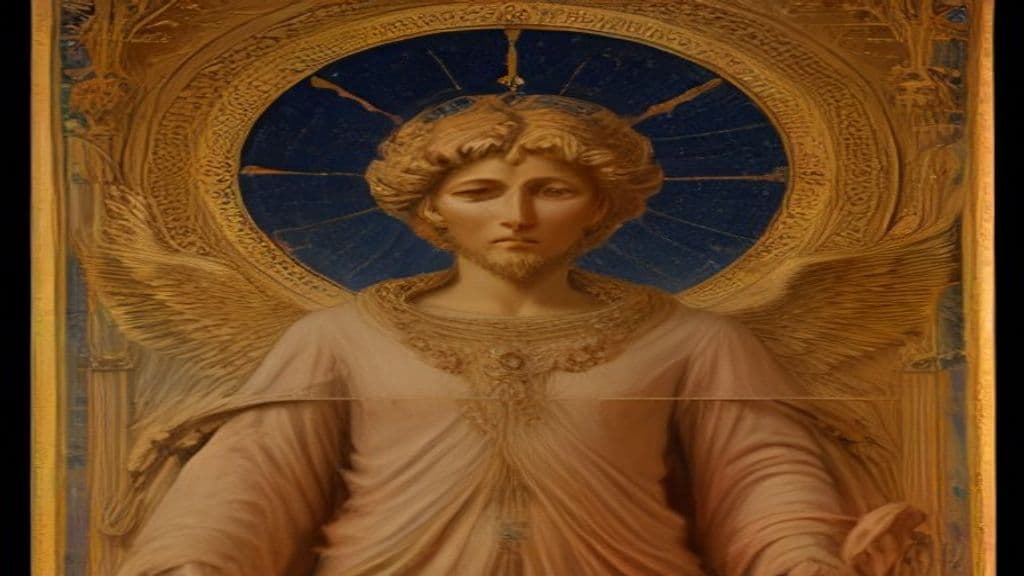
The cherub appears in Hebrew scripture (notably Ezekiel's visions) as part of a prophetic cosmology and is often linked by scholars to ancient Near Eastern guardian hybrids (e.g., Assyrian/Babylonian lamassu/shedu). Philological proposals connect Hebrew kərūḇ with Mesopotamian kirubu/karâbu/kāribu terms, which various scholars have read as indicating a protective, propitious, or intercessory figure placed at temple and palace thresholds. Later Jewish, Christian and Islamic literatures place cherubim within ordered hierarchies of angels, sometimes very near the divine throne.
In Ezekiel (chs. 1 and 10) cherubim are described within a tetramorphic schema: each having four faces — of a man, a lion, an ox (in Ezekiel’s ch.1) and an eagle; chapter 10 repeats the formula but replaces 'the face of the ox' with 'the face of a cherub,' a variance noted in the sources. Ezekiel also describes straight legs with soles like the hooves of a bull, gleaming like polished brass. Comparative evidence and scholarship note parallel iconography in the Ancient Near East (winged human-headed lions/bulls such as lamassu/shedu and griffin-like hybrids), while Western Christian art later depicts cherubim as putti — small, plump winged children — a distinct and later visual tradition.
Sources attribute to cherubim protective and service-oriented roles: guarding sacred thresholds (traditionally the entrance to Eden), serving as attendants or bearers of the divine throne, and existing in close proximity to God as high-ranking heavenly beings. Etymological and comparative-linguistic proposals have suggested an intercessory or 'blesser' sense (from Mesopotamian roots meaning 'one who prays' or 'propitious'), but the etymological reading is interpretive rather than a direct scriptural description. Textual materials (e.g., Ezekiel) also connect cherubim with the enigmatic 'living creatures' (chayot), though the exact relationship between those categories is ambiguous in the sources.
Weaknesses
- otherNo traditional weaknesses specified in the provided sources
Wards
- otherNo warding rituals or protective measures against cherubim are documented in the provided sources

Lamia
A child-devouring demon of Greek mythology — once a queen of Libya and lover of Zeus, driven mad by Hera's destruction of her children and transformed into a monstrous hunter of other women's children.
Lamia
A child-devouring demon of Greek mythology — once a queen of Libya and lover of Zeus, driven mad by Hera's destruction of her children and transformed into a monstrous hunter of other women's children.
Abel
Abel is the second son of Adam and Eve in the Genesis narrative, a shepherd whose accepted offering and subsequent murder by his brother Cain form the biblical account of the first death. Later interpretive traditions expand his role, treating him as an archetypal righteous victim, a postmortem avenging or adjudicating figure, and in some systems (notably Mandaean) identifying him with an angelic lightbeing.
Abraham
Abraham (originally Abram) is the foundational patriarchal ancestor in the Hebrew Bible whose life establishes a covenantal relationship between his family/people and God. He functions as an exemplar of faith, the progenitor of promised descendants, and a narrative anchor for claims of land, blessing, and communal identity in later religious traditions.
Abraham (Ibrāhīm) in Islam
Ibrāhīm (Abraham) in Islam is a human prophet and messenger chosen by God, a paradigm of pure monotheism (hanīf), patriarchal ancestor to later peoples and prophets, and traditionally regarded as having helped establish the Kaʿbah with his son Ismāʿīl. He is called Khalīl Allāh ('Friend of God') and is central to rites commemorated in Hajj and Eid al‑Adha.
Adam (ʾĀdam)
In Islamic theology Adam (Arabic: آدم, ʾĀdam) is presented as the first human being and the first prophet (nabī), created by God from earth/clay, granted life by God's spirit, placed in a paradisal Garden, taught knowledge (the "Names"), tested by divine command, tempted by Iblīs, and ultimately sent to live and die on Earth while remaining eligible for repentance and forgiveness.
Adam and Eve
Adam and Eve are the primordial human pair in the Abrahamic creation narratives who function as the first man and woman, placed in the Garden of Eden to steward creation. Their eating of the forbidden fruit produces a changed human condition—knowledge of good and evil, shame, pain, labor, mortality—and their story underpins later doctrines such as the Christian doctrine of original sin while being read differently across Jewish and Islamic traditions.
Adonai
Adonai (אֲדֹנָי) is one of the sacred Hebrew names used in Judaism to refer reverently to the singular God. It functions as a liturgical and devotional substitute or form for the divine Name and is treated with linguistic and ritual care in Jewish practice; it also appears in Christian liturgy (e.g., the Advent antiphon “O Adonai”).
Adonay
Adonay (אֲדֹנָי, often transcribed Adonai or Adonay) is a sacred Hebrew appellation meaning roughly "Lord" or "Master," used in Jewish liturgical and scriptural language as a reverent name for the divine. In the provided sources it functions as a theological title within Judaism rather than a personified folkloric being; discussions around it center on reverent usage and the communal care taken with divine names.
Allah
Allah is the Arabic-language term for the singular monotheistic God of the Abrahamic tradition as used in Islamic theology and by Arabic-speaking Jews and Christians. Linguistically related to other West Semitic divine names, the term in Islamic usage functions as God's unique proper name (Lafẓ al-Jalālah) and denotes the transcendent creator and sovereign of the universe.
Alpha and Omega
A titulary formula and visual symbol formed from the first and last letters of the Greek alphabet (Α/α and Ω/ω), used in Christian scripture and art to denote God's or Christ's totality — 'the beginning and the end.' It functions as a theological appellation rather than an independent supernatural being.
Al‑Yasa (Elisha)
Al‑Yasa (Elisha) is a prophetic figure attested in Abrahamic scriptural traditions. In the Hebrew Bible he is described as an Israelite prophet and 'wonder‑worker'; later traditions in Christianity and Islam also recognize him among the line of prophets.
Angel
A spiritual or heavenly being functioning primarily as a messenger and intermediary between a transcendent deity and humanity; angels also act as protectors, guides, and executors of divine will across several Abrahamic and adjacent traditions.
Angel of the Lord
A recurring divine messenger in the Hebrew Bible and New Testament who appears on behalf of the God of Israel, acting as God's representative in speech and deed. The figure—Hebrew מַלְאַךְ יְהוָה (mal’ākh YHWH)—functions as intermediary, guide, protector, judge, and announcer at decisive narrative moments.
Community Record
- [1]Cherub — Wikipedia. Wikipedia contributors. 'Cherub.' Wikipedia, The Free Encyclopedia.wiki
- [2]Putto — Wikidata. Wikidata entry on Putto (illustrating putti/cherub artistic association).other
- [3]John Dough and the Cherub — Project Gutenberg. L. Frank Baum, John Dough and the Cherub (mentioned among modern/cultural uses of 'cherub').literary
- [4]Archive: miscellaneous modern/cultural items referencing 'cherub'. Various archive items cited in the research notes documenting modern cultural uses of the term (e.g., musical, gaming, legal references).other