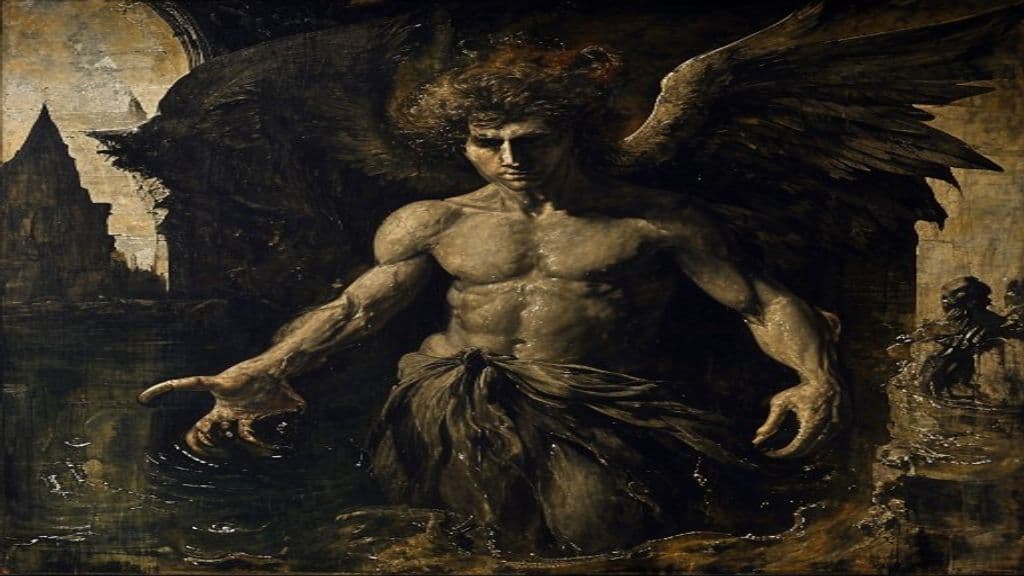
Farfarello appears as one of the Malebranche in Dante Alighieri's Divine Comedy, specifically connected to Cantos XXI–XXIII of Inferno, where the Malebranche are the demons who guard Bolgia Five of the Eighth Circle (Malebolge). In that literary context Farfarello functions as one member of a collective of infernal custodians charged with enforcing punishments upon a particular class of sinners (barrators).
Primary source summaries emphasize the Malebranche's collective demeanor as 'vulgar and quarrelsome' but do not provide a detailed individual physical description of Farfarello. The supplied materials therefore attest to temperament and role rather than distinct corporeal features for this named demon.
In Dante's portrayal the Malebranche (including Farfarello) act as enforcers: their duty in Bolgia Five is to force corrupt politicians (barrators) to remain under the surface of a boiling lake of pitch. This indicates coercive, custodial behavior and a readiness to engage aggressively; the group is characterized as quarrelsome and vulgar. Separately, in modern popular verse the name Farfarello is used as a threatening figure invoked by adults to make children obey, indicating cultural usage of the name as a disciplinary bogey-figure.
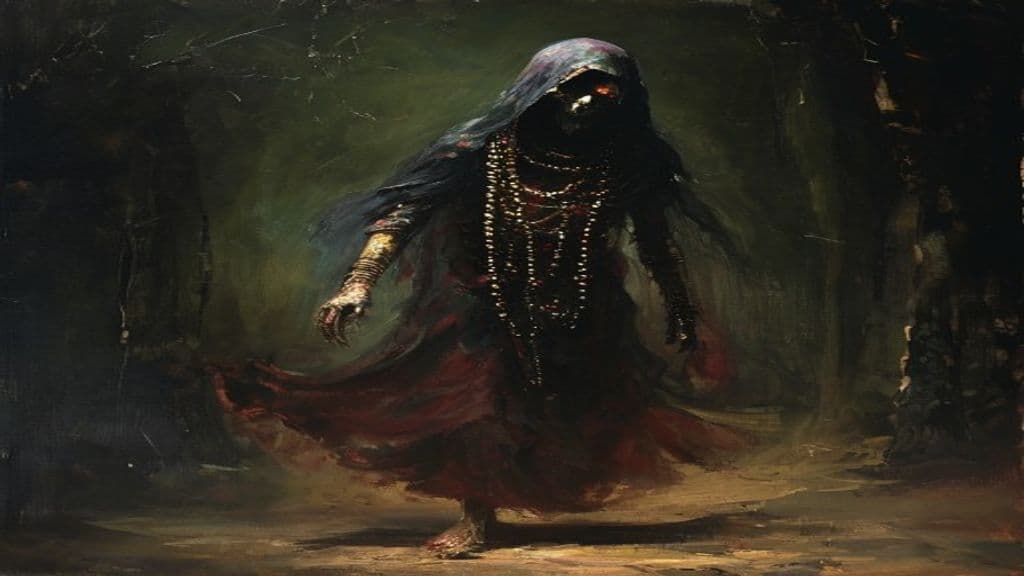
Far darrig (fear dearg)
A solitary Irish faerie-class trickster traditionally called fear dearg ('Red Man'), the far darrig is noted for practical—and sometimes gruesome—jokes, a reputed connection to changelings and nightmares, and a characteristic red coat and cap. Accounts portray it as an ambivalent domestic/liminal being that can bring good luck if placated but imaginative punishments if offended.
Faramarz
Heroic figure in Persian epic tradition, son of Rustam and protagonist of the Faramarz-nama. (Note: - Power tier: Lower, based on source material (heroic figure, son of Rustam), should be at least Greater=powerful regional spirit - Origin story: Only mentions relationship to Rustam, no Primordial or)
Faramir
Faramir is a fictional human noble of J. R. R. Tolkien's legendarium: younger son of Denethor II, brother of Boromir, captain of Gondor who commands forces in the War of the Ring, later Steward under King Aragorn. He is notable for resisting the temptation of the One Ring and for being healed by Aragorn with athelas in the Houses of Healing.
Farangis
Farangis is a human literary character in the Persian epic the Shahnameh: the eldest daughter of Afrasiab of Turan, the second and favourite wife of the Iranian prince Siyâvash, and the mother of the hero and later king Kai Khosrow. Her role in the epic is genealogical and political, marked by loyalty, mourning, and participation in dynastic succession.
Faravahar
The Faravahar is an ancient winged-disc/winged-figure emblem prominent in Zoroastrian and Iranian visual culture. Scholarly and traditional readings variably interpret it as an icon of the fravashi (personal spirit), khvarenah (royal/divine glory), or a general symbol of divine favor and moral guidance, and it has been reappropriated in modern pan‑Iranian identity.
Farbod
In Persian tradition, Farbod is a concept associated with protection, honor, and prestige. (Note: - Power tier should be "Primordial" or unclear, as no specific abilities or behaviors are mentioned. - Origin story is accurate, but could be expanded upon with more context about pre-Islamic Persia a)
Farhad (Persian literature)
In Persian literature and mythology, Farhad is a character associated with the love story of Khosrow and Shirin. (Note: 1. Power tier should be revised to "Minor Spirit" since Farhad's abilities are more related to his devotion and determination, rather than cosmic or deity-level powers. 2. Remove description of "Appea)
Fariburz (Shahnameh)
Fariburz is a legendary Iranian prince and warrior in Ferdowsi’s Shahnameh, a son of King Kay Kavus and brother of Siyâvash who appears as a recurrent Kayanian court hero in episodes such as the Mazandaran (Bahman’s fortress) campaign and the First 'Joust of the Rooks'. He is a human martial figure within the epic, not a supernatural being.
Farinata degli Uberti
Farinata degli Uberti (born Manente degli Uberti, 1212–11 November 1264) was a 13th‑century Florentine aristocrat, knight, and leader of the Ghibelline faction whose political career, posthumous inquisitorial prosecution (1283), and literary depiction by Dante have made him a charged exemplar in medieval debates about heresy and the afterlife.
Faro
Faro is identified in the supplied sources as a deity prominent in the Mandé creation narrative. Beyond a single disambiguation reference, the provided material contains no further ethnographic or mythic details about Faro's attributes, stories, or rituals.
Farud
Farud (also Firoud, Forud) is a human princely figure in the Persian epic Shahnameh, presented as the son of Siavash and ruler of Kelat. His encounter with the army of his brother Kai Khosrow—marked by misrecognition, restrained tactics, and tragic wounding—functions as a moral episode about kinship, counsel, and the ethics of warfare.
Farânak
Farânak is a human female character in the Persian epic Shâhnâmeh, attested as the wife of Abtin and the mother of the hero-king Fereydun. Her name derives from Persian terms meaning 'butterfly' and by extension is linguistically associated with the Persian lynx/caracal; however, the cited sources present her as a mortal figure within epic genealogy rather than a supernatural being.
Community Record
- [1]Malebranche (Divine Comedy) - Wikipedia. "The Malebranche are the demons in the Inferno of Dante's Divine Comedy who guard Bolgia Five of the Eighth Circle (Malebolge). They figure in Cantos XXI, XXII, and XXIII. Vulgar and quarrelsome, their duty is to force the corrupt politicians (barrators) to stay under the surface of a boiling lake of pitch.", Malebranche - Wikipediawiki
- [2]Farfarello (Wikidata). Wikidata entry for Farfarello (Q15809310)other
- [3]Trilussa, La ninna nanna de la guerra (archive recording / text). Trilussa, La ninna nanna de la guerra — contains the lullaby line 'dormi, dormi, cocco bello, sennò chiamo Farfarello' used as a threat to quiet a child.folk