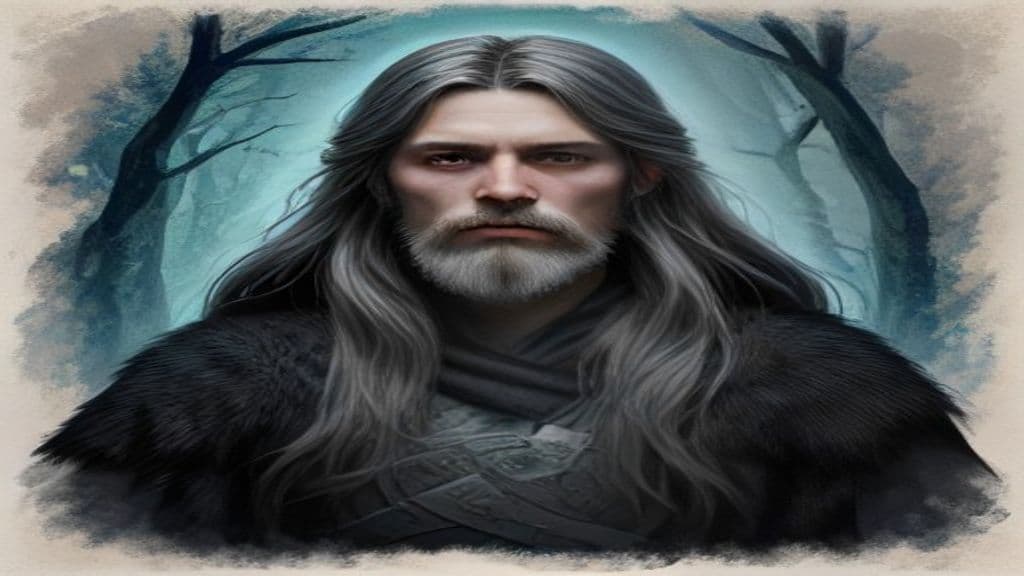
In the Old Norse literary tradition Fornjótr is presented as a jötunn who fathers three personified natural forces: Hlér (sea), Logi (fire) and Kári (wind). Saga-attestations (for example Orkneyinga saga and Hversu Noregr byggdisk) present him in some manuscripts as a legendary king of northern lands variously named (Finnland/Kvenland; some variants read Gotland or Jutland) and include him in genealogical lines that serve to link mythic ancestry with later royal pedigrees.
Surviving sources do not supply a descriptive physical portrait of Fornjótr beyond classifying him among the jötnar and listing him in the þulur (poetic lists). Poetic kennings invoke his name and his sons (for example 'son of Fornjótr') to denote elemental forces, but no specific bodily attributes, size, or coloration are recorded in the provided material.
The attested functional roles of Fornjótr are chiefly genealogical and etiological: he is named as the father of Hlér (sea), Logi (fire) and Kári (wind), thereby serving as a mythic progenitor of these elemental powers. Skaldic verse uses formulations derived from him—Þjóðólfr of Hvinir apparently uses 'son of Fornjótr' as a kenning for fire, and a skald called Svein uses 'ugly sons of Fornjótr' to mean the wind—indicating that his name functions in verse as a source-label for elemental phenomena. Beyond paternity of these personifications and his presentation as a legendary territorial ruler in some sagas, the provided sources do not ascribe discrete magical spells, interventions, or other specific supernatural acts to him.
Alvaldi
Alvaldi (Old Norse: Alvaldi / Ölvaldi) is a jötunn in Norse mythic genealogies, attested chiefly as the father of the notable jötunn Þjazi and described in one source as exceedingly rich in gold. He survives in the record mainly as a familial antecedent and an etiological figure rather than as an active participant in preserved narratives.
Andhrímnir
Andhrímnir is the named cook of the Æsir and the einherjar in Old Norse myth, responsible for slaughtering and preparing the beast Sæhrímnir daily in Valhalla and for producing the gods' mead from Heiðrún's milk. He is attested in the Poetic Edda and summarized in modern reference works.
Austri, Vestri, Norðri and Suðri
A quartet of named dwarfs in Old Norse cosmology positioned at the four cardinal points who are described in medieval sources as holding up the sky after the gods made heaven from Ymir’s skull. They function as structural/cosmogonic supports and are attested in the Prose Edda and the Dvergatal of Völuspá, with echoes in skaldic kennings and in later scholarly interpretation linking their role to roof-beam terminology.
Bestla
Bestla is a jötunn (giantess) in Old Norse mythic genealogies, attested as the mother of Odin, Vili, and Vé by the giant Borr. She functions primarily as a maternal progenitor in the medieval Icelandic corpus (Poetic Edda, Prose Edda, and skaldic verse), and surviving references to her are sparse and fragmentary.
Brimir
In Old Norse mythic tradition the name Brimir appears in two closely related roles: as a name applied to a primordial jötunn (often equated with Ymir/Aurgelmir) whose body supplies the material of the world, and as the name of a beer‑hall or hall of plenty that Snorri interprets as an afterlife dwelling for virtuous survivors after Ragnarök.
Búri
Búri is an Old Norse primordial divinity attested in the Prose Edda and a skaldic verse as an early ancestor of the Æsir. He is presented as a first-born godlike figure who is freed from salty rime by the primeval cow Auðumbla and is genealogically prior to later gods such as Borr and, by descent, the Æsir.
Býleistr
Býleistr is an Old Norse mythic name attested as a brother of Loki. He appears only as a kin-term in skaldic and Eddic contexts and in Snorri Sturluson's prose lists; no independent deeds or narratives are preserved for him in the cited sources.
Dagr
Dagr is the Old Norse personification of the day: a luminous being who rides across the sky on the horse Skinfaxi, bringing daylight in the mythic cosmology preserved in the Poetic Edda and Prose Edda. The lexical item Dagr functions both as the common noun for 'day' and as a proper name for this mythic actor.
Durinn
Durinn is an early named dwarf (Old Norse: dvergr) attested in the medieval Norse corpus; counted as the second-created dwarf after Mótsognir and associated in saga tradition with exceptional smithcraft, including a role in forging the magic sword Tyrfing.
Dvalinn
Dvalinn is an Old Norse mythic name attested in the Poetic Edda and several sagas applied to at least two distinct figures: a named dwarf among the dwarf-kind (craftsman, rune‑figure, leader in some lists) and one of the four harts/stags that feed among the branches of the world‑tree Yggdrasill. The corpus does not reconcile these uses of the same name into a single coherent biography.
Eitri
Eitri (also attested as Sindri) is an Old Norse dwarf smith celebrated in the Skáldskaparmál episode for forging three famous artifacts — Gullinbursti, Draupnir, and Mjöllnir — while working with his brother Brokkr. He is presented as a master craftsman whose work directly affects the gods, not as a deity.
Eldir
Eldir is a named servant of the sea-being Ægir in Old Norse myth, attested in the poem Lokasenna where he stands outside Ægir's hall and speaks with Loki. His name, Old Norse Eldir, is glossed as 'fire-stoker' and marks him as a household attendant and threshold interlocutor rather than a deity.
Community Record
- [1]Fornjót — Wikipedia. Wikipedia entry 'Fornjót' (summary of Old Norse attestations, name-questions, kennings, and saga references)wiki
- [2]Fornjótr — Wikidata. Wikidata item Q389673 labeling Fornjótr as a Norse mythical character; giantother
- [3]Archive: Sacred Church Of Bulgaria Decree Of Blessing And Sanctity 89449394. Modern archival document that includes genealogical phrasing referencing Fornjótr as 'the Ancient Giant, King of Kvenland, House of Yngling' (modern compilation; provenance and scholarly value not established in supplied materials)other
- [4]Archive: Sacred ORTHODOX TRADITION APOSTOLIC CHURCH Decree Of Blessing And Sanctity 98934. Modern archival document citing Fornjótr in a genealogical list (modern compilation; not primary medieval source)other
- [5]Archive: Hail the Hail!. Modern archive item referencing Fornjótr in a genealogical/modern context (not a primary medieval source)other