In Hesiod's sequence Gaia arises directly after Chaos as the everlasting seat of the immortals on Olympus. From Gaia come major physical features (the Ourea, Pontus) and through her union with or production of Uranus (Sky) she becomes the mother of the Titans, Cyclopes, and Hecatoncheires. She also generates some offspring independently (Pontus, the Mountains). Variant mythographers (summarized in later sources) record alternate genealogies and episodes — for example additional births of monstrous beings or different parentages — but the consistent Hesiodic core presents Gaia as a first‑generation, creative earth‑mother in theogony.
Classical sources emphasize Gaia's earthlike, maternal aspect rather than a consistent anthropomorphic portrait. Hesiod uses epic epithets such as "wide-bosomed" to stress her fecundity and capacious, nurturing character; she is conceived as the inhabitable earth itself — the foundational seat for the immortals — rather than a narrowly defined human figure. The supplied texts do not give standardized iconographic features; instead poetic language presents her as the vast, sustaining ground from which mountains, seas, and first beings emerge.
Hesiodic and related mythic accounts attribute to Gaia spontaneous procreation (producing the Ourea and Pontus without a consort), co‑parentage of principal divine lines (with Uranus producing Titans, Cyclopes, Hecatoncheires), and advisory and scheming agency in divine affairs. Notably, when Uranus injures her by hiding their children inside her, Gaia devises a plan and provides a grey flint (or adamantine) sickle that Cronus uses to castrate Uranus. She aids Rhea by supplying the stone that substitutes for the infant Zeus and is implicated in later births of monstrous challengers (in some traditions she and Tartarus sire Typhon). Across the narratives she functions as progenitor, counselor, protector of offspring, and — when wronged — a source of vengeance through monstrous progeny.
Weaknesses
- otherClassical sources do not specify actionable vulnerabilities or human-usable countermeasures; Gaia is a foundational primordial force rather than a creature with enumerated weaknesses
Wards
- otherNo classical warding rituals against Gaia are recorded in the supplied sources; she is generally a maternal/cosmic principle rather than an adversary requiring protective rites

Pontus
Pontus is attested in the supplied sources primarily as a Greek theonym meaning "sea" (Πόντος, Póntos) and as a geographic/ethnic designation for the region on the southern coast of the Black Sea. The corpus does not provide evidence of Pontus functioning as a discrete, living folkloric spirit with attendant rituals or abilities.
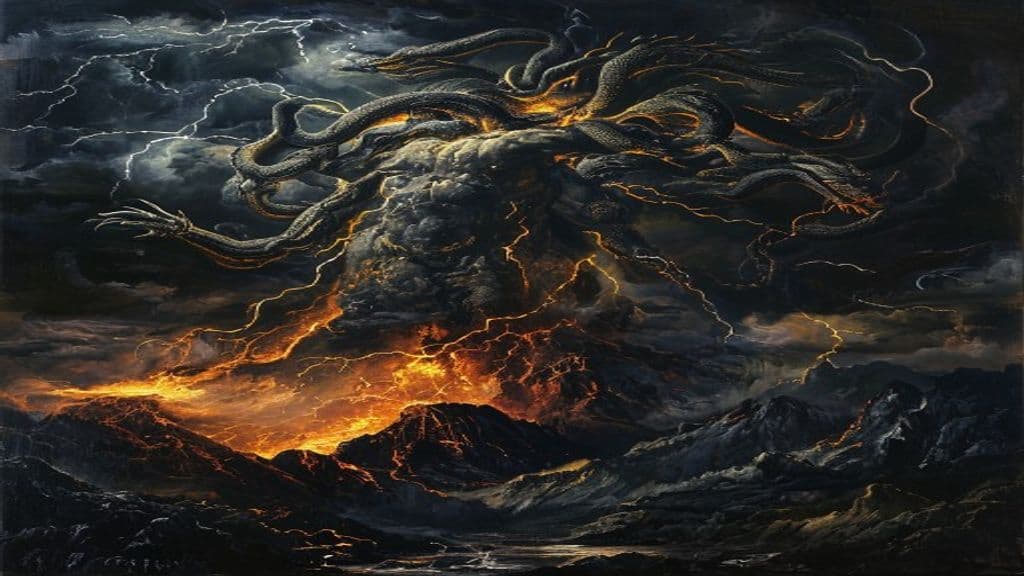
Typhon
The last great monster of Greek mythology — a vast, fire-breathing giant whose shoulders sprouted a hundred serpent heads, nearly toppling Zeus from Olympus.
Community Record
- [1]Gaia (Wikipedia). Wikipedia: Gaia (accessed as provided in research notes)wiki
- [2]Pontus (mythology) (Wikipedia). Wikipedia: Pontus (accessed as provided in research notes)wiki
- [3]Uranus (mythology) (Wikipedia). Wikipedia: Uranus (accessed as provided in research notes)wiki