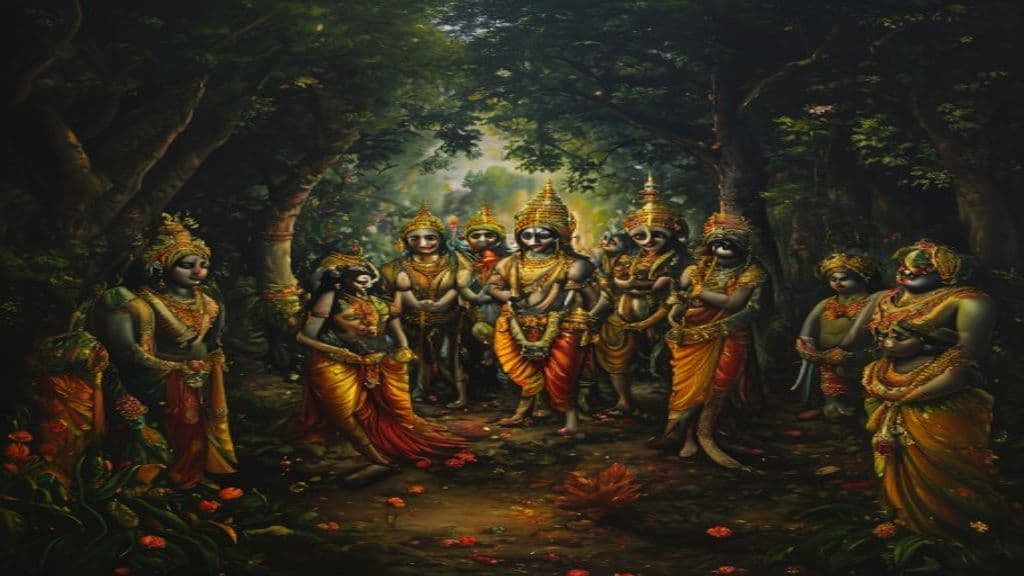
The term gandharva functions as a taxonomic name across Indic textual traditions rather than a single origin myth in the supplied excerpts. Vedic texts present the gandharva as a celestial watcher/guardian connected to Soma and as an escort who brings things from ‘outside’ into the world. In later Hindu accounts they serve at Indra’s court and possess a realm called Gandharvaloka. In Buddhist canonical/commentarial literature the cognate term (gandhabba / gandharva in some contexts) is also applied doctrinally to the intermediate sentient state involved in rebirth and to a low rank of devas; the commentary distinguishes the doctrinal gandhabba (a being/state enabled to be born by karma) from the celestial deva-class gandharva.
Descriptions vary by textual context. Many accounts depict gandharvas as handsome beings who wear fragrant attire; some individual gandharvas have partly animal elements (notably bird or horse features in Hindu descriptions). Buddhist descriptions emphasize their dwelling amid trees, flowers and the scents of bark, sap, and blossoms rather than a fixed anthropomorphic form. No single uniform portrait is given across sources; several named gandharvas appear as distinct persons or kings in epic and Puranic literature.
Core attributes documented across traditions include expert musical and performative skill (males commonly noted as musicians and singers; females often as dancers), an escort/guardian function (Rigvedic role as watcher of Soma and as an escort that brings and neutralizes potentially dangerous arrivals), associations with fertility and virility (often paired with apsaras and linked to marital/sexual themes), supernatural mobility (flight, residence in deva realms such as Indraloka or Gandharvaloka, and presence in liminal natural places), and occasional martial portrayals in epic literature. In Buddhist doctrinal contexts the related term gandhabba denotes an intermediate being/state required for conception/rebirth (a usage distinct from the deva-class functions).
Weaknesses
None recorded.
Wards
- ritualGandharvanpattu / theyyam / kalampattu (regional Kerala practices)
Apsara
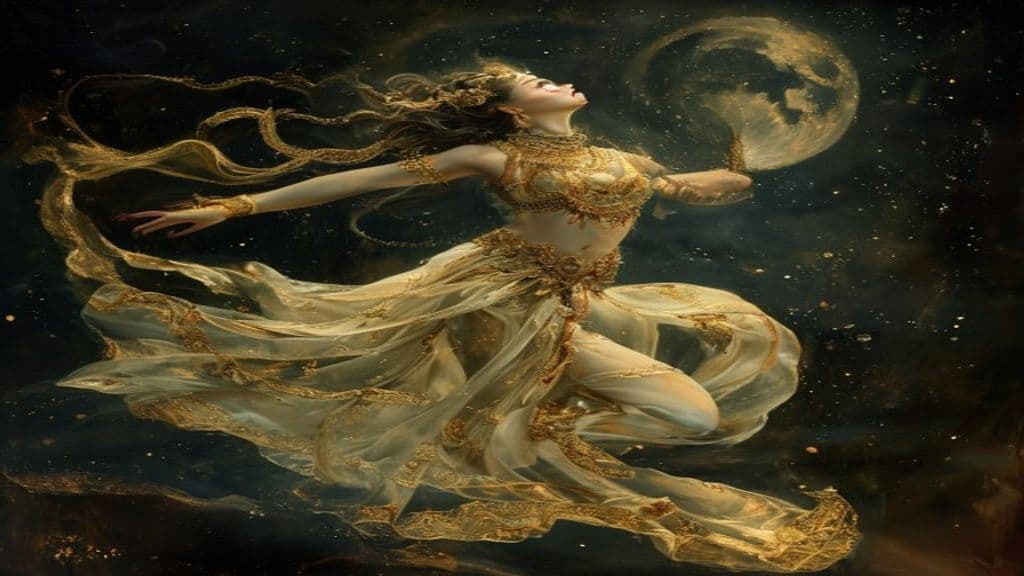
Celestial dancers and water nymphs of Hindu cosmology — beautiful semi-divine beings who dance at the court of Indra and, by his command, descend to earth to distract sages from excessive asceticism.
Yaksha
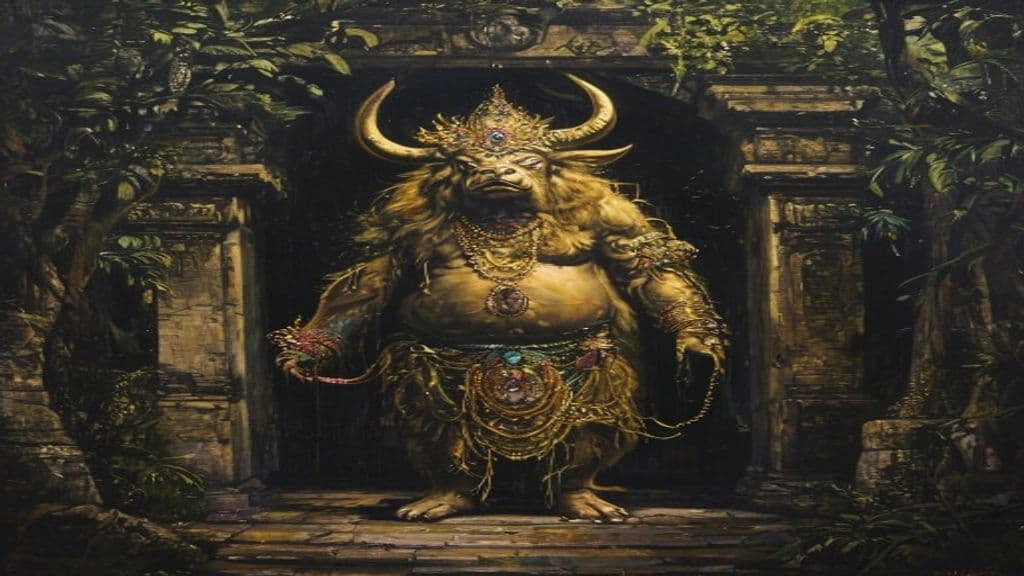
Nature spirits of Hindu, Buddhist, and Jain cosmology — guardians of forests, treasures, and wilderness. Ambivalent beings, capable of great benevolence to the respectful and terrible harm to the greedy.
Indra
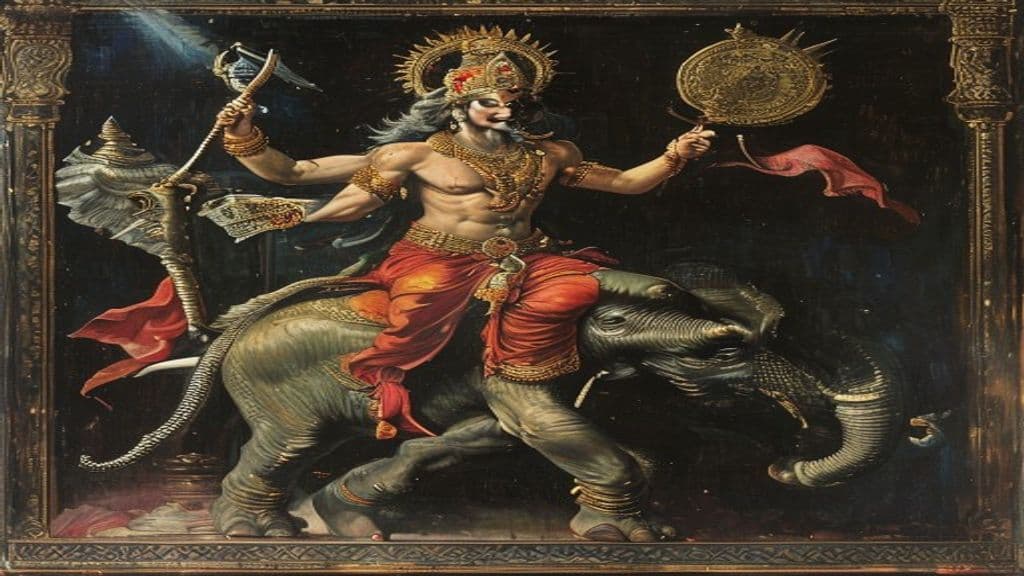
Indra is a major Vedic deity, king of the devas and lord of Svarga (heaven), associated primarily with the sky, storms, lightning, rain, rivers and martial heroism; he is central in the Rigveda and later appears across Hindu, Buddhist and Jain cosmologies with varying status.
Abhinandananātha
Abhinandananātha is the fourth Tīrthaṅkara (ford-maker) of the current Jain cosmic age (avasarpini). Traditional accounts place his birth in Ayodhyā to the Ikshvāku (Solar) dynasty, describe his renunciation and attainment of omniscience beneath a priyangu tree, and record his liberation on Mount Śikharjī.
Adi (asura)
Adi is attested in modern reference works as the name of an Asura who 'appears in the Matsya Purāṇa.' Beyond this single-line citation in secondary sources, no descriptive material about the figure is provided in the supplied research notes.
Adi Shakti
Adi Shakti (also Adi Parashakti, Mahadevi, Adya Shakti) is the primordial feminine power in Hindu/Shakta theology, regarded as the ultimate reality (Para Brahman) and the source from which all goddesses and gods manifest. She is both an impersonal cosmic principle (Mulaprakriti) and a focus of devotional invocation in temples, mantras, and pilgrimage sites such as Shakti Peethas.
Adi Vinayaka
Adi Vinayaka (Ādi Vināyaka; also called Nara Mukha Vinayaka) is a named iconographic and devotional form of the Hindu god Ganesha portraying the deity with a human head, described in sources as the form before the episode of decapitation by Shiva. It is rarely worshipped and appears in a small number of South Indian shrines and in devotional/musical repertoires.
Aditi
Aditi is a major Vedic goddess in Hindu tradition who personifies the boundless, infinite cosmic principle and functions as the maternal matrix from which many celestial deities (the Ādityas and other groups) are born. In the Vedic hymns she is invoked as a protective liberator who guards petitioners, provides wealth and safety, and frees devotees from hindrances such as sin and sickness.
Agni
Agni is the Vedic personification of fire in Hindu tradition: a sacred, mediating principle that manifests as terrestrial fire, atmospheric lightning, and celestial sun, and that receives and conveys sacrificial offerings. Prominent in the Rigvedic corpus, Agni functions as sanctifier, witness of rites of passage, and a transformational inner principle in later Upanishadic literature.
Ahalya
Ahalya is a mytho-legendary woman of South Asian (primarily Hindu) narrative tradition, described as created by the god Brahma, married to the sage Gautama, seduced (or tricked) by Indra, cursed by her husband, and ultimately redeemed by Rama. Her tale is a locus for themes of creation, desire, curse/penance, and redemption and she is counted among the ritual-mnemonic panchakanya.
Aindri (Indrani / Shachi / Paulomi)
Aindri (commonly rendered in sources as Indrani, also called Shachi or Paulomi) is a Hindu goddess presented as the queen-consort of Indra. She is depicted in the available material as a courtly queen associated with beauty, pride and kindness who also appears in at least one account as an active martial participant in the devas' battles with asuras.
Ajitanātha
Ajitanātha is the second tirthankara of the current cosmic age in Jainism: an enlightened spiritual teacher who renounced worldly life, attained omniscience (kevalajñāna), and achieved liberation (moksha), and who is credited with establishing a large four-part monastic order in the tradition's hagiography.
Akshayavata
In Hindu mythology, Akshayavata is a sacred banyan tree and/or lake that symbolizes eternal life. It is mentioned in both Hindu and Jain traditions and associated with the Puranas. (Note: - The power tier should be "Greater" or at least "Ancient", as it is associated with the Puranas, which are considered ancient texts. - No specific physical description is provided, but that doesn't m)
Alakshmi
Alakshmi is an inauspicious female supernatural figure in Hindu tradition, presented as the negation or shadow-counterpart of the prosperity-goddess Lakshmi. She personifies poverty, grief, jealousy and social discord and is managed in domestic ritual and festival practice.
Alamelu
Alamelu (also Alamelu Manga / Alarmel Mangai) is a South Indian devotional name for the goddess Padmavati, identified in sources as an avatar of Lakshmi and the consort of Venkateswara; the name is also used widely as a female personal name and in titles of cultural works in Tamil and Telugu contexts.
Community Record
- [1]Gandharva - Wikipedia. Wikipedia, 'Gandharva' (summary of Vedic, Puranic, Buddhist, and regional practices including Gandharvanpattu)wiki
- [2]Wikidata: gandharva. Wikidata summary of gandharva (residences, habitats, nightfall/wilderness associations)other
- [3]Representative archival materials (music and devotional recordings referenced in notes). Archive collection cited in research notes as reflective of cultural musical association (lexical/cultural usage example)other
- [4]Representative archival darshan recording (referenced in notes). Archive recording cited in research notes (contextual cultural material)other