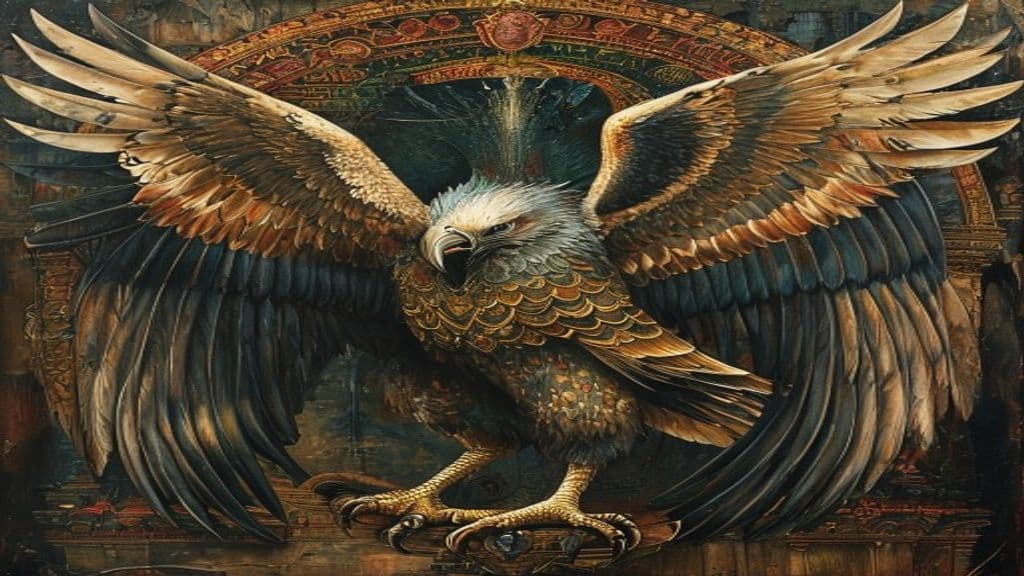
According to Vedic, Purānic and epic accounts summarized in the sources, Garuda is born to the sage Kaśyapa and his wife Vinatā; he is the brother of Aruṇa (charioteer of the Sun). Puranic narratives place Garuda within a wide kinship network (many classes of supernatural beings are born from Kaśyapa's various wives). In Purānic and epic episodes he undertakes a quest for amṛta (immortality nectar) to free his mother from enslavement by the Nāga lineage, and in some accounts even wages war against gods such as Indra. The Rigveda and Mahābhārata identify a related figure, Garutman, with overlapping attributes (winged celestial deva, great speed, and metamorphic abilities).
Sources report two principal iconographic modes: a zoomorphic form — an enormous eagle- or kite-like bird often shown with wings partially open — and an anthropomorphic bird-man with wings and avian features (beaked nose, bird-legs). Iconographic treatises cited give detailed prescriptions: Silparatna recommends two hands and four color bands (golden-yellow from feet to knees, white from knees to navel, scarlet from navel to neck, and black above the neck) with hands in abhaya posture; the Sritatvanidhi recommends a kneeling figure wearing one or more serpents, a pointed beak-like nose, and two hands in namaste (anjali) posture. In temple art Garuda is commonly shown kneeling with hands in anjali; when not bearing Viṣṇu he is sometimes shown holding a jar of amṛta and an umbrella in rear hands.
Textual summaries attribute to Garuda extraordinary flight and speed (the power to travel swiftly everywhere), vigilance and martial might; a mythic claim records that his wing-flapping can halt the spinning of heaven, earth and hell. He is traditionally an enemy of the Nāgas (serpents) and in some epic accounts (Mahābhārata) Garutman/Garuda can shapeshift and enter any form or place. Beyond physical powers, Vedic and Purānic texts use Garuda metaphorically for ritual and soteriological concepts (rik, sāman, yajña and the ātman), indicating a symbolic role in sacrificial and philosophical registers.

Community Record
- [1]Wikipedia: Garuda. Wikipedia contributors, 'Garuda,' Wikipedia, The Free Encyclopedia.wiki
- [2]Wikidata: Garuda Indonesia (contemporary name-use example). Wikidata entry Q512468 (Garuda Indonesia), cited as evidence of modern cultural reuse of the name.other