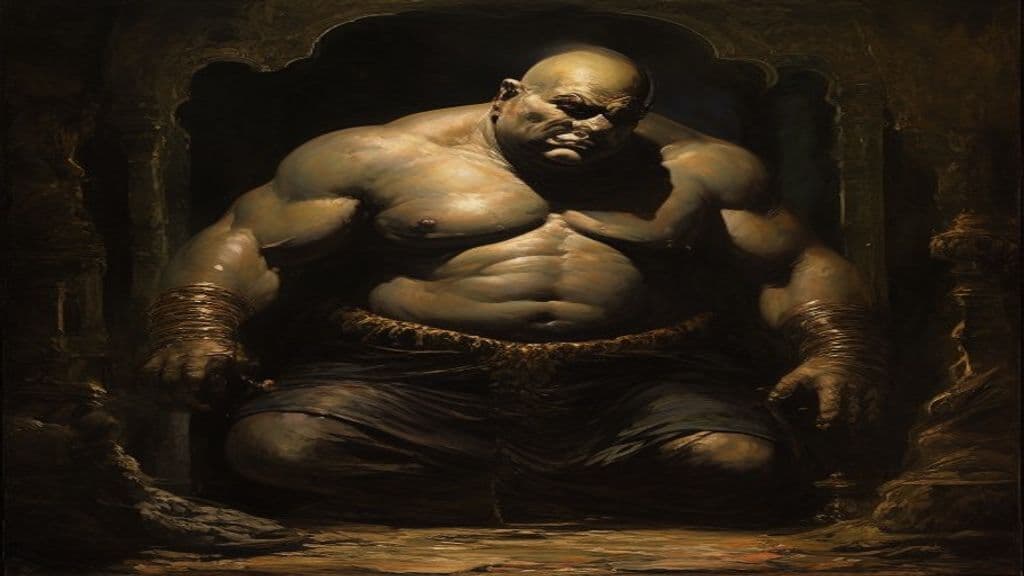
In the Mahabharata narrative Ghatotkacha is born in the forest after Bhima (a Pandava prince) encounters and marries the rakshasi Hidimbi. Hidimbi raises him in the forest; he is of rakshasi lineage through his mother while maintaining filial ties to his human father Bhima and the Pandava household. In later episodes of the epic, during the Pandavas' exile and the Kurukshetra War, Bhima summons or remembers him and Ghatotkacha appears to aid the Pandavas in battle.
The name Ghatotkacha is explained as referring to a pot-shaped, bald head (ghata = pot; utkacha interpreted as head), and sources emphasize his distinctive round/bald head. He is described as physically large and powerful; at his death he is said to enlarge his body to crush an akshauhini of the enemy army. Beyond these traits the cited material presents him primarily through martial and supernatural attributes rather than a standardized visual schema.
Ghatotkacha functions as a major warrior allied to the Pandavas: he leads troops of rakshasas and is described in the epic as head of an akshauhini. He fights and kills numerous enemy combatants and asuras, employs the mace like his father Bhima, and uses magical powers and celestial weapons in combat. He is especially effective at night — his powers (including the power of illusion) are described as heightened after sunset — and can cause massive destruction, most notably forcing Karna to expend his single-use vasavi śakti to mortally wound him. The epic also records that Bhima could summon him by thinking of him, indicating a close, prompt availability to the Pandava side.
Weaknesses
- conditionvulnerable to single-use celestial weapon (vasavi śakti) in epic account
Wards
None recorded.

Bhīma
Bhīma (Bhīmasena) is one of the principal heroes of the Hindu epic Mahābhārata: the second of the five Pāṇḍava brothers, a semi‑divine warrior famed for prodigious physical strength, mastery of the gada (mace), and ferocious devotion to family and vows. He is presented as the mythic son of the wind god Vāyu, whose divine paternity explains his extraordinary attributes and role in the Kurukṣetra War, where he slays the hundred Kaurava brothers among other foes.

Rakshasa (Himalayan variants)
A Himalayan reception of the pan-Indian rakshasa motif: hostile or disruptive non‑human beings known from Sanskrit epic and Puranic literature, here noted where Himalayan sources and discussions intersect with the broader epic tradition. The supplied sources do not document distinct, well‑attested Himalayan folklore variants; the entry therefore presents primarily the epic/legendary profile as transmitted into Himalayan contexts in general references.

Asura
Asura (Sanskrit: असुर) are a class of supernatural beings in Indian religious traditions. In Hinduism they are described as power-seeking beings related to, and often oppositional toward, the Deva; in Buddhist cosmology they form a demigod/titan class characterized by passions such as wrath and envy. Individual asura figures (notably the asura Svarbhānu) appear in myths that produce the eclipse-entities Rahu and Ketu.
German
German is a South Slavic male vegetation and weather spirit recorded in eastern Serbia and northern Bulgaria. Known primarily through ritual effigies and rites performed by girls and young women, he is associated in folk belief with bringing rain and hail and with a symbolic death-and-revival cycle tied to agricultural fertility.
Germanic Dragon
A large, serpentine creature from Germanic mythology that hoards gold and shares characteristics with cosmic beings. (Note: 1. Power tier should be Ancient instead of Primordial, as the source describes them sharing characteristics with "other dragons in European mythology", implying a level below cosmic. 2. Remove "venomo)
Germanic Heroic Age
A cultural and historical period in Germanic societies, reflected in their poetry and stories, which often expressed the values and customs of the time. (Note: 1. "Minor Spirit" is an incorrect power tier; no mythological beings are associated with this entity. 2. Remove mention of appearance and abilities as they do not apply to a historical/cultural period)
Geryon
Geryon is a monstrous, martial figure from Greek heroic-age mythology who dwells on the far-western island Erytheia and guards a valuable herd of red cattle; he is best known as the opponent slain by Heracles in the Tenth Labour. Classical sources present multiple, conflicting physical descriptions; later reception (notably Dante) recasts the name as an allegorical composite monster.
Geshtinanna
Geshtinanna is a Sumerian goddess functioning as the underworld's chief scribe and a specialist in scribal arts and dream interpretation; mythically she is the sister of Dumuzi and participates in his death‑and‑return cycle, once residing in the netherworld for part of the year in his stead.
Gevurah
Gevurah (Hebrew: גְּבוּרָה, Găḇūrā) is the fifth sephirah on the Kabbalistic Tree of Life, an emanation representing the divine principles of judgment, limitation, and disciplined strength. It functions as a structural attribute within Jewish mystical cosmology rather than an individual personal spirit.
Ghoshayatra Parva
Episode from the Hindu epic Mahabharata where Kauravas are captured by gandharvas and released by the Pandavas. (Note: - Power tier: Ancient (deity-level abilities would fit better with the described events in the source material) - Appearance: Should be added as per source material does not describe but one can infer)
Ghost
A ghost is, in folklore, the soul or spirit of a dead person or non-human animal believed by some to be able to appear to the living. The concept functions across many cultures as an afterlife manifestation tied to ancestor belief, animism, and rituals intended to rest or manage the dead, while modern scientific accounts treat reported phenomena as lacking proof and often propose physiological or environmental explanations.
Ghost Child (toyol, urn)
A named supernatural figure appearing in the 2013 Singaporean horror film Ghost Child (Chinese: 鬼仔), identified in the film as a toyol kept within an urn that brings malicious domestic disturbances to a household. The film is the only supplied source that presents this discrete spirit as an agent in a folk-derived domestic narrative.
Ghost Rider
Ghost Rider is a Marvel Comics mantle borne by multiple human hosts who transform into a flaming-skulled, skeletal superhuman bonded to a supernatural agency variously described as a demon (Zarathos), a Spirit of Vengeance, or an incarnation of Death/Judgment. The figure functions in-universe as an avenger/antihero who enacts retributive justice and is associated with hellfire and a supernatural vehicle (motorcycle or, in some incarnations, a muscle car).
Ghost Ship (Phantom Ship)
A ghost ship (or phantom ship) denotes either a physical vessel found adrift with no living crew or a spectral vessel apparition reported in maritime folklore. The motif functions across maritime cultures as omen, memory of catastrophe, and a narrative way to confront unexplained loss at sea.
Ghost Shirt (Lakota Tradition)
A spiritualized object imbued with powers to protect its wearer from harm or possession by malevolent spirits. (Note: 1. Power tier: Primordial (given its association with spiritual visions from the founder, it's reasonable to assume a higher power level) 2. Abilities: The source material doesn't explicitly mention p)
Community Record
- [1]Ghatotkacha — Wikipedia. Wikipedia article 'Ghatotkacha' (accessed as provided in research notes)wiki
- [2]The Birth Of Ghatotkacha (Amar Chitra Katha comic listing). Archive listing for Amar Chitra Katha: 'The Birth Of Ghatotkacha' (bibliographic source referenced in research notes)other
- [3]Vir Ghatotkacha (regional dramatic/folk listing). Archive listing 'Vir Ghatotkacha Natak' (regional/dramatic retelling referenced in research notes)other
- [4]Ghatotkacha — Ed. By Anant Pai (1997 listing). Archive listing for a 1997 India Book House/Anant Pai edition referenced in research notesother