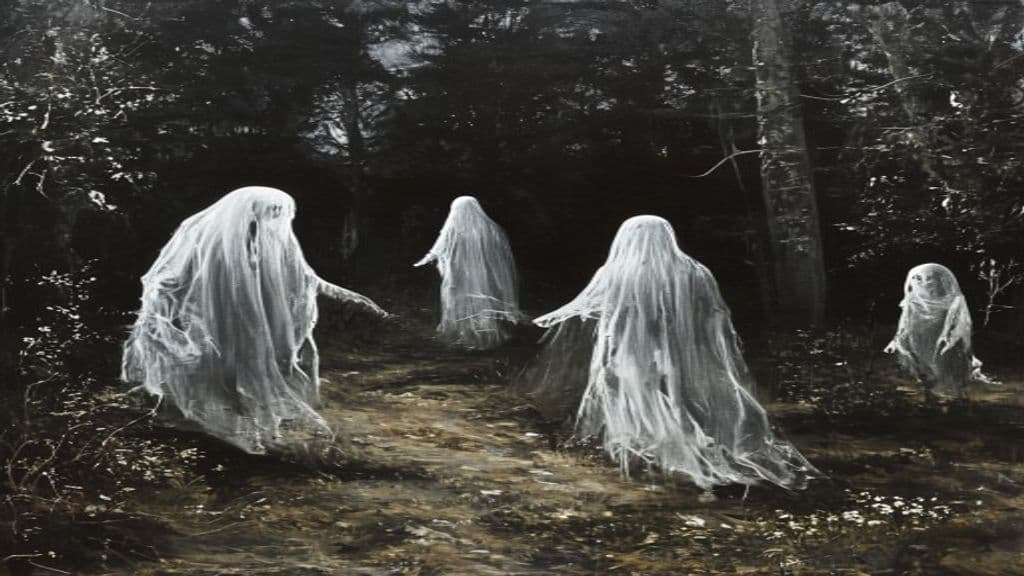
The English term 'ghost' derives from Old English gāst ('breath, spirit, soul, ghost'), tracing to Proto-Germanic *gaistaz and a reconstructed Indo-European root; historically the term covered senses from life-breath and divine spirit to the souls of the dead. Folkloric belief in ghosts is widespread and ancient, often placed by scholars as continuous with animism and ancestor-worship practices in pre-literate societies. Across cultures the ghost concept functions as the continued presence or agency of a formerly living being, connected to social practices (for example, funeral rites) that manage the transition of the dead.
Descriptions vary widely: ghosts may be experienced as an unseen presence, as translucent or wispy shapes, or as realistic, lifelike apparitions resembling the deceased human or animal. Most accounts describe solitary, humanlike essences, though traditions also include animal ghosts and larger phenomena such as spectral groups; related terminology (for example, 'poltergeist'—literally 'noisy ghost' in German) marks behavioral or appearance subtypes rather than a single fixed image.
Folkloric attributions include the ability to appear to the living and to haunt locations, objects, or people associated with them in life; some traditions describe interaction with the physical environment (the poltergeist type is associated with unexplained movement or disturbance of objects). Cultural practices such as necromancy or spiritist séances are named as deliberate techniques for contacting such spirits. Modern scientific sources emphasize that there is no proof of ghosts and often explain reported experiences by alternative causes (neurological disease, certain drugs, or environmental toxins such as carbon monoxide), presenting a competing interpretive frame to folkloric claims.
Weaknesses
- ritualfuneral rites
- ritualexorcism
- ritualritual magic and spiritist practices intended to rest or manage spirits
Wards
- ritualproper funeral rites (culturally specific)
- ritualexorcism (tradition-dependent)
- ritualcontrolled spirit contact (séance / spiritism) as management
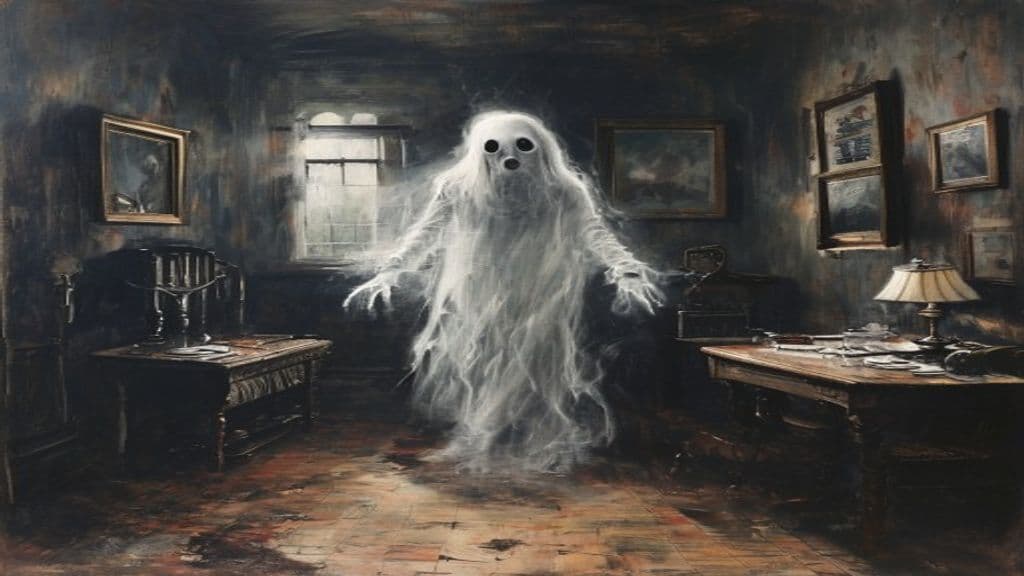
Poltergeist
A poltergeist is a German-derived ghostlore label for an unseen agent associated chiefly with noisy, kinetic, and disruptive physical phenomena in domestic settings. Modern summaries and case literature emphasize episodic outbreaks of object movement, loud noises, and occasional assaults or electrical/foul-smell disturbances, with competing explanations ranging from spirit activity to hoax, psychogenic projection, or natural physical causes.

Ghoul
A ghoul is a demon-like or monstrous humanoid originating in pre-Islamic Arabian religion, traditionally associated with graveyards and the consumption of human flesh. The concept later entered broader folklore and has been widely reused and transformed in modern fiction and popular culture.
Nang Mai (Tree Spirits)
Nang Mai are female tree spirits in Thai folklore inhabiting individual large trees or tree clumps. They are localized tutelary/ghostly presences tied to the well‑being of particular trees and are said to punish those who cut or harm their trees.
Undead
A category of beings that were once dead or are corpses yet continue to behave as if alive; a broad catch-all used in myth, legend, and fiction for both reanimated bodies and incorporeal continuations of persons.
Geryon
Geryon is a monstrous, martial figure from Greek heroic-age mythology who dwells on the far-western island Erytheia and guards a valuable herd of red cattle; he is best known as the opponent slain by Heracles in the Tenth Labour. Classical sources present multiple, conflicting physical descriptions; later reception (notably Dante) recasts the name as an allegorical composite monster.
Geshtinanna
Geshtinanna is a Sumerian goddess functioning as the underworld's chief scribe and a specialist in scribal arts and dream interpretation; mythically she is the sister of Dumuzi and participates in his death‑and‑return cycle, once residing in the netherworld for part of the year in his stead.
Gevurah
Gevurah (Hebrew: גְּבוּרָה, Găḇūrā) is the fifth sephirah on the Kabbalistic Tree of Life, an emanation representing the divine principles of judgment, limitation, and disciplined strength. It functions as a structural attribute within Jewish mystical cosmology rather than an individual personal spirit.
Ghatotkacha
Ghatotkacha (Sanskrit: घटोत्कच, IAST: Ghaṭotkaca) is a singular mytho-heroic figure in the Indian epic Mahabharata, born to the Pandava Bhima and the rakshasi Hidimbi. He is portrayed as a powerful rakshasa-warrior allied to the Pandavas, famed for night-effective magic, illusions, great size, and a climactic death that cost the Kaurava side a large-scale loss.
Ghoshayatra Parva
Episode from the Hindu epic Mahabharata where Kauravas are captured by gandharvas and released by the Pandavas. (Note: - Power tier: Ancient (deity-level abilities would fit better with the described events in the source material) - Appearance: Should be added as per source material does not describe but one can infer)
Ghost Child (toyol, urn)
A named supernatural figure appearing in the 2013 Singaporean horror film Ghost Child (Chinese: 鬼仔), identified in the film as a toyol kept within an urn that brings malicious domestic disturbances to a household. The film is the only supplied source that presents this discrete spirit as an agent in a folk-derived domestic narrative.
Ghost Rider
Ghost Rider is a Marvel Comics mantle borne by multiple human hosts who transform into a flaming-skulled, skeletal superhuman bonded to a supernatural agency variously described as a demon (Zarathos), a Spirit of Vengeance, or an incarnation of Death/Judgment. The figure functions in-universe as an avenger/antihero who enacts retributive justice and is associated with hellfire and a supernatural vehicle (motorcycle or, in some incarnations, a muscle car).
Ghost Ship (Phantom Ship)
A ghost ship (or phantom ship) denotes either a physical vessel found adrift with no living crew or a spectral vessel apparition reported in maritime folklore. The motif functions across maritime cultures as omen, memory of catastrophe, and a narrative way to confront unexplained loss at sea.
Ghost Shirt (Lakota Tradition)
A spiritualized object imbued with powers to protect its wearer from harm or possession by malevolent spirits. (Note: 1. Power tier: Primordial (given its association with spiritual visions from the founder, it's reasonable to assume a higher power level) 2. Abilities: The source material doesn't explicitly mention p)
Ghost Sickness (Navajo Tradition)
A cultural and psychological concept describing a state of being consumed by grief or preoccupation with the deceased. (Note: - Power tier: Primordial (Ghost Sickness is not an entity with concrete abilities, but rather a psychological state that affects individuals) - Appearance: No description needed, as it's a psychologic)
Community Record
- [1]Ghost — Wikipedia. Wikipedia contributors. "Ghost." Wikipedia, The Free Encyclopedia.wiki
- [2]ghost — Wikidata. Wikidata entry Q45529, 'ghost'.wiki