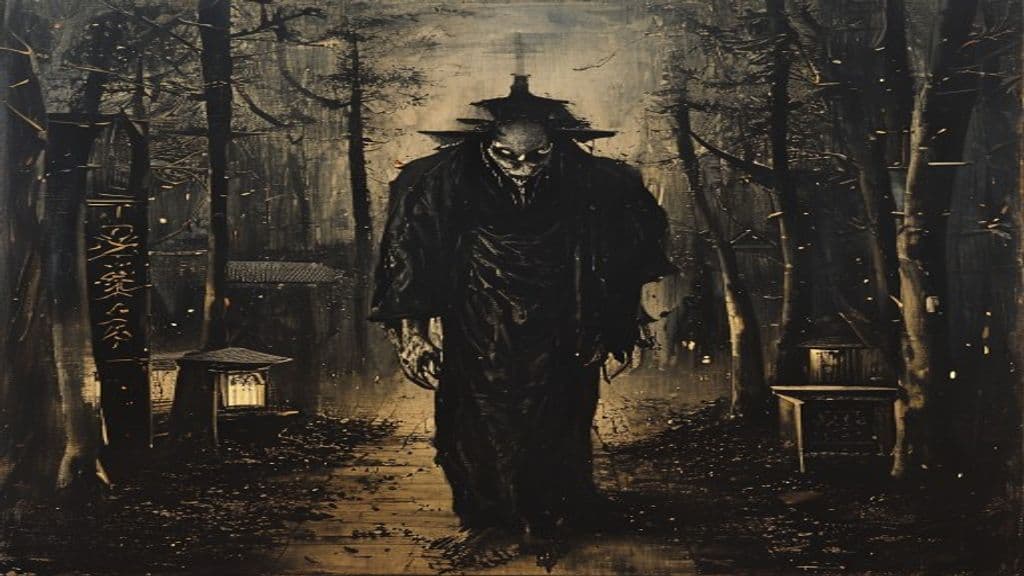
The concept of goryō emerged in historical Japanese political-religious contexts (noted in Nara–Heian period examples) in which the untimely or unjust death of notable persons—for example Prince Sawara (d. 785) and Sugawara no Michizane (d. 903)—was followed by epidemics, storms, fires, or other misfortunes in the capital. The court interpreted these disturbances as the activity of offended spirits. Remedies combined political corrections (restoration of rank, annulment of exile orders, posthumous promotions) with religious remediation such as foundation or patronage of Shinto shrines. Through such official appeasement a feared spirit could be incorporated into the Shinto system as a kami (for example, Prince Sawara at Kamigoryo Shrine and Sugawara no Michizane at Kitano Shrine), converting a source of calamity into a sanctioned protective presence.
Sources do not provide a standardized or consistent physical description for goryō. The category is defined primarily by circumstance and effect rather than by visible form: goryō is an honorific term for spirits associated with hauntings and calamity, and historical accounts emphasize epidemics, storms, lightning, fires, floods, and social disorder following an afflicted person's death rather than a recurring corporeal appearance. Individual narrative depictions vary with each case and the emphasis in the literature is on their socially consequential agency.
Documented attributions for goryō focus on social and natural calamities rather than detailed supernatural mechanics. Historically, goryō were blamed for causing hauntings and tangible misfortunes in the polity: pestilence and epidemic disease, famine, heavy rain, lightning strikes, fires, floods, and additional deaths among the living. The typical scenario recorded in sources involves a person of rank who died prematurely or in political disgrace; the community or court interprets subsequent disasters as the aggrieved spirit's retribution until political and ritual remediation is undertaken. The literature treats goryō both as agents of harm and, once pacified, as beings who can be transformed into protective kami.
Weaknesses
- ritualpolitical and religious remediation (posthumous restoration of rank, annulment of punishments)
- ritualenshrinement as a kami at a Shinto shrine
Wards
- ritualrestoration of office and rank (posthumous promotion)
- ritualannulment or destruction of punitive orders (e.g., burning exile orders)
- ritualconstruction and dedication of a Shinto shrine to placate the spirit (e.g., Kamigoryo Shrine, Kitano Shrine)
Onryō
Onryō are vengeful spirits in Japanese folklore who return after death to redress wrongs suffered in life by harming the living; they are commonly portrayed in literature and film as wronged individuals—frequently women—whose resentment manifests as lethal retribution, and in some accounts as causing wider calamities.

Kami
Kami (神; kami) are the central sacred beings and forces venerated in Shinto, encompassing deities, spirits, natural phenomena, qualities, and the spirits of the venerable dead. They are understood as immanent in nature, morally ambivalent, and inhabit a hidden or complementary existence sometimes referred to as the world of the kami (神界).
Ajisukitakahikone
Ajisukitakahikone is a kami in Japanese mythic literature (Kojiki/Nihon Shoki). He appears in the transfer-of-rule cycle between heaven and earth, is described as a son of Ōkuninushi, associated with the Kamo cult (called Kamo no ōmikami in some modern museum/catalog entries), and features in narratives that explain landscape formation and meteorological genealogy.
Amaterasu Ōmikami
Amaterasu Ōmikami is the sun deity and a principal kami in Shinto tradition, presented in classical Japanese sources as ruler of Takamagahara (the High Celestial Plain) and the mythic ancestress of the Imperial House through her grandson Ninigi. She is central to shrine cult at Ise and to ritual nomenclature and practice within institutional Shinto.
Amatsumara
Amatsumara (天津麻羅), also called Amenomahitotsu, is a Shinto kami presented in sources as the divine smith of Takamagahara who is said to have aided in making the mirror used in the Amaterasu cave episode and who serves as a patron of earthly blacksmiths.
Ame-no-Koyane-no-mikoto
Ame-no-Koyane-no-mikoto is a male Amatsukami (heavenly kami) in classical Shinto myth, presented as the ritual-official ancestor of the Nakatomi clan and linked genealogically to the Fujiwara. He functions as a divine ritual specialist—performing divination and liturgical speech in foundational myths (notably the Ama-no-Iwato episode) and as guardian of the sacred mirror—and is venerated at major shrines such as Kasuga Taisha and Hiraoka Shrine.
Ame-no-Minakanushi
Ame-no-Minakanushi (天之御中主) is a primordial kami named in Japan's classical creation texts as one of the very first deities to come into being in Takamanohara (High Heaven). Presented in the Kojiki and Nihon Shoki as a solitary, hidden first god, he functions primarily as a mythic point of cosmic origin rather than an actively intervening deity in surviving narratives.
Ame-no-Tajikarao
Ame-no-Tajikarao is a kami in Japanese Shinto myth notable for exceptional physical strength. He appears in the Ama-no-Iwato narrative as the deity who pulls Amaterasu from the heavenly rock cave, and he is venerated at numerous shrines across Japan with associations to physical power and local lineage claims.
Ame-no-Tokotachi
Ame-no-Tokotachi is a primordial kami in classical Shinto cosmology attested in summaries of the Kojiki and Nihon Shoki tradition. Sources identify a very early solitary or among-the-first deity who manifests at the creation of heaven and earth; supplied materials also reference a closely related name, Ame-no-Minakanushi, in English summaries of those chronicles.
Ame-no-Uzume-no-Mikoto
Ame-no-Uzume-no-Mikoto is a Shinto kami of dawn, mirth, revelry and the performing arts whose comic and erotic dance at the entrance of Amano‑Iwato lures the sun goddess Amaterasu from hiding, restoring light; her action is cited as the mythic origin of kagura and of certain ritual/performance lineages.
Ame-no-hohi
Ame-no-hohi (also rendered Ame no Fuhi) is a male kami in Japanese mythology identified in sources as the second son of the sun goddess Amaterasu. He is principally attested as an ancestral figure: historical rulers of Izumo and the modern heads of Izumo Taisha and Izumo-taishakyo claim descent from him.
Ame-no-wakahiko
Ame-no-wakahiko is presented in the provided sources as a kami in Japanese mythology, described specifically as a god of grains and counted among the Amatsukami (heavenly deities). The sources identify him as a son of Amatsukunitama and note a medieval prose narrative, the Ame no Wakahiko Monogatari, exists about him.
Amenohoakari
Amenohoakari (天火明) is a Japanese kami associated with sunlight, heat, and the ripening of grain; he functions as an agricultural deity and a divine ancestor claimed by multiple clans and hereditary priestly lineages. Textual sources place him within heavenly genealogy (tensonzoku) while other records give alternate parentage, producing divergent traditions about his origins and relationships to other kami.
An (案)
An (案) is a small table, desk, or platform used in Shinto ceremonies to bear offerings. It is a liturgical furnishing and material mediator in shrine rites rather than a sentient supernatural being.
Community Record
- [1]Goryō. Wikipedia: 'Goryō' article (accessed via supplied research notes)wiki
- [2]Goryō (Wikidata). Wikidata entry Q3273210 (supplied research notes)other