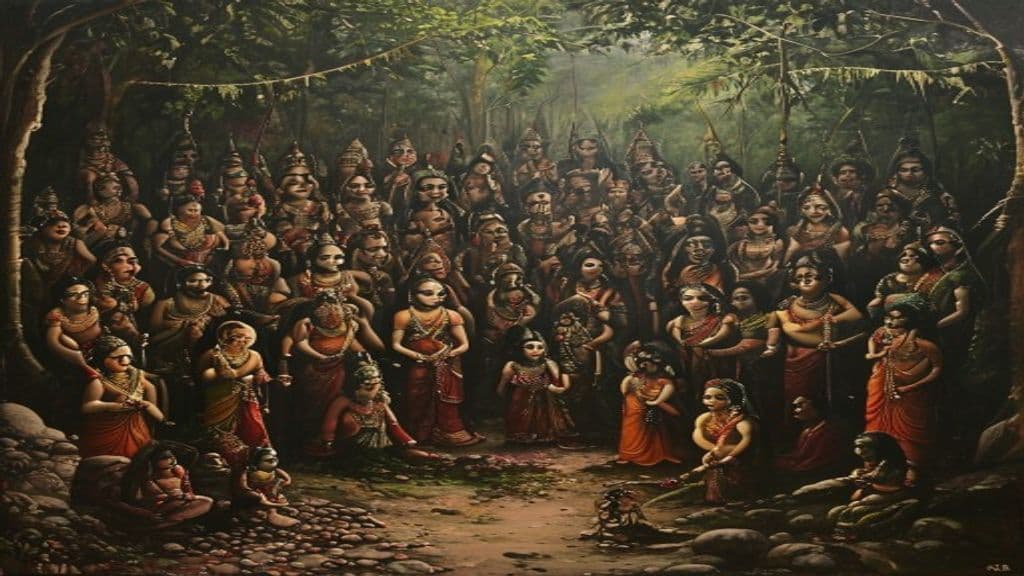
Scholars and tradition-keepers treat gramadevatas as deeply rooted localized forms of divine guardianship rather than as a single founder myth. The term derives from Sanskrit grāma (village) + devatā (deity) and denotes the deity regarded as synonymous with a locality and everything within it. Comparative and archaeological observations in the literature note continuities of localized earth- and mother-goddess cults (for example parallels drawn to prehistoric fertility figurines and later sapta-matrika motifs), and suggest that gramadevata worship represents a long-standing strand of local, non-scriptural devotion that has been integrated in many places with pan-Indian gods; these suggestions are presented as scholarly interpretation of parallels rather than proof of an unbroken institutional identity.
Representations of gramadevatas vary widely by region and by local tradition. In many South Indian contexts gramadevatas are predominantly female and are depicted as mother- or disease/fertility-goddesses; iconography can range from simple aniconic boundary markers (piles of stones, flags) or small open-air shrines to sculptural images and full temple icons (for instance multi-armed Durga forms in particular temples). Common associated imagery includes mother-goddess motifs and clusters such as the sapta-matrika; other forms can be fierce in aspect. Some gramadevatas are represented without elaborate imagery while others possess formal temple icons and attendants, reflecting local variation and syncretism with major deities.
Within their cultural contexts gramadevatas are believed to function as guardians of fields, village boundaries and the social unit of the village. When propitiated they are regarded as preventing or averting misfortunes such as epidemics, famines, pestilence, banditry and other calamities; conversely, if neglected or angered they are thought capable of causing illness, misfortune or communal disorder. Many traditions emphasize a dual temperament—benevolent to diligent supplicants and fierce toward wrongdoers—and some local deities are woven into wider divine kinships or identified with Puranic gods, indicating flexible agency within regional mythic systems.
Weaknesses
- ritualMaintained propitiation and shrine upkeep
- ritualOfferings including animal sacrifice where locally customary
Wards
- ritualRegular village-level propitiation (tending the shrine, offerings, community sevas)
- ritualSeasonal and annual festivals (local rathotsava, Navaratri homas, harvest rites)
- ritualHousehold acknowledgement of local devata in domestic worship (pooja)
- conditionRitual placement and acknowledgement of boundary shrines
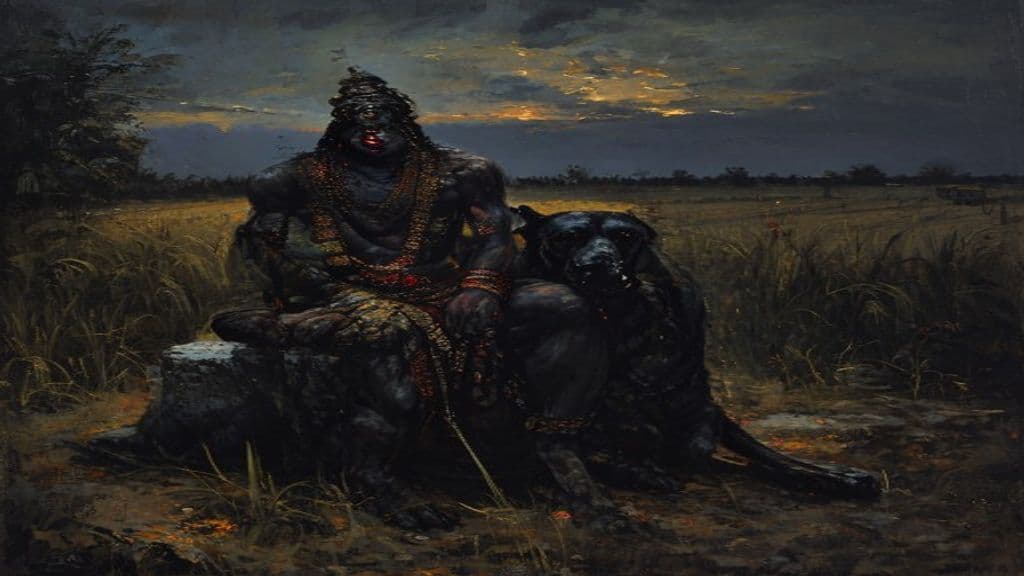
Goshtasp (Vishtaspa)
A legendary/semi-legendary Iranian king who, in Zoroastrian tradition, is presented as the royal patron and early follower of the prophet Zoroaster (Avestan: Vishtaspa), and who in Ferdowsi's Shahnameh appears as a Kayanian monarch and the father of the epic hero Esfandiyār.
Gostaham
Gostaham is a personal name applied to multiple heroic figures in the Persian epic tradition of the Shahnameh. Two principal bearers appear in different episodes: Gostaham son of Nowzar (installed as a local ruler in Turan and among heroes who disappear/die in snow during Kay Khosrow's ascent) and Gostaham son of Gazhdaham (a martial companion of Bizhan active in the Davazdah Rokh combats and, in one tradition, castellan of the border fortress Dez-e Sepid).
Gotama Buddha (Siddhartha Gautama)
Siddhartha Gautama, commonly called Gotama or the Buddha, is presented in these sources as a historical religious teacher from the Sakya clan who attained full awakening (nirvana) and founded the Buddhist sangha; he is treated both as a human exemplar shaped by historical circumstances and, in devotional accounts, as the fully awakened Buddha situated among a sequence of past buddhas.
Goudarz
Goudarz (Persian: گودرز) is a heroic figure from the Iranian national epic tradition, primarily the Shahnameh. Presented as a veteran warrior, counselor, and progenitor of a notable family, he appears across the epic's heroic age as a military leader and elder statesman who participates in key episodes such as the retrieval of Kay Khosrow and the Davazdah Rokh.
Grafton Monster
A modern local cryptid from Grafton, Taylor County, West Virginia, first publicized after a cluster of roadside sightings in June 1964. Commonly described in secondary sources as a very tall (7–9 ft), pale, smooth-skinned, apparently headless biped that produced an unusual sound and became a local media sensation and later tourist/entertainment motif.
Grahana
In Hindu tradition, a Grahana refers to an eclipse, a celestial event of significant importance in Hindu cosmology. (Note: 1. Summary: While accurate, it could be more concise and clear. 2. Power tier: Primordial (as a celestial phenomenon with significant importance in Hindu cosmology) 3. Abilities: Note the absence of s)
Grani
Grani is the named horse of the hero Sigurðr (Sigurd) in the Old Norse Völsunga saga. Presented as descended from Odin's steed Sleipnir, Grani is an exceptional, singular heroic mount attested in the saga narrative and in later Norse iconography and kennings.
Granmar
Granmar is a legendary-historical king of Södermanland in Old Norse literary tradition. He appears in Snorri Sturluson's Heimskringla and in Eddaic and saga material (notably the Helgi Hundingsbane poems and the Volsunga saga) as a political actor whose marriage alliances, feasting, and military resistance intersect with wider heroic cycles; in Heimskringla he is ultimately burned to death in a treacherous hall-burning arranged by King Ingjald.
Granny Weatherwax
Esmerelda "Esme" Weatherwax, commonly called Granny Weatherwax or Mistress Weatherwax, is a human witch and the leading figure among the Ramtops witches in Terry Pratchett's Discworld novels. She is a practicing herbalist and folk-psychologist ('headology') who serves as a pragmatic guardian of the Kingdom of Lancre and its people.
Grant
The Grant (also attested as Gyant) is a creature attested in Gervase of Tilbury's Otia Imperialia (medieval Latin) described as a kind of demon resembling a yearling colt that runs through towns as a warning of fire. Later commentators have debated its identification, comparing it to horse-like bogies or suggesting it may reflect a hare omen, but the sole medieval description is equid-like and portentous.
Grass snake (Natrix natrix)
A Eurasian semi‑aquatic, non‑venomous colubrid snake (primarily Natrix natrix and closely related taxa) commonly found near water, compost heaps and field edges. Treated in the provided sources as a biological species with well‑documented natural history rather than a mythic or supernatural being.
Gration
Gration (Greek: Γρατίων) is attested in modern reference databases as a named member of the Giants (Gigantes) of Greek mythology. The supplied sources give only a brief indexical identification and no ancient narrative, description, or ritual material for this figure.
Community Record
- [1]Gramadevata — Wikipedia. Wikipedia entry 'Gramadevata' (summarizes nature, roles, offerings, and regional variation).wiki
- [2]Gramadevata (Wikidata). Wikidata item summarizing the presiding/guardian deity of a Hindu village, town or city.other
- [3]Sri Durgaparameshwari Temple, Mundkur (archive). Temple guide and archived materials describing local temple rites (homas, maha poojas, aarti, offerings) and festival practices.folk
- [4]Taak - The Silvery Divine Effigy (archive). Regional study noting categories of devata and local practices including Kshetrapalaka/Kalabhairava associations in Maharashtra.other
- [5]Honoring the Spirit Of Community — Hinduism Today. Discussion of the gramadevata as the Deity regarded as synonymous with the locality and everything within it; commentary on community identity and local cults.folk