
The provided sources do not supply a full origin myth for the Grey wolf. Source material identifies the Grey wolf (Old Turkic: Böri; Turkish variants such as Bozkurt, Gökbörü; Mongolian: Börteçine) as a sacred animal and national symbol within Turkic, Mongolian, and Altaic mythology, indicating an important cultural role, but the excerpts do not give a narrated ethnogenetic or cosmogonic origin tale for the animal.
As a zoological species (Canis lupus) the wolf is described as the largest extant wild member of Canidae, with fur usually mottled white, brown, grey, and black, and arctic subspecies that may be nearly all white. Compared with some other Canis species it has less pointed ears and muzzle, a shorter torso, and a longer tail. The mythological sources in the provided excerpts describe the wolf as sacred or as a prominent mythic figure but do not supply standardized supernatural morphological attributes for Turkic/Mongolian sacred wolves.
The cited biological sources describe natural predator traits and life-history concerns relevant to conservation (survival, reproduction, vulnerability to poaching). Mythological sources characterize the Grey wolf as a sacred and symbolically powerful animal in Turkic/Mongolian/Altaic contexts; they do not ascribe specific supernatural powers in the provided excerpts. Separate Norse mythic material references powerful mythic wolves (e.g., Fenrir) who threaten cosmic order and must be bound, but those are literary mythic figures distinct from the zoological species in the provided corpus.
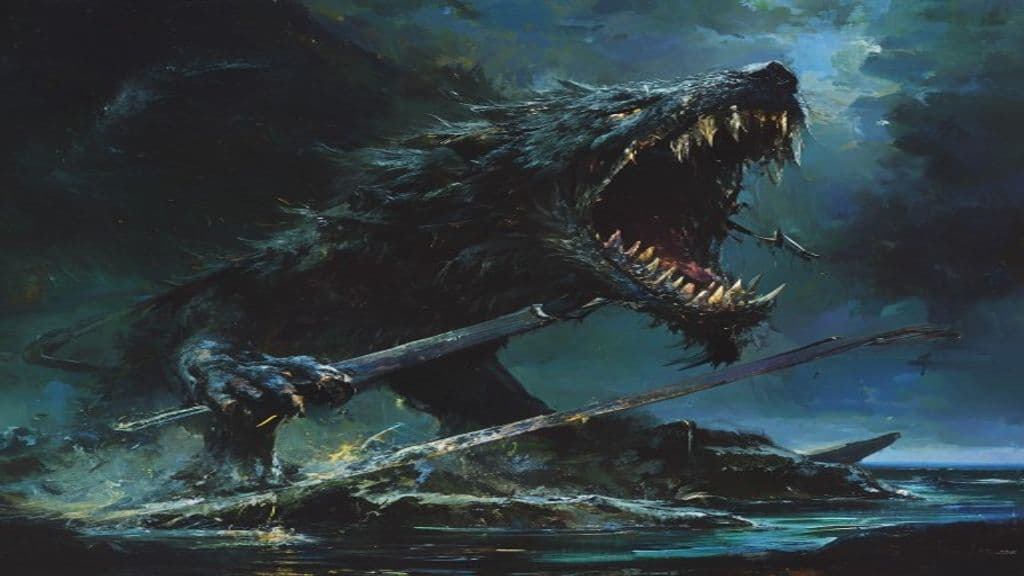
Fenrir
The monstrous wolf son of Loki, bound by the gods with a magical ribbon until Ragnarök — when he will break free and swallow Odin, and the world.
Fenrir
The monstrous wolf son of Loki, bound by the gods with a magical ribbon until Ragnarök — when he will break free and swallow Odin, and the world.
Alaz
Alaz is the Turkic god of fire associated with hearths, flame, and the Great Fire (Ulugh Od). He is described as a powerful fire-being who sends protector-spirits (İye) to household hearths and can cause destructive fires when angered; fire under his authority is also a purifying force.
Archura
Archura (Arçura) is a Turkic woodland chura — a shapeshifting forest spirit associated with particular woodland tracts and wild animals. Traditions portray Archura as a protector of wildlife and a trickster-like figure that can be dangerous to humans.
Burkut
Burkut (also Bürküt, Merküt) is a sacred eagle figure in Turkic mythic cosmology associated with the sun, rulership, and protective authority. Treated as an emblematic or quasi-divine bird rather than a mundane animal, it appears in shamanic rites, world-tree iconography, folk performance, and modern heraldic motifs.
Erkliğ Han
Erkliğ Han is a Turkic–Altai celestial lord associated with space, stars, meteorites (falling stars), and the planet Venus. Traditionally titled a Han (ruler), he is described in source material as responsible for visible stellar phenomena, linked in some lists with virility and read as a martial symbol by analogy to his action at sunrise.
Erlik
Erlik (Erlig, Erlik Khan; Mongolian Erleg/Yerleg) is the chthonic ruler of the underworld in Turkic and related steppe mythologies, associated with death, disease, and malignant spirit-agents. He functions as judge and lord of the lowest realm (Tamag), opposes upper-world figures like Ülgen, and demands sacrifices to avert his taking of souls.
Etügen Eke
Etügen Eke (also Etügen, Itügen, Etügen Ekhe) is an earth-mother goddess in Turkic and Mongolic Tengrism traditions, personifying the earth, fertility, homeland and natural forces. She is described in the sources as occupying a high place in the cosmic order, subordinate only to Kök‑Tengri, and is propitiated with seasonal sacrifices tied to pastoral and agricultural cycles.
Ev İyesi
Ev İyesi is a Turkic household spirit (İye) that functions as the unseen guardian and possessor of a house. It maintains domestic order, may assist with chores, and is placated by offerings and good household upkeep; it becomes hostile only when offended by neglect or profanity.
Kayra
Kayra (also Kaira; Old Turkic: 𐰴𐰖𐰺𐰀) is the supreme creator-being in Turkic mythic cosmology. Presented as the originative power who orders the world, plants the tree of life (Ulukayın), and directs fate from the seventeenth heaven, Kayra appears in some accounts as a non-human, liminal creator and a parent of other divine figures.
Komur Han
Komur Han is a named underworld functionary in Turkic myth, listed among the nine sons or subordinate 'hans' of Erlik. He is associated symbolically with coal/charcoal and darkness and is described in popular summaries as commanding evil entities and mediating between Erlik and 'dark shamans.'
Kormos
Kormos (also Kormoz; Tuvan: кормос; Turkish: Körmöz/Körmös) is a Turkic category of spirit-entities encompassing a range of post-mortem conditions — ancestral or beneficent sky-spirits, wandering suffering souls on earth, and demonic underworld spirits — variously described as helpful, harmful, or ambivalent depending on subtype and allegiance.
Kubai (Kübey)
Kubai (Turkish: Kübey) is a maternal birth and child-protecting figure in Turkic mythology. Traditionally described as a daughter of Kayra who lives in the Ulukayın (world tree) and draws life-water (Bengisu), she bestows souls, gives healing milk to newborns, eases birth pains, and guards infants until key developmental milestones.
Kyzaghan
Kyzaghan (Kızagan, Kyzaghan Han) is a Turkic war deity associated with martial success and protection of warriors. Described as a son of Kayra/Kara Han and a brother of Ulgan, he is placed high in the sky-cosmos (explicitly on the ninth floor of the sky in one source) and is semantically linked to the color red and the notion of anger or fierceness.
Community Record
- [1]Grey wolf (Wikipedia: species summary). "The wolf, also known as the grey wolf or gray wolf, is a canine native to Eurasia and North America."; "The wolf's fur is usually mottled white, brown, grey, and black, although subspecies in the arctic region may be nearly all white."wiki
- [2]Grey wolf (mythology) (Wikipedia excerpt). "The Grey wolf or Graywolf (Old Turkic: Böri) is a sacred animal and national symbol in Turkic, Mongolian, and Altaic mythology."; "Bozkurt (Boskord, Pusgurt, Gökkurt, Gökbörü, Kökbörü)."; "In Mongolian it is called Börteçine (Börteşına)"wiki
- [3]Evaluating how lethal management affects poaching of Mexican wolves (archive). Modern conservation and management contexts (Mexican grey wolves) discussed in the provided archive material indicate contemporary human–wolf conflict and governance concerns.other
- [4]The Elder and Younger Eddas (Project Gutenberg) / Norse myth references. Fragmentary references to binding the wolf (Fenrir) and Tyr in Norse myth appear in the provided Norse material excerpts (e.g., "BINDING THE WOLF FENIR").literary