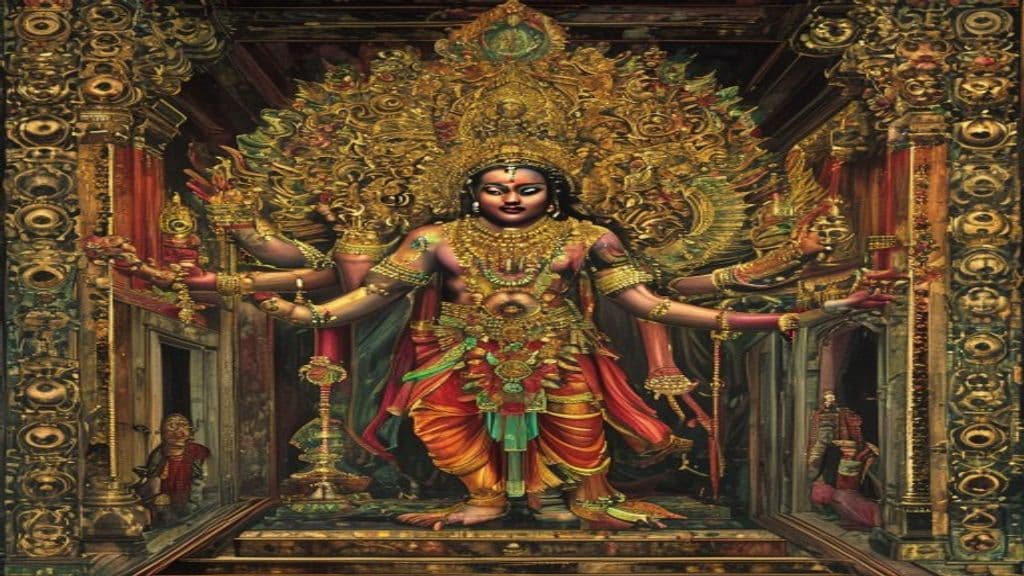
No single pan-traditional creation myth is attested in the provided sources. Instead the Dikpāla/Lokapāla concept functions as an institutionalized set of guardian offices: deities or divine figures assigned to rule and protect particular spatial sectors (cardinal, intercardinal, zenith, nadir, and center). The grouping and membership vary regionally—classical Sanskrit formulations record Aṣṭa‑Dikpāla (eight guardians), Daśa‑Dikpāla (ten with zenith and nadir), and Nava‑Dikpāla/Nava‑Dikpala forms appear in ancient Java and Bali; Meitei tradition records a ten-guardian configuration—indicating adaptation rather than a single origin myth (Sources 1, 6).
The guardians are commonly depicted in temple iconography—paintings, sculptures, and reliefs placed on walls, ceilings, entrances, and altar corners. Specific iconographic details vary by tradition and local practice. For example, in the Buddhist Heavenly King corpus Virudhaka, guardian of the south, is described as having a blue face, wearing armor and holding a sword; fearsome bulging eyes and demonic attendants are noted as part of his protective imagery. Javanese and Balinese nine-direction sets (Dewata Nawa Sanga) and other regional variants are represented in local emblems and temple art, though precise iconographic lists are not provided in the supplied sources (Sources 1, 5).
Across the cited traditions the Dikpāla/Lokapāla function as rulers or guardians of specified directions and as protectors of sacred spaces and of the dharma. Their primary role in temple and altar placement is to watch over cardinal and other directions and to protect against malevolent forces; Buddhist Heavenly Kings are explicitly placed at entrances or altar corners to protect against evil spirits. The sources do not attribute additional specific powers or behaviors beyond this protective and territorial guardianship (Sources 1, 5).
Weaknesses
None recorded.
Wards
- otherIconographic placement in temple architecture

Will-o'-the-Wisp
A wandering light seen over marshy ground at night, leading travellers astray into bogs and fens. Possibly a spirit, possibly the soul of the unbaptised dead, possibly the devil himself.

Naga
Divine serpent beings of Hindu, Buddhist, and Jain cosmology — powerful guardians of water, earth, and underground treasures. Revered as deities in South and Southeast Asia.
Abhinandananātha
Abhinandananātha is the fourth Tīrthaṅkara (ford-maker) of the current Jain cosmic age (avasarpini). Traditional accounts place his birth in Ayodhyā to the Ikshvāku (Solar) dynasty, describe his renunciation and attainment of omniscience beneath a priyangu tree, and record his liberation on Mount Śikharjī.
Adi (asura)
Adi is attested in modern reference works as the name of an Asura who 'appears in the Matsya Purāṇa.' Beyond this single-line citation in secondary sources, no descriptive material about the figure is provided in the supplied research notes.
Adi Shakti
Adi Shakti (also Adi Parashakti, Mahadevi, Adya Shakti) is the primordial feminine power in Hindu/Shakta theology, regarded as the ultimate reality (Para Brahman) and the source from which all goddesses and gods manifest. She is both an impersonal cosmic principle (Mulaprakriti) and a focus of devotional invocation in temples, mantras, and pilgrimage sites such as Shakti Peethas.
Adi Vinayaka
Adi Vinayaka (Ādi Vināyaka; also called Nara Mukha Vinayaka) is a named iconographic and devotional form of the Hindu god Ganesha portraying the deity with a human head, described in sources as the form before the episode of decapitation by Shiva. It is rarely worshipped and appears in a small number of South Indian shrines and in devotional/musical repertoires.
Aditi
Aditi is a major Vedic goddess in Hindu tradition who personifies the boundless, infinite cosmic principle and functions as the maternal matrix from which many celestial deities (the Ādityas and other groups) are born. In the Vedic hymns she is invoked as a protective liberator who guards petitioners, provides wealth and safety, and frees devotees from hindrances such as sin and sickness.
Agni
Agni is the Vedic personification of fire in Hindu tradition: a sacred, mediating principle that manifests as terrestrial fire, atmospheric lightning, and celestial sun, and that receives and conveys sacrificial offerings. Prominent in the Rigvedic corpus, Agni functions as sanctifier, witness of rites of passage, and a transformational inner principle in later Upanishadic literature.
Ahalya
Ahalya is a mytho-legendary woman of South Asian (primarily Hindu) narrative tradition, described as created by the god Brahma, married to the sage Gautama, seduced (or tricked) by Indra, cursed by her husband, and ultimately redeemed by Rama. Her tale is a locus for themes of creation, desire, curse/penance, and redemption and she is counted among the ritual-mnemonic panchakanya.
Aindri (Indrani / Shachi / Paulomi)
Aindri (commonly rendered in sources as Indrani, also called Shachi or Paulomi) is a Hindu goddess presented as the queen-consort of Indra. She is depicted in the available material as a courtly queen associated with beauty, pride and kindness who also appears in at least one account as an active martial participant in the devas' battles with asuras.
Ajitanātha
Ajitanātha is the second tirthankara of the current cosmic age in Jainism: an enlightened spiritual teacher who renounced worldly life, attained omniscience (kevalajñāna), and achieved liberation (moksha), and who is credited with establishing a large four-part monastic order in the tradition's hagiography.
Akshayavata
In Hindu mythology, Akshayavata is a sacred banyan tree and/or lake that symbolizes eternal life. It is mentioned in both Hindu and Jain traditions and associated with the Puranas. (Note: - The power tier should be "Greater" or at least "Ancient", as it is associated with the Puranas, which are considered ancient texts. - No specific physical description is provided, but that doesn't m)
Alakshmi
Alakshmi is an inauspicious female supernatural figure in Hindu tradition, presented as the negation or shadow-counterpart of the prosperity-goddess Lakshmi. She personifies poverty, grief, jealousy and social discord and is managed in domestic ritual and festival practice.
Alamelu
Alamelu (also Alamelu Manga / Alarmel Mangai) is a South Indian devotional name for the goddess Padmavati, identified in sources as an avatar of Lakshmi and the consort of Venkateswara; the name is also used widely as a female personal name and in titles of cultural works in Tamil and Telugu contexts.
Community Record
- [1]Guardians of the directions (Wikipedia). Wikipedia, 'Guardians of the directions'wiki
- [2]Wikidata: Guardians of the directions (Q1398903). Wikidata Q1398903other
- [3]Heavenly King Virudhaka (Cleveland Museum catalog entry). Cleveland Museum / archive entry describing Heavenly King Virudhakaother
- [4]Meitei guardians of the directions (Wikipedia). Wikipedia, 'Meitei guardians of the directions'wiki