Sources present multiple, partly distinct traditions attached to the name. In Greek Lapith tradition Halaesus (Greek Ἅλαισος) is counted among the Emathian Lapiths who attended the wedding of Pirithous and Hippodamia and was killed and stripped of his armor by the Centaur Latreus (attested in summaries of the Centauromachy). In Trojan-cycle and Italian foundation traditions he is named as a companion of Agamemnon during the Trojan War—some accounts even call him an illegitimate son of Agamemnon—who escaped the massacre of Agamemnon's retinue orchestrated by Clytaemnestra and Aegisthus, then sailed to Italy and was credited with founding the city called Falerii (identified in later antiquity with Civita Castellana). In Roman epic reception (notably in the Aeneid tradition as glossed by Servius) he appears fighting for Turnus against Aeneas and meets his death at the hands of Pallas while defending a comrade named Imaon.
The provided sources give no physical description or iconographic attributes for Halaesus. Surviving references focus on his actions, affiliations, genealogy, and fate rather than on appearance; no ancient representations or detailed descriptions are attested in the cited material.
Halaesus is presented solely in martial and genealogical roles: as a warrior of the Lapiths, a combatant in the Trojan-cycle milieu, and an eponymous founder of a city in Italy. No supernatural powers, cultic functions, or magical abilities are attributed to him in the supplied sources; he functions as a mortal heroic figure whose deeds serve etiological and narrative purposes.
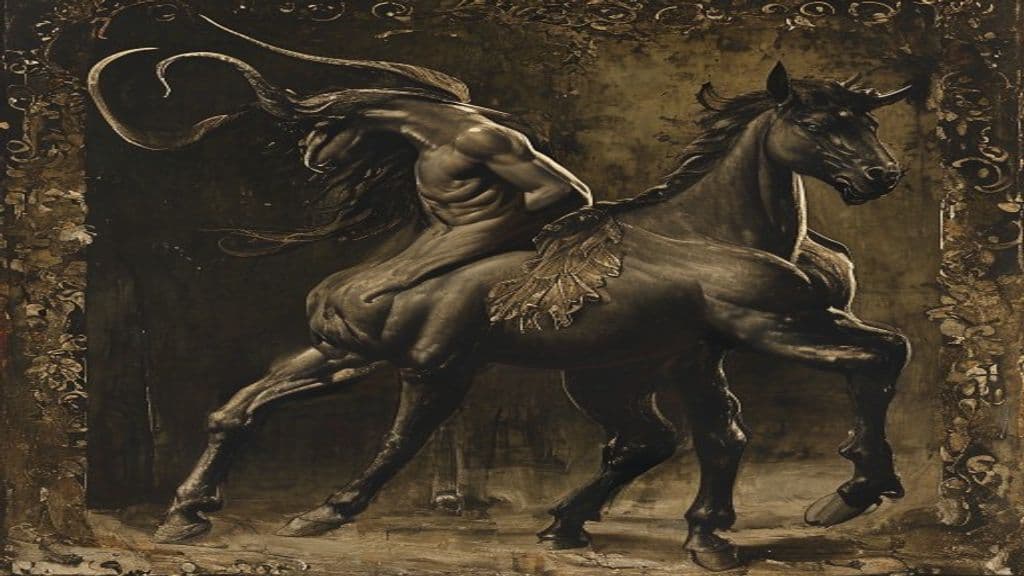
Centaur
A mythic hybrid from ancient Greek tradition with the upper body of a human and the lower body and legs of a horse. Centaurs appear as a tribal population associated with mountainous and wooded regions of Greece and embody tensions between human social order and untamed nature.

Agamemnon
Agamemnon is the legendary king of Mycenae (or Argos), head of the House of Atreus, and commander of the Achaean forces at Troy in Greek epic and tragedy. His story links dynastic guilt, ritual obligation, and political authority, culminating in the sacrifice-at-Aulis episode and his murder on return from Troy followed by juridical atonement in the Oresteia.

Pallas
Pallas is a name applied to multiple distinct figures in Greek myth (several mortal, semi-divine, and Titan personages) and functions as an epithet of the goddess Athena; in later usage the name is also applied to non-mythic objects such as the asteroid 2 Pallas and a genus name in biology. The sources do not treat Pallas as a single unified supernatural species but as a polyvalent label across genealogies and later nomenclature.

Turnus
Turnus is the legendary mortal King of the Rutuli and chief martial antagonist to Aeneas in Roman epic tradition (most prominently Virgil's Aeneid). Presented as a brave, hot‑headed warrior and suitor of Lavinia, his resistance to the Trojan settlement and eventual slaying by Aeneas form a key episode in Rome's mythic origins.

Latreus
Latreus is a named Thessalian centaur warrior who appears in accounts of the Centauromachy; he kills the Emathian Halesus, fights the Lapith Caeneus, and is slain in the wedding-battle recounted in Ovid's Metamorphoses and related retellings.
Community Record
- [1]Halaesus — Wikipedia. Wikipedia contributors, 'Halaesus', Wikipedia, The Free Encyclopediawiki
- [2]Halaesus (Wikidata entry Q3609647). Wikidata entry Q3609647, statements summarizing traditionswiki
- [3]Mélanges de philosophie, de littérature et d'histoire ancienne offerts à Pierre Boyancé (bibliographic record). Mélanges… (bibliographic listing; contains an article titled fragmentarily 'Halaesus ou Messapus'), Archive.org recordother
- [4]Servius' commentary on Virgil (as cited in secondary summaries). Servius ad Aen. (commentary referencing Halesus' motive for joining Turnus and noting death by Pallas) — cited in modern summaries such as the Wikipedia entryliterary
- [5]Classical summaries of the Centauromachy (Lapiths and Centaurs). Ancient mythographic summaries and scholiastic notes that list Halaesus/Halesus among the Emathian Lapiths killed by the Centaur Latreus — reported in modern reference entriesliterary