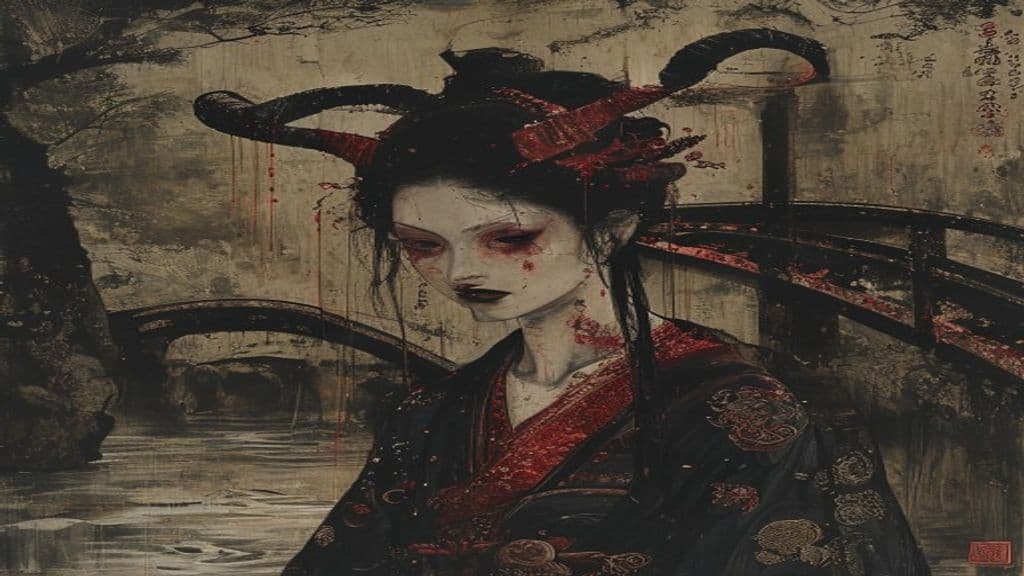
In early court poetry (e.g., Kokin Wakashū) Hashihime appears as the poetic figure "the Maiden of Uji Bridge," embodying loneliness and waiting. In later medieval narratives derived from expanded Heike-cycle materials and related texts the name is attached to a story in which a jealous woman, instructed by Kifune Shrine, undertakes a ritual retreat and immersion in the Uji rapids (a sequence variously dated in the texts) to become a demon who avenges perceived betrayal; these expanded variants connect the poetic epithet, local ideas of bridge guardian presences, and a ritualized human-to-demon metamorphosis that is dramatized in Noh (Kanawa) and other retellings. The manuscript traditions present chronological and geographic shifts (e.g., Uji Bridge origin versus an ambush at Ichijō Modoribashi) rather than a single linear origin.
Descriptions vary by source. In early waka Hashihime is an implied lonely woman waiting on a bridge with no fixed physical detail. In the Heike-derived transformation narrative she adopts a horrific guise: she ties her hair into five horn-like shapes, paints her body red with cinnabar and red lead, dons an inverted iron tripod (kanawa) on her head with torches affixed to its legs, and is described as carrying a torch in her mouth; in a later encounter she first appears as a beautiful woman to lure a warrior and then reveals a demonic form — a severed arm from that encounter is later described as having darkened and grown coarse white hair.
Across sources Hashihime's agency ranges from passive poetic emblem to an active, violent kijo. The Heike-derived accounts record a ritualized transformation that yields a being able to kill and terrorize many people in the capital, to change appearance for luring victims (the expanded variant says she "changes her form as needed" for predatory ends), and to assault warriors (attempting to abduct Watanabe no Tsuna and fly him to Mount Atago). The narrative also recounts effects on bystanders (onlookers in one account die of fright) and leaves a tangible remnant (a demonic severed arm) that requires ritual sealing.
Weaknesses
- ritualSealing by onmyōji (Abe no Seimei-style containment)
- ritualPurification rites (seven-day purification for the afflicted)
- otherMartial countermeasure (sword attack: narrative sword Higekiri/Onikiri used by Watanabe no Tsuna)
Wards
- ritualSummon onmyōji to seal malignant remnants
- conditionPropitiation / enshrinement of bridge guardian deity
- behavioralAvoid offending speech at a bridge
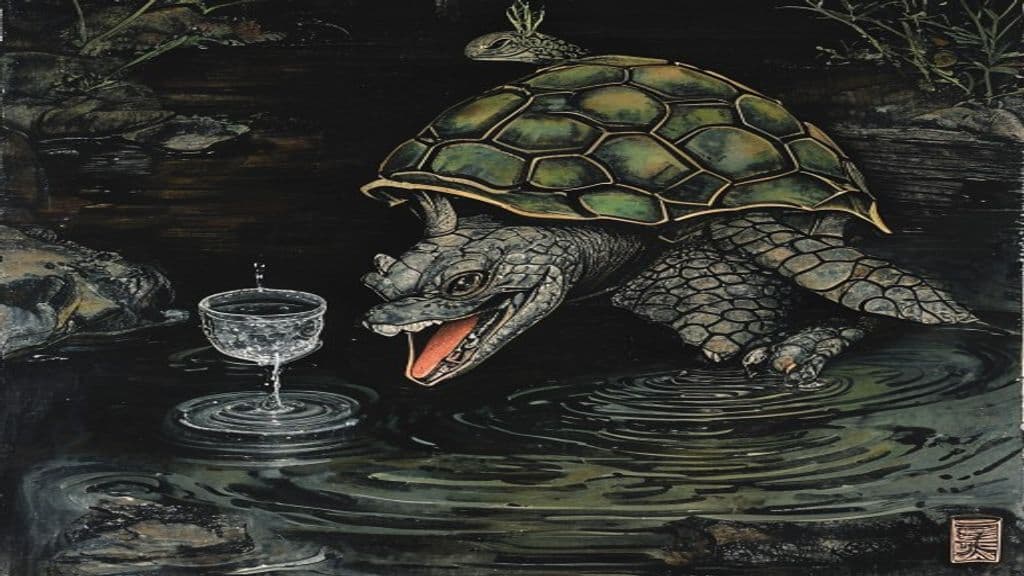
Kappa
A water-dwelling imp of Japanese folklore with a bowl of water on its head. Mischievous but bound by strict codes of politeness; dangerous near rivers.

Banshee
A female spirit of Irish and Scottish folklore whose wail heralds an impending death in a family of Gaelic descent. Not a cause of death — a witness to it.
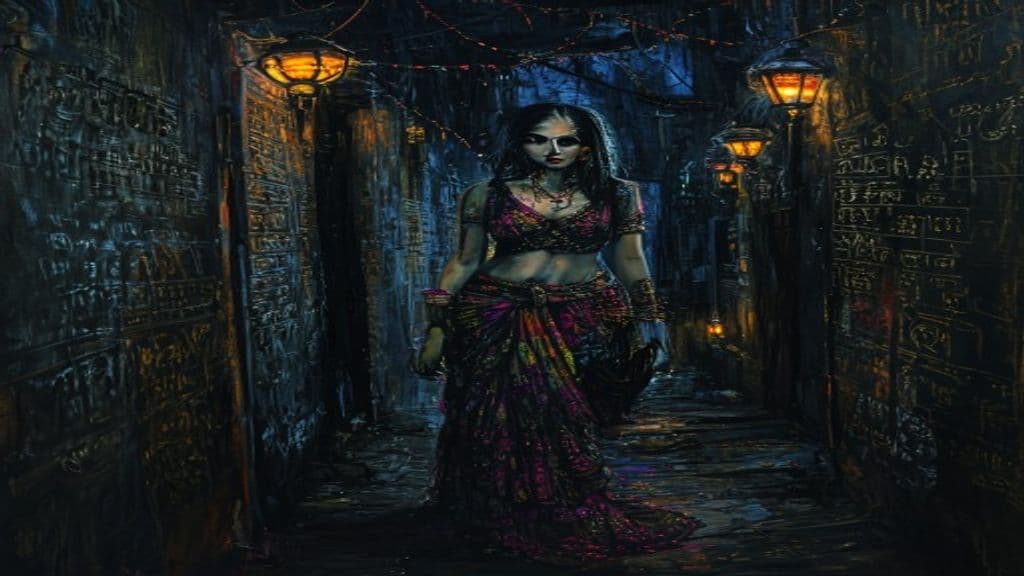
Stree
A vengeful female spirit from Chanderi who abducts men during festival nights. Warded off by the inscription 'O Stree, kal aana' — her legend, still practised on walls across Madhya Pradesh, inspired the 2018 Bollywood horror-comedy.
Harpies
Harpies are winged, half-human/half-bird beings from Greek (and later Roman-identified) myth, commonly portrayed as swift personifications of storm winds and as agents of theft or vengeance in epic and heroic narratives.
Harpina
Harpina is a local Naiad-nymph of the Eleian/Pisatis tradition tied to a spring or stream near Pisa in Elis. In genealogical myth she is daughter of the river-god Asopus (and Metope) and mother, by Ares, of King Oenomaus; her name is given to a nearby town (Harpina/Harpinna) and the stream Harpinates. She is attested in literary topography and as a figure in a Phliasians' sculptural dedication at Olympia.
Harpocrates (Horus the Child)
Harpocrates is the Hellenistic form of the Egyptian Har-pa-khered (Heru-pa-khered), the infant aspect of Horus representing the newborn sun; in Ptolemaic Alexandria he was adapted into a minor god associated with silence, secrets, confidentiality, and the protection of reputations.
Harpy
In Greek and Roman myth, a harpy is a hybrid bird-human creature and personification of storm-winds that acts as an agent of divine punishment — snatching food, fouling victuals, and carrying off or tormenting wrongdoers, sometimes delivering them to chthonic justice.
Harsomtus
Harsomtus (also Harsomptus, Somtus) is an ancient Egyptian child-deity associated with fertility, birth and the solar-primordial creative principle. Worshiped in local temple contexts (notably Dendera and Edfu) and venerated in mammisi (birth-houses), he functions as a youthful or infant form of the Horus/Ra divine line and is integrated into regional triads and family-group theology.
Harut and Marut
A pair of figures named in the Qur'an (Surah 2:102) and elaborated in classical Islamic exegesis as heavenly beings associated with Babylon and the transmission of sorcery; their status (angels, kings, or men) and culpability are debated across commentaries. They function etiologically to explain the origin of illicit magic and as exemplars of divine testing or temptation.
Hashmal
In the supplied Jewish textual materials, Hashmal (Hebrew חַשְׁמַל; pl. Hashmallim) appears both as a luminous element in Ezekiel's prophetic theophany and as the name of an angelic rank in later Jewish angelology, described in secondary sources as administrative officers of Heaven.
Hasshaku-sama
Hasshaku-sama (八尺様) is a contemporary Japanese urban-legend figure depicted as a very tall, pale womanlike spirit associated with isolated rural zones; circulating since the late 2000s in internet folklore, she is said to target children and young people and is warded in stories by sealed rooms, talismans, salt, and boundary Jizō statues.
Hat Man
A modern popular-paranormal variant of the 'shadow person' phenomenon: described in sources as a humanoid, shadow-like figure discussed in paranormal communities and occasionally linked in contemporary notes to drug- or sleep-related experiences.
Hata no Kawakatsu
Hata no Kawakatsu (秦河勝 / Hada no Kōkatsu) is a semi-legendary Asuka-period courtier and leader of the Hata clan attested in classical chronicles. In the Nihon Shoki he appears as a high-ranking official who received a Buddha image from Prince Shōtoku, founded Hachioka-dera (Kōryū-ji), escorted foreign envoys, and suppressed the popular cult of Tokoyo-no-Kami. Later medieval traditions expand his biography with legendary accretions (e.g., claimed descent or identification with Qin imperial lineage, enshrinement as Ōsake Daimyōjin, and association with performing-arts ancestry).
Hathor
Hathor (Ancient Egyptian ḥwt-ḥr, 'House of Horus') is a major polyvalent goddess of ancient Egypt associated with the sky, maternal and royal motherhood, music, joy, fertility, and the Eye of Ra; she appears in multiple local manifestations and assisted the deceased into the afterlife.
Hatif
Hatif (Arabic: هَاتِف, hātif) is an auditory phenomenon in Arabic and Bedouin traditions described as a voice heard without discovering the body that made it. Sources record multiple, sometimes conflicting explanations: an unseen communicator such as a jinn, the voice of the dead near graves, or a psychological hallucination arising from loneliness.
Community Record
- [1]Hashihime - Wikipedia. Wikipedia contributors, 'Hashihime,' Wikipedia, The Free Encyclopedia.wiki
- [2]JAANUS / Hashihime 橋姫. JAANUS entry 'Hashihime (橋姫)'academic
- [3]Hyakumonogatari Kaidankai: 'Hashihime – The Bridge Princess' (blog retelling and notes). Hyakumonogatari Kaidankai, 'Hashihime – The Bridge Princess.'folk
- [4]Hyakumonogatari Kaidankai: 'The Tale of the Hashihime of Uji' (retelling/summary). Hyakumonogatari Kaidankai, 'The Tale of the Hashihime of Uji.'folk
- [5]Hashihime of the Old Book Town (fan/modern page). Em Reed, 'Hashihime of the Old Book Town' (modern project page).other
- [6]Archive.org Miraheze hashihime wiki snapshot. Miraheze 'Hashihime of The Old Book Town' wiki (archival snapshot).other