The assembled sources do not provide a single unified origin story but record multiple culturally specific origins. In Greek myth the canine guardian of Hades is Cerberus, described as a multi-headed dog that guards the gates of the Underworld. Old Norse sources name Garmr (Garm) as a blood-stained dog associated with Hel and named in material about Ragnarök. Welsh tradition describes the Cŵn Annwn (literally 'hounds of Annwn' and sometimes Cŵn Mamau) as spectral hounds of the otherworld; secondary Christian reinterpretation led to these being called 'Hounds of Hell' though medieval Annwn is depicted in sources as an otherworldly realm rather than a Christian Hell. Regional tales add further origin elements: Catalan Dip is described as an emissary of the Devil; the Guanche Tibicenas appear as canine attendants of the volcanic deity Guayota; and various Latin American black‑dog figures (Perro Negro, Cadejo, Huay Chivo and similar) are cast locally as sorcerous familiars, devilish incarnations, or omens.
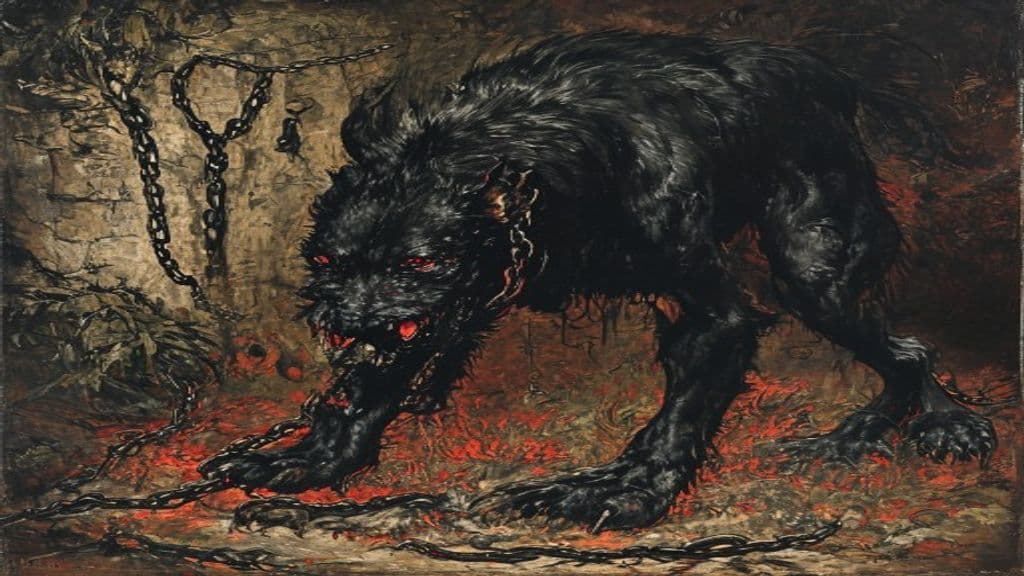
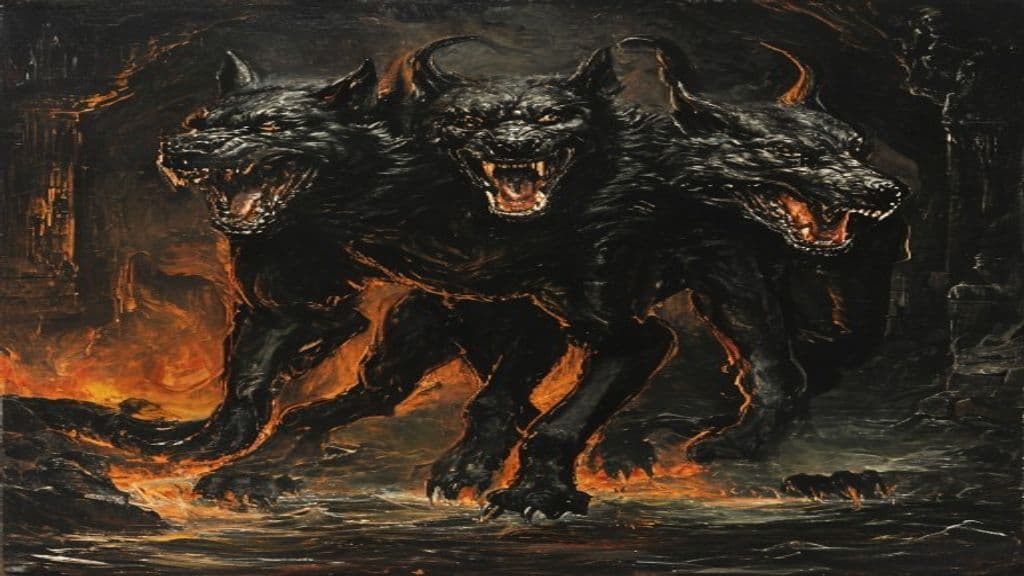
Across the surveyed traditions hellhounds are commonly portrayed as large, dark or black dogs, often anomalously large compared with normal canines. Specific features reported in sources include fiery or red eyes (Welsh gwyllgi, Flemish/Dutch 'Old Red Eyes'), chains or the dragging of chains (Walloon Tchén al tchinne, Normandy Rongeur d'Os), bone‑gnawing behavior (Rongeur d'Os), blood‑staining (Garmr), lameness of a limb in some demonized hounds (Catalan Dip), and in classical myth multi-headed or monstrous anatomy (Cerberus: three heads, serpent tail, snakes on his body). Not every tradition assigns every trait; the sources emphasize recurring motifs (black coloration, large size, red eyes, nocturnal aspect) rather than a single fixed morphology.
Traditional descriptions associate hellhounds with roles at the threshold of life and death: guarding underworld gates (Cerberus; an Albanian three‑headed dog who never sleeps and guards an underworld gate), escorting or hunting souls (Cŵn Annwn and other Wild Hunt traditions, Urco leading the Santa Compaña), and acting as omens of death (various black‑dog legends, e.g., Meriden, Connecticut). Some regional tales describe aggressive or vampiric behavior (Catalan Dip is said to suck blood). Folkloric summaries and reference works commonly describe them as unusually large and powerful and as more intelligent than normal dogs, but the sources show these attributes vary by tradition. Modern fictional sources (e.g., the Darkhold/Marvel appendix) attribute enhanced durability, speed, sharp teeth and mystical senses; those are modern fiction usages and are cited separately in the sources.
Weaknesses
- conditionavoidance (stay away from known times/places of appearance)
- conditionChristian authority/interpretation (sources note Christian communities recast some hounds as demonic; texts imply Christian rites might be used historically though no specific rite is cited)
Wards
- otheravoidance of liminal nights and places (implicit preventive measure documented in regional lore, e.g., not being outdoors on nights of the Cŵn Annwn)
- otherChristian liturgy or sanctuary (sources record Christian reinterpretation and church contexts in accounts, but do not record a specific folkloric warding ritual)
Abas
Abas (Ancient Greek: Ἄβας, gen.: Ἄβαντος) is not a single mythic being but a recurring personal name borne by multiple mortals and minor mythic figures in Greek epic and genealogical traditions — kings, founders, seers, warriors, attendants, a centaur, and a youth transformed by a goddess. The name is glossed in the sources as 'guileless' or 'good-hearted' and appears across Argive, Theban, Trojan, Euboean, and other local cycles.
Acheilus
Acheilus (also spelled Akheilos/Achilleus in some sources) is a minor figure of Greek myth described as a mortal son of Zeus who was transformed into a shark and thereafter called a 'shark-formed sea daimon.' Surviving summaries frame his story as a hubris metamorphosis: boasting about his beauty led a goddess to change him into a marine monster.
Achelois
Achelois (Ancient Greek: Ἀχελωίς, 'she who drives away pain') is an attributive name or epithet used in ancient Greek mythic contexts rather than a single, consistently characterized being. The term appears applied to several different figures — a surname of the Sirens, a general name for certain water-nymphs (Acheloides), and as the name of a daughter of Pierus — and functions within Greek naming practice as a descriptive label rather than a fixed ontological office.
Achilles (son of Zeus)
A minor figure in Greek myth named Akhilleus (Ancient Greek: Ἀχιλλεύς), presented in some traditions as a son of Zeus and the Lamia who was famed for irresistible beauty, won a beauty contest judged by Pan, and was transformed into ugliness by Aphrodite. This Akhilleus is distinct from the Homeric hero of the Trojan War.
Achiroe
Achiroe (variants Anchirrhoë, Anchinoë/Ankhinoe) is a minor Greek mythological figure: a Naiad associated with the river Nile, daughter of the river-god Nilus, who becomes the wife of the Egyptian king Belus and mother of mythic progenitors such as Aegyptus and Danaus (with some accounts also naming Cepheus and Phineus). She functions primarily as a genealogical link between river-divinity and royal lineages rather than as an active agent in surviving myths.
Acontes
Acontes (Ancient Greek: Ἀκόντην) is an Arcadian prince in Greek mythology, counted among the fifty sons of the impious King Lycaon. He appears in the Lycaon narrative as a participant in a sacrilegious meal prepared for Zeus (disguised as a peasant) and is destroyed by the god's lightning as punishment.
Actaea
Actaea is a named sea‑nymph in Greek mythic lists, identified in the provided sources as the personification or eponym of the seashore. She appears primarily in onomastic and catalogue contexts (lists of nymphs/Nereids) and has no surviving independent narrative or cultic rites attested in the cited material.
Acte (Akte)
Acte (Ancient Greek Akte, sometimes rendered Acme) is a divine personification in Greek myth: one of the Horae who embodies a particular hour of the day — specifically the hour of eating and pleasure, a designated afternoon work-hour — and functions chiefly as a temporal marker rather than an active mythic agent.
Adonia
The Adonia festival is a ritual mourning celebration for Adonis, the consort of Aphrodite in ancient Greek mythology. (Note: 1. The draft claims that the article is about a "ritual mourning celebration", but the source only mentions the festival as a mourning celebration. 2. Power tier should be Primordial or Ancient since )
Aega
Aega is attested in modern reference works as a mythological name from the Greek tradition; the string 'Aega' is used for more than one minor figure or entry in Greek mythic catalogs. Surviving provided sources give no coherent myth, iconography, or rituals tied to a single, identifiable deity or spirit named Aega.
Aegaeus
Aegaeus (Ancient Greek: Αἰγαῖος) appears in Greek myth as (1) a local river-god associated with the island called Scheria (traditionally associated with Corfu) and father of the nymphs Aigaiides and of Melite (who in some sources bore Heracles a son, Hyllus), and (2) as a toponymic surname/epithet of the sea-god Poseidon derived from the town of Aegae in Euboea.
Aegesta
Aegesta is an ancient place-name and eponym recorded in Greek and Roman sources as an alternate form of Segesta, an Elymian city in northwestern Sicily, and as a mythic personal name (Aegestus/Aegesta) tied to Trojan foundation legends rather than a supernatural being.
Community Record
- [1]Hellhound — Wikipedia. Wikipedia, Hellhoundwiki
- [2]Hellhound — Wikidata. Wikidata entry Q2280977other
- [3]Hellhound (Darkhold demon) — Marvel Appendix. Marvel Appendix, Hellhound (Darkhold demon)literary
- [4]Bell Witch documentary (archive). The Bell Witch of Tennessee | Documentary (Archive)other
- [5]Catalan Dip and other regional entries — compiled folkloric summaries. Wikipedia summary citing Catalan Dip, Tibicenas, Cadejo and related formswiki
- [6]Wild Hunt and Cŵn Annwn — Welsh material (summary). Wikipedia summary noting Cŵn Annwn, their calendrical nights, and Christian reinterpretationwiki
- [7]Regional folk mentions and examples (compiled notes). Compiled regional examples (Cerberus, Garmr, Dip, Tibicenas, Rongeur d'Os, Tchén al tchinne, Urco, Perro Negro/Cadejo)wiki
- [8]Hellhound cultural afterlife — music, records, fandom (examples). Hellhound Records (Wikipedia) and assorted archive references in source listother