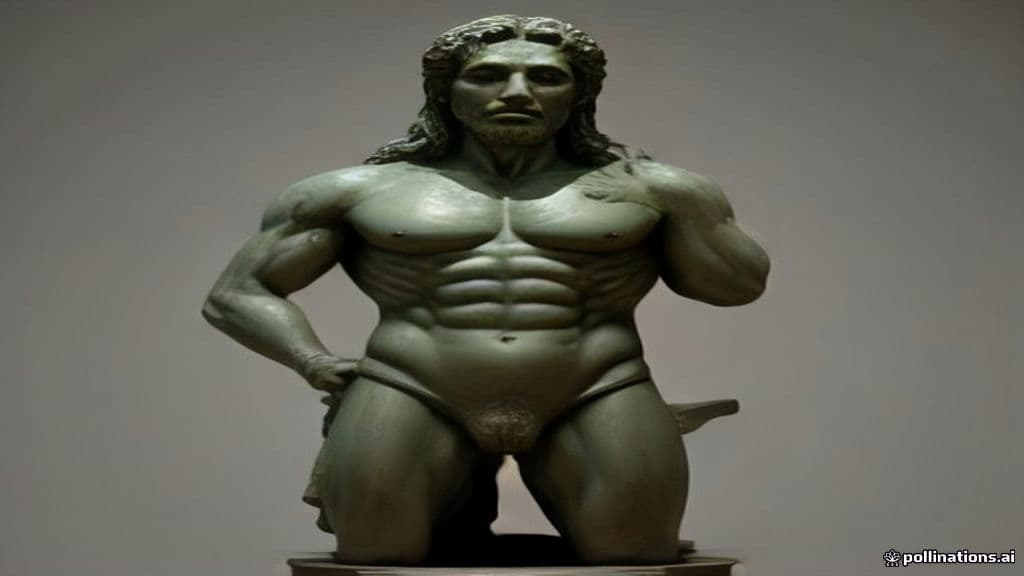
In Etruscan religious imagination Hercle is described as the exemplary mortal elevated to divine status by incorporation into the divine household of Tinia and Uni. Iconographic scenes—most famously the suckling motif in which Uni breast-feeds Hercle—represent his ritual adoption or apotheosis into the chief gods' family. While visually cognate with the Greek Heracles, Etruscan sources present Hercle as a locally-integrated culture-hero whose deeds justify divine elevation and whose figure served as an aspirational model for aristocratic identity.
Etruscan art consistently portrays Hercle as a muscular male hero often nude or partially nude, usually bearing the standard Heracles attributes of a club and a lionskin. He appears across mediums—bronze mirrors, small bronzes, and painted pottery—in varied scenes including intimate compositions with Menrva, presenting the child Epiur, and being crowned by a deity (Munthuch). Some Etruscan mirrors name or label him, linking iconography to cult identity.
Hercle functions in multiple overlapping roles in Etruscan religion: he is depicted as a liminal defender against creatures beyond human borders, a master of animals and protector of flocks, herds, and herdsmen, and is associated with running water in Etruria. He also held a more oracular character in Etruria than his Greek counterpart; archaeological inscriptions and dedications (notably from a sanctuary at Caere) attest to cultic invocation and votive practice. His narrative of divine elevation (suckling by Uni, crowning scenes, presentation of Epiur) further marks him as a protector and exemplar incorporated into the divine family.

Tinia
Tinia (also Tin, Tinh, Tins, Tina) is the chief sky god of the Etruscan religion, associated with thunderbolts, divination, and the guarantying of boundaries. He occupies a role analogous to Roman Jupiter and Greek Zeus and appears in Etruscan votive inscriptions and on the Piacenza Liver used for haruspicy.
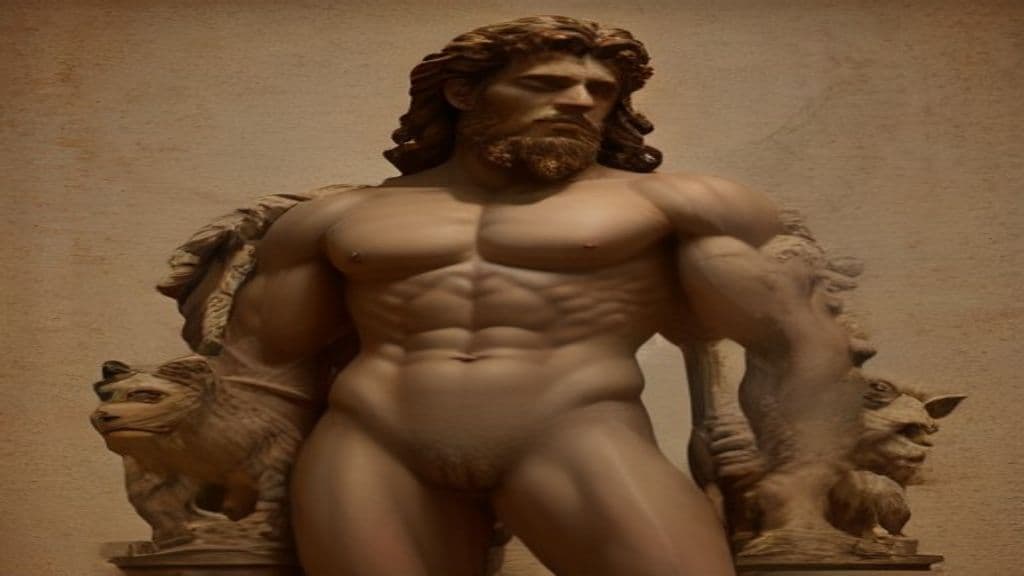
Hercules
Hercules (Latin: Hercules) is the Roman reception of the Greek divine hero Heracles: a semi-divine, divinized heroic figure son of Jupiter and the mortal Alcmena who was widely venerated across Italy. Represented in cult, votive art, and literature, he functions as a protector and martial champion whose identity was adapted through Etruscan and local Italic contexts.
Community Record
- [1]Hercle. Wikipedia contributors, 'Hercle,' Wikipedia, The Free Encyclopedia.wiki
- [2]Hercle (Wikidata). Wikidata entry Q2738940 for Hercle.other
- [3]Epiur. Wikipedia contributors, 'Epiur,' Wikipedia, The Free Encyclopedia.wiki
- [4]Los Etruscos (excerpted material). Peinado, Lara & Federico, Los Etruscos (excerpt).other
- [5]Plautus and Terence: use of Hercle (Mehercle). Scholarly article on classical Latin usages of Hercle/Mehercle as oath-forms (Plautus, Terence).academic