
Accounts vary by community. In several Lakota strands Iktómi appears among the earliest divine genealogies: one tradition names him as the first-born son of Inyan (the Rock), while some Oglala and other accounts present Iktómi as a later or degenerate manifestation of Ksa (the spirit or god of wisdom) after a sequence of mimicry and confusion involving figures called Gnaski/Ksapela. These variant narratives place Iktómi among primordial beings who shape language, stories and social technologies rather than as a single unified origin across all sources.
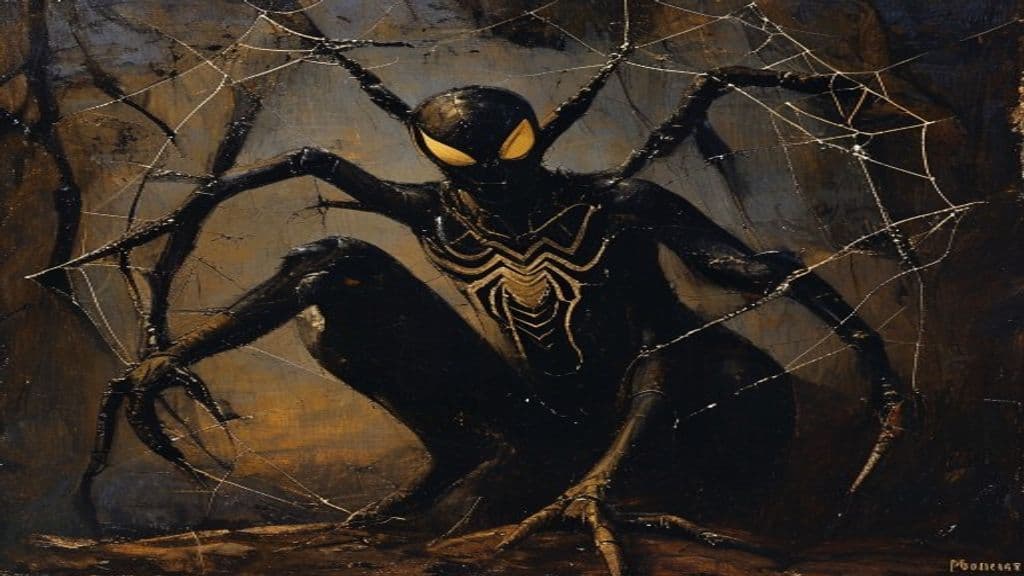
Iktómi's primary form is that of a spider; many stories explicitly describe his appearance as a spider. He is also a shapeshifter and is said to take human form on occasion; when described as human he is reported to wear red, yellow and white paint with black rings around his eyes. Narrative descriptions attribute spider-associated traits to him in stories (weaving, strings, puppetry) though sources indicate these are motifs in tales rather than a fixed physical trait of every human guise.
Stories portray Iktómi as a trickster-teacher who invents or transmits cultural goods (stories, names, games, and language in some strands) and as a being whose cunning both instructs and misleads. He is a shapeshifter, can use strings to control humans like puppets according to tale motifs, and in some accounts is said to make potions that can change gods or gain control over people. He alternately aids people with protective knowledge and brings harm; many tales emphasize that his intricate schemes often backfire, underlining his ambivalent moral valence.
Weaknesses
- conditionschemes often backfire
- conditionavoidance of his gaze (cultural precaution)
Wards
- othercaution/avoidance of his gaze (cultural precaution)
- othertransmission of trickster tales and moral teaching (social-protective practice)
Dragon (Long)
Long (龍, "dragon") is a pervasive cultural and artistic motif that appears in Taoist sacred-geographical contexts, Chinese literature, and modern exhibitions; the provided sources treat it as part of the broader mythic imagery present around Taoist sites and ritual scenes rather than as a single, consistently described doctrinal entity.
Ghost Shirt (Lakota Tradition)
A spiritualized object imbued with powers to protect its wearer from harm or possession by malevolent spirits. (Note: 1. Power tier: Primordial (given its association with spiritual visions from the founder, it's reasonable to assume a higher power level) 2. Abilities: The source material doesn't explicitly mention p)
Great Spirit
A supreme, often-immanent life force or creator-being present in the traditional spiritual beliefs of many Indigenous peoples of what is today Canada and the United States; concepts and names vary by nation and may refer to a single creator, a pervasive sacred power, or a collective of mysterious sacred forces.
Happy Hunting Ground (Lakota Tradition)
In the Lakota tradition, the Happy Hunting Ground is a peaceful afterlife realm where the spirits of the deceased live out their lives in happiness and abundance. (Note: - Power tier: Primordial (not Minor Spirit, as it's a cosmic realm) - Summary: Inaccurate - the article describes the Happy Hunting Ground as a peaceful afterlife realm, but doesn't mention its abunda)
Heyókȟa (Heyoka)
A sacred contrarian figure and ceremonial role in Lakota and Dakota (Sioux) traditions, the heyókȟa functions as a sanctioned 'sacred clown' whose deliberate inversion of social norms, satire, and ritualized shame help heal emotional pain and test communal values. Cosmologically the role is tied to visions of the thunder beings (Wakíŋyaŋ) and is sometimes represented in myth as a thunder or lightning spirit.
Iya
A malevolent storm-monster from Lakota mythology, consuming villages and living beings. (Note: 1. Power tier: Downgrade to Ancient (deity-level) - Iya's abilities are not primordial or cosmic in scale. 2. Origin story: Remove "born from the same cosmic energies as his brother Iktomi" - there is)
Minkah (Lakota)
No documented Lakota supernatural being named 'Minkah' is present in the supplied source set. The name appears in the provided materials only as the given name of a contemporary individual (Minkah Fitzpatrick); there are no ethnographic, linguistic, or folkloric sources in the corpus that describe a Lakota entity called Minkah.
Mitakuye Oyasin
Lakota concept reflecting the interconnectedness of all living beings, used in prayers and ceremonies. (Note: - Power tier should be Primordial (as it's a cosmic concept, not deity-level or regional). - No information about appearance, sensory cues, weaknesses, and wards can be found in the source material. -)
Stoneco (Stone people / Rock spirits - lesser-known stone sentinels)
No evidence in the provided sources supports the existence of a Lakota supernatural entity named "Stoneco" or a folkloric tradition of "stone people" or "rock spirits." The materials supplied refer to corporate entities or municipal contractor listings that include the string "Stoneco" or "StoneCo," and an unrelated corporate Wikipedia page; they contain no ethnographic or folkloric information about Lakota stone spirits.
The Great Race
A cosmic event in Lakota creation stories where humans and buffalo competed to establish supremacy, resulting in humans emerging victorious through cunning and strategy. (Note: 1. The power tier should be Primordial instead of Ancient. 2. Add sensory cues: dreams, omens, visions 3. Add weaknesses: loss of trust between humans and buffalo; spiritual disconnection from the nat)
Thunder Butte
A large, isolated hill with cultural significance in Lakota tradition. (Note: 1. Power tier is likely Greater (powerful regional) rather than Primordial (cosmic), as it has cultural significance but doesn't appear to possess supernatural abilities. 2. Abilities should be explic)
Unk Cekula
Unk Cekula is a serpentoid supernatural creature in Lakota mythology identified as responsible for many unexplained disappearances and deaths; a male counterpart is named Unk Tehi. Sources classify the figure as a mythological serpent within Lakota narrative material and note a possible relation to broader North American 'horned serpent' traditions.
Community Record
- [1]Iktomi (Wikipedia). Wikipedia: "Iktomi" entry (summary of myths, appearance, abilities, interpretations, and cultural notes).wiki
- [2]Iktomi (Wikidata Q767795). Wikidata entry Q767795 (concise descriptor).wiki
- [3]Iktomi and the boulder : a Plains Indian story (Paul Goble collection). Archive.org: Paul Goble retellings and Iktomi stories (used to illustrate narrative motifs and child-oriented retellings).folk
- [4]Legend of the Dream Catcher (Lakota vision excerpt). Legend of the Dream Catcher (excerpt describing a vision in which Iktomi appears to a spiritual leader; linked to origin of dreamcatcher story).folk
- [5]Iktomi references in archive and secondary lists. Archive: American local color writing and related secondary references cited in the research notes (contextual corroboration).other