Ili-mīšar is first attested in textual sources from the Ur III period. In the Old Babylonian period he is documented as the tutelary deity of Dūr-Rīmuš in the kingdom of Eshnunna. Additional attestations place his worship in Mari, Assur, Babylon, Sippar and in the land of Suhum. He continued to appear in Mesopotamian religious contexts into later periods and was introduced into the pantheon of Uruk in the Seleucid period. Some summaries present him as a son of the weather god Adad and Shala, placing him within the genealogical networks of major Mesopotamian gods (sources: Wikipedia entries summarizing these attestations).
Surviving summaries and the cited excerpts do not provide a consistent physical description or iconography for Ili-mīšar. Textual sources emphasize his functional role as the personification of justice and occasionally portray him as a divine judge; some late or secondary references also depict him in attendant/subordinate roles to other deities. No specific visual attributes, emblems, or standardized temple cult images are attested in the provided materials.
The primary attributed function of Ili-mīšar is as the personification of justice — acting as a divine guarantor of legal and judicial order and sometimes portrayed as a divine judge who adjudicates or upholds right conduct. He is often associated with other juridical deities such as Išartu and Kittu, indicating overlapping or complementary roles in truth, law, and rectitude. In some textual/scholarly contexts Ili-mīšar appears as an attendant deity (for example in a list where he is named alongside Lugalmea) while other readings associate him with Imzuanna, showing variable subordinate or associative roles across sources.
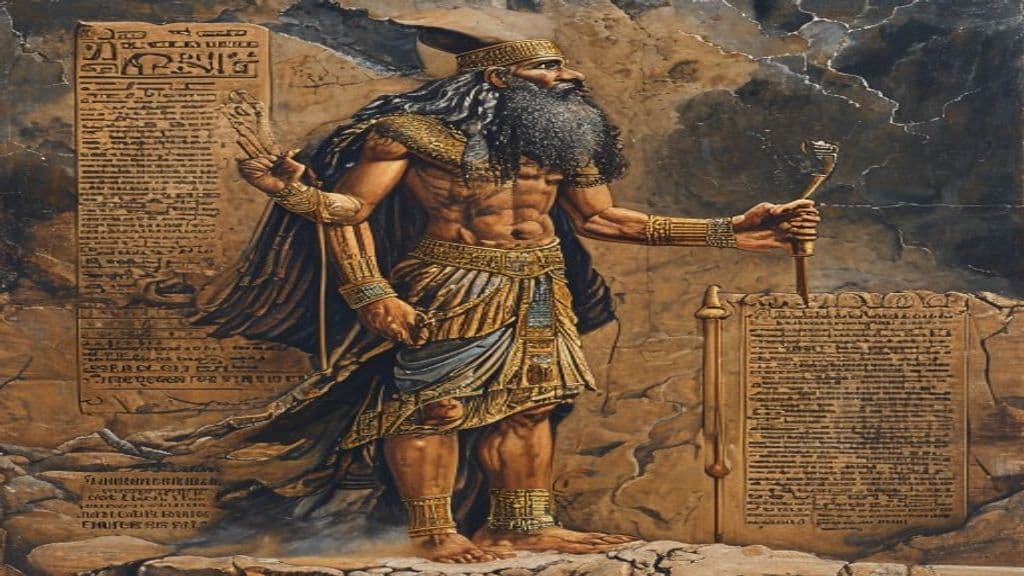
Adad
Adad (also Hadad, Haddad; Sumerian Iškur) is the storm- and rain-deity attested in ancient Mesopotamian and Canaanite religious contexts. Sources identify him as a principal weather god whose domain is storms and rainfall and whose name appears across multiple Near Eastern languages and sites, including Ebla (as Hadda, c. 2500 BCE).
Shala (Šala)
Shala is a Mesopotamian goddess associated with weather and grain, known principally as the wife/consort of the storm god Adad (Ishkur). She appears in god lists, hymns and cylinder‑seal inscriptions from the Old Babylonian period onward and functions as a fertility and communal-protective figure tied to dew and agricultural well‑being.
Community Record
- [1]Mīšaru. Wikipedia contributors, "Mīšaru," Wikipedia, The Free Encyclopedia, https://en.wikipedia.org/wiki/M%C4%AB%C5%A1aruwiki
- [2]Lugal-Marada. Wikipedia contributors, "Lugal-Marada," Wikipedia, The Free Encyclopedia, https://en.wikipedia.org/wiki/Lugal-Maradawiki