Across German-speaking countries and parts of France the motif functions as a landscape-centered explanation for why travellers become lost in woods: an enchanted plant (Irrwurz / herbe d'égarement) grows in forests and causes bewilderment or disorientation to those who step on, carry, or in some variants ingest it. Regional names and identifications vary (Irrwurz, Irrwurzel, Irrkraut in German; herbe d'égarement and variants in French; ar Iotan in Breton). The motif migrated with German immigrants to North America where Pennsylvania Dutch tradition mapped it onto local flora (Verirrgraut / rattlesnake plantain). Celtic analogues such as the 'stray sod' serve similar explanatory functions in other regional corpora.
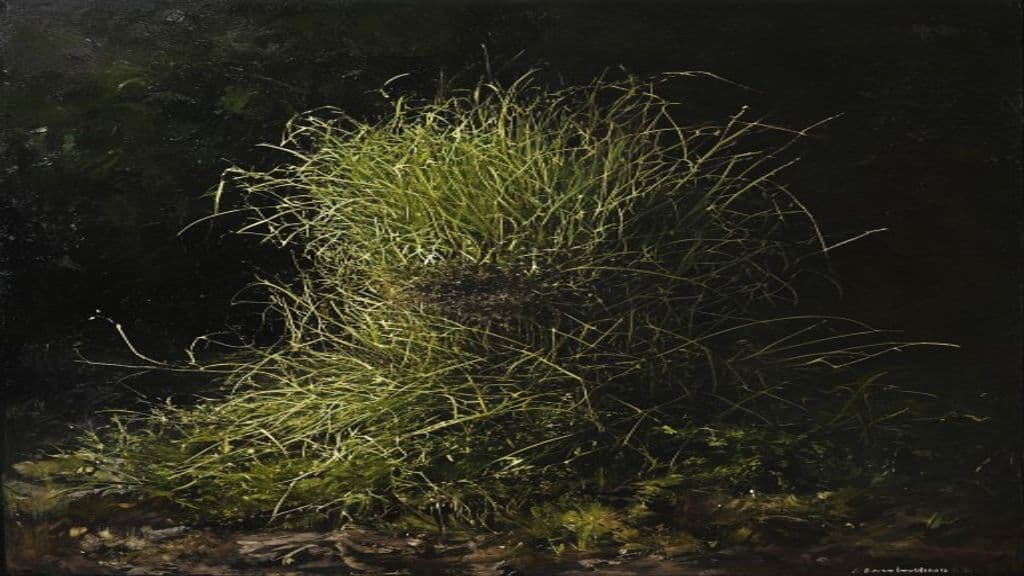
No single fixed morphology is agreed in the sources. Some accounts identify the Irrwurz with fern (Swiss Vexierchrut; certain Thuringian notes), while other traditions describe it as an unusual tree root (roots growing crosswise or like St. Andrew's cross, or roots from trees struck by lightning). French descriptions often call the herbe d'égarement a plant of unknown appearance. The Breton ar Iotan variant is additionally described as spreading a phosphorescent light at night in some local accounts.
The core attribute is to disrupt orientation: whoever steps on, steps over unseen, carries in a pocket, or in a few variants has the seed in a shoe will lose the way, retrace steps, or wander aimlessly and be unable to find home. Regional specifics include the Thuringian warning that stepping over a fern unseen causes going astray; Swiss reports that carrying the plant in a pocket leads to misdirection; Tyrolean lore stating that stepping on an Irrwurz can immediately transfer the victim to a knacker's yard or swamp; and Pennsylvania Dutch lore that stepping on it at night forces wandering until morning while daytime cases require an external shock to end the wandering. Some local accounts add associated effects: a Thuringian variant claims adders and vipers will chase someone carrying the plant, and Carinthian and Breton notes attribute the effect to a spirit or goblin associated with the plant (in Carinthia a spirit is said to stand before the right path and hide it; in Brittany ar Iotan is said to be inhabited by a spirit).
Weaknesses
- conditionanother person steps on the same plant (Tyrol variant)
- conditionwaiting until morning (Pennsylvania Dutch night case)
- substanceherb Paris seeds (Burgundy account; seeds reveal the continuation of the path)
Wards
- ritualshoe removal or shoe-switching (take off shoes or switch right/left)
- ritualwalking barefoot
- ritualturn clothing/apron inside out (tie apron on inside out)
- otheravoid stepping on unknown ferns/roots (recognition/avoidance)
Abandinus
Abandinus is a locally attested Romano‑Celtic theonym known from a single inscribed bronze feather (votive object) dedicated at Godmanchester (the Roman fort Durovigutum) in Cambridgeshire. Scholars interpret him as a local god or male spirit tied to a specific place and possibly associated with a nearby spring or stream; this association is tentative and based on etymological readings of the name.
Abarta (Ábartach)
Abarta (also Ábartach) is a figure of Irish myth who, in surviving accounts, tricks Fionn mac Cumhaill's warriors by giving them a supernatural grey horse that bears them into the Otherworld. Sources variably identify him as a member of the Tuatha Dé Danann or as a Fomorian; after the incident he is compelled to release the captured warriors and is refused entry to the Fianna.
Abcán (Abhcán)
Abcán (modern spelling Abhcán) is a named dwarf poet and musician of the Tuatha Dé Danann in Irish myth. He appears in a small number of narratives as a musician whose art has soporific power and as the ferryman who brings the goddess Ruad from the Otherworld to the human world.
Abhean
Abhean is a named poet of the Tuatha Dé Danann in medieval Irish literature, described as a poet in particular of Lugh and recorded as having been killed by Óengus before Midir in a poem by Fland Mainistreach preserved in the Lebor Gabála Érenn.
Abnoba
Abnoba is a Gaulish theonym and toponym attested in Roman-era sources and inscriptions: a localized deity associated with woods, springs and the sources of rivers (notably the Danube) and simultaneously the name applied to a mountain or mountain range in the Black Forest/Baar/Odenwald region. Roman altars equate her with Diana, reflecting syncretic cult practice in frontier provinces.
Abraun
Abraun is an attested name in German-language plant-legend scholarship (Der abraun, ein beitrag zur pflanzensagenkunde, 1916) and a short database entry (Wikidata) labels it as a spirit from German mythology. Surviving accessible documentation is extremely limited: the principal academic treatment is a 1916 contribution to pflanzensagenkunde (plant-saga studies), but the excerpts available here contain only bibliographic metadata and do not record tales, descriptions, or rituals.
Accolon
Accolon is a mortal knight of the Arthurian court, presented in the Post-Vulgate Merlin tradition and Malory's Le Morte d'Arthur as Morgan le Fay's paramour and instrument in a plot to supplant King Arthur; his tale centers on enchanted weapons (Excalibur and its scabbard), love-manipulation, and a tragic duel with Arthur.
Achall
Achall is an eponymous mortal woman in the Ulster Cycle of early Irish literature whose grief-induced death is given as the origin of the hill-name Achall (identified with the modern Hill of Skryne). She appears as a genealogical and etiological figure tied to Tara and later legendary events at the hill, rather than as a recurring supernatural agent.
Achtland
Achtland is a figure from Irish tradition who, according to the surviving account, was a mortal woman famed for rejecting mortal suitors who married a member of the Tuatha Dé Danann and crossed into the síde to become immortal as his wife.
Adar Llwch Gwin
Legendary large, intelligent birds from Welsh tradition said to understand human speech and obey their master's commands; best known for tearing their master Drudwas ap Tryffin to pieces when bound by a literal order in an Arthurian battle narrative. The term later came to be applied to raptors and metaphorically to brave men in medieval Welsh poetry.
Adar Rhiannon
Adar Rhiannon ('birds of Rhiannon') are a set of three magical birds in medieval Welsh narrative (the Mabinogi) whose song can 'wake the dead and lull the living to sleep.' They appear as otherworldly song‑beings tied to the figure Rhiannon and function within tales as providers of enchanted music that sustains and consoles characters.
Aderyn y Corff
Aderyn y Corff (literally 'bird of the corpse') is a bird-like death-porter in Welsh folklore said to call outside the door of a person about to die. Described as an avian portent that may lack feathers or wings and as existing on another plane when not manifesting, it is treated in Welsh ghost lore and sometimes naturalized as a screech owl in modern accounts.
Community Record
- [1]Irrwurz - Wikipedia. Wikipedia, 'Irrwurz' article (accessed from provided research notes)wiki
- [2]Irrwurz - Wikidata. Wikidata entry for Irrwurz (referenced in provided research notes)other