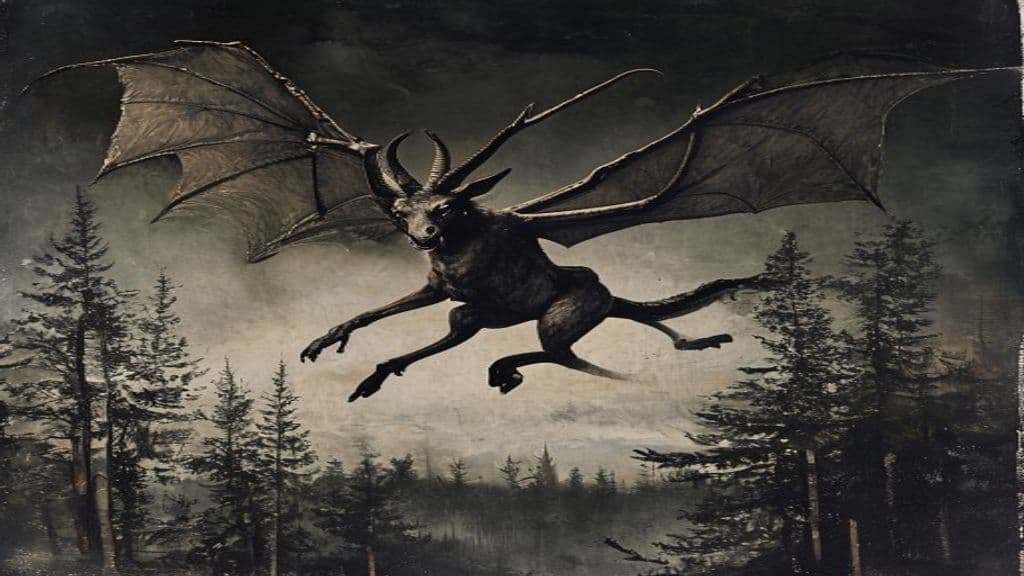
Sources present competing origin frames preserved in local tradition. One widely circulated folkloric variant recounts a Leeds woman allegedly pregnant with a thirteenth child who cursed the fetus in frustration—'Let the child be the devil!'—after which the newborn supposedly grew wings, a tail, and claws and flew away into the Pine Barrens. Alternative historical-sociological interpretations, notably advanced by scholar Brian Regal in the available summaries, argue that the Leeds-family monster legend crystallized from reputation, polemical disputes, and gossip surrounding the Leeds family (figures such as Daniel or Titian Leeds) and that folk narratives evolved over time into the modern Jersey Devil story rather than arising from a single miraculous birth event. The sources present both frames as variant elements of the tradition rather than a single established history.
Descriptions across sources form a composite rather than a single canonical form. The popular aggregate portrays a flying biped with cloven hooves, often likened to a kangaroo- or wyvern-like posture, with a horse- or goat-like head, horns, small clawed forearms, leathery bat-like wings, an elongated body and a forked or barbed tail. Illustrations and eyewitness summaries vary considerably; the listed features represent the common motifs repeated in secondary summaries and anomalistics catalogues rather than a definitive, uniform description.
Accounts emphasize mobility and startling vocalization rather than a catalogue of consistent supernatural powers. Reported abilities and behaviors in the sources include rapid movement and flight; a characteristic high-pitched, 'blood-curdling' scream; and, in origin variants, an immediate postnatal transformation in which a newborn purportedly sprouted wings, claws, and a tail and departed the home. Beyond such sightings and origin-tale features, the provided material treats the creature as a persistent folkloric/cryptid figure and does not document systematic powers like weather control, consistent predation patterns, or possession.
Weaknesses
- otherNo consistent vulnerabilities recorded in sources
Wards
- ritualclergy exorcism (unspecified)
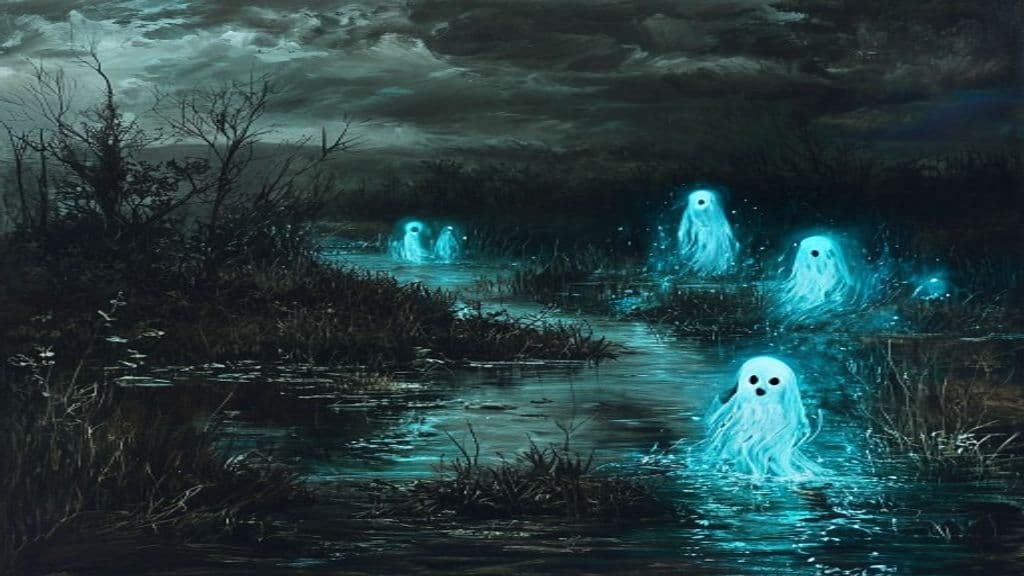
Will-o'-the-Wisp
A wandering light seen over marshy ground at night, leading travellers astray into bogs and fens. Possibly a spirit, possibly the soul of the unbaptised dead, possibly the devil himself.
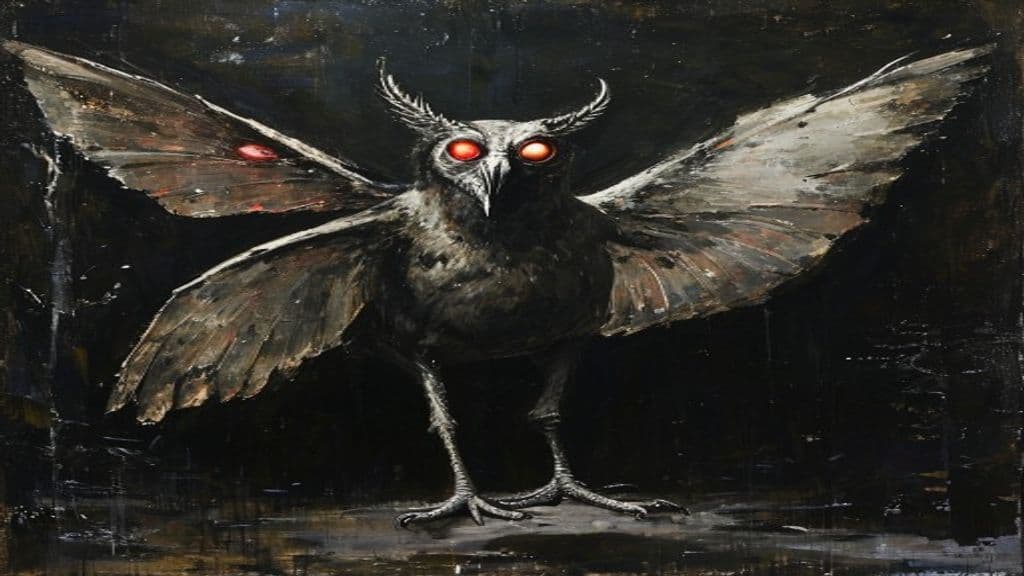
Mothman
A modern American folkloric figure originating from a cluster of 1966–67 sightings around Point Pleasant, West Virginia. Described in press reports and later retellings as a large humanoid or winged creature with notable eyes, the Mothman legend has been variously interpreted as misidentified wildlife, hoaxing/sensationalism, or a paranormal omen linked in some retellings to the Silver Bridge collapse.

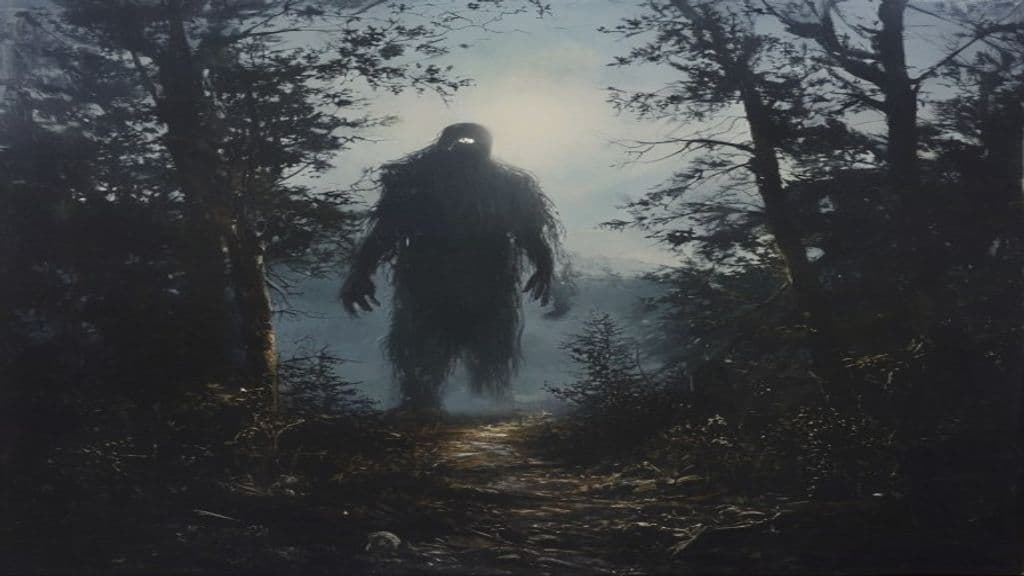
Bigfoot (Sasquatch)
A North American folkloric large, hairy, bipedal humanoid reported chiefly from the forests of the Pacific Northwest. The figure functions as a 'wild man' type in regional and popular traditions and is documented primarily through sightings, footprint casts, media, and a subculture of enthusiasts rather than accepted biological evidence.
Flatwoods Monster
A creature reported in Flatwoods, Braxton County, West Virginia, on September 12, 1952, seen on the ground after witnesses observed a bright light cross the night sky. Treated in sources as an anomalous terrestrial/extra‑terrestrial apparition recorded in mid‑20th‑century American popular anomalistics and later reinterpreted by investigators with natural explanations (meteor + barn owl + perceptual factors).

Ghoul
A ghoul is a demon-like or monstrous humanoid originating in pre-Islamic Arabian religion, traditionally associated with graveyards and the consumption of human flesh. The concept later entered broader folklore and has been widely reused and transformed in modern fiction and popular culture.
Brown Mountain lights
A long‑reported series of unexplained nocturnal lights observed near Brown Mountain in Burke County, North Carolina. Local storytelling treats them as mysterious 'ghost lights,' while early 20th‑century USGS investigations and later skeptical accounts correlated many sightings with ordinary light sources such as locomotive and automobile headlights and brush fires.
Jenny Greenteeth
A figure of northern‑English folklore personifying dangerous still and slow freshwater. Presented as a green‑skinned river‑hag who lures or seizes children and the elderly into ponds, rivers, and lakes; stories function primarily as cautionary warnings about aquatic hazards.
Jentil
In Basque mythology, the Jentil are a race of giants associated with pre-Christian civilizations and megalithic monument builders. (Note: - Power tier should be Primordial because the text suggests they are associated with pre-Christian civilizations and megalithic monument builders, but doesn't imply cosmic powers. - Summary should cla)
Jentilak (the Jentil / Gentiles)
Jentilak are a Basque folkloric race of enormous, hill‑dwelling humanoids traditionally credited with shaping the landscape and building megalithic monuments. Conceptually they are framed as pre‑Christian or 'gentile' ancestors whose disappearance is associated in folklore with the spread of Christianity.
Jeonggamnok
The Jeonggamnok is a compilation of prophetic works describing a messianic figure known as the 'True Man' with the surname Jeong, expected to bring about a new utopian dynasty. (Note: - Power tier: Primordial (due to the "messianic figure" and the scope of its prophetic works) - Origin story: missing - Appearance: missing - Abilities: should describe how it is believed the 'True Ma)
Jerahmeel (archangel)
Jerahmeel (Hebrew Yəraḥməʾēl) is a theophoric Hebrew personal name meaning roughly 'May God have mercy' that, in later apocryphal/deuterocanonical and devotional materials, appears also as the name of a heavenly being rendered Jeremiel/Eremiel/Remiel and sometimes listed among named archangels in varying traditions.
Jerry Cornelius
Jerry Cornelius is a fictional, protean literary persona created by Michael Moorcock, presented across multiple novels and stories as a mutable archetype — an urban adventurer, trickster/Pierrot figure, and one incarnation of Moorcock's Eternal Champion concept. The character's identity, appearance, and role shift across narratives rather than forming a single fixed biography.
Jessica Jones
Jessica Jones is a modern fictional character from Marvel Comics: a woman whose exposure to radioactive chemicals granted her limited superhuman powers. She is portrayed as a former costumed hero who becomes a private investigator and a narrative focus for stories about trauma, recovery, and street-level superheroics in New York City.
Jesus son of Damneus
Jesus son of Damneus (Greek: Ἰησοῦς του Δαμναίου; Hebrew: ישוע בן דמנאי, Yeshua ben Damnai) is attested in Josephus as a Herodian-era High Priest of Judaea in Jerusalem who was appointed after the removal of Ananus son of Ananus and was deposed in less than a year. Sources treat him as a historical officeholder within the first-century Judean priestly and political framework rather than a supernatural being.
Jesus, son of Fabus
Jesus, son of Fabus (also rendered Jesus son of Phabet, Jesus son of Phiabi, Joshua ben Fabus) is attested in secondary summaries and priestly lists as a historical holder of the Jewish high priesthood in late Second Temple Judea. Sources present him as a human officeholder whose tenure and removal occurred within the political influence of Herodian and Roman authorities; precise dates and family relations are inconsistent across sources.
Jewish Mythological Entities
A collection of mythological beings from Jewish mythology, including angels, demons, and divine entities. (Note: 1. Power tier is not supported by source material (no description of entities with cosmic powers). 2. No mention of "primordial" or specific power levels. 3. Sensory cues, wards, and weaknesses are al)
Jhakar / Phansigar (no attestation as supernatural being)
The names 'Jhakar' (and variants like 'Jhakari') appear in available sources as toponyms and a personal/surname in Indian records; the supplied materials contain no folkloric or ethnographic attestation of a forest or guardian spirit called Jhakar or Phansigar. This entry documents what the sources do and notes the absence of any supernatural description.
Community Record
- [1]Jersey Devil — Wikipedia. Wikipedia contributors, 'Jersey Devil,' Wikipedia, The Free Encyclopedia.wiki
- [2]Encyclopedia of Strange and Unexplained Physical Phenomena (catalogue entry). Encyclopedia of Strange and Unexplained Physical Phenomena (catalogue listing includes 'Jersey devil').other
- [3]Jersey Devil — Wikidata. Wikidata entry Q3281601 for Jersey Devil.other