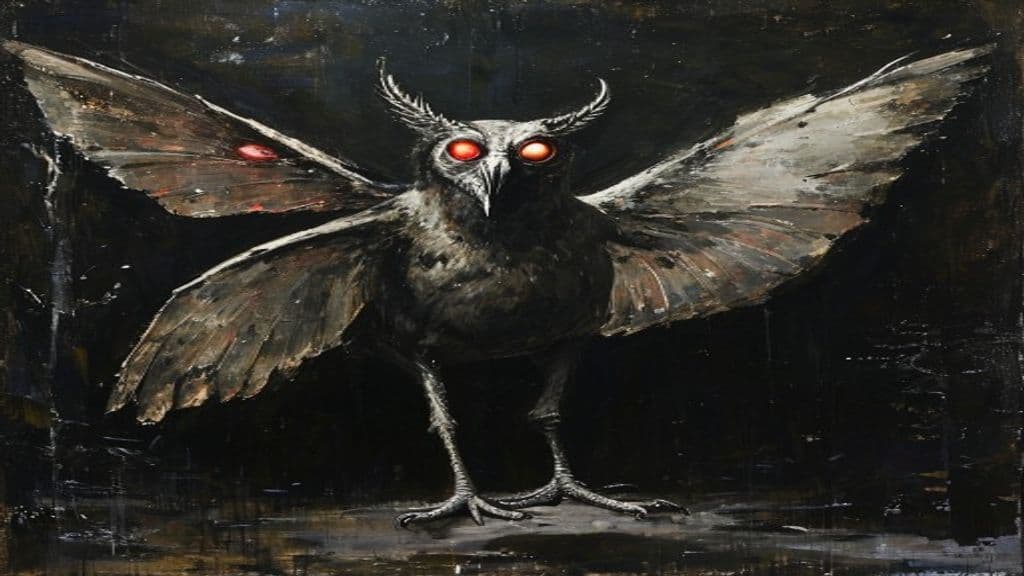
The Mothman label arose from newspaper coverage of November 1966 reports near Point Pleasant, West Virginia, where several witnesses reported encountering a large winged, man‑sized creature. The coinage 'Mothman' and the iconic image of a red‑eyed winged humanoid were shaped by press headlines and later popular writers (e.g., Gray Barker, John Keel). Folklorists treat the episode as a case of modern legend formation driven by local reporting, subsequent national media attention, and later books and film; some commentators connected the sightings narratively to the 1967 Silver Bridge collapse, though that linkage is a feature of later retellings rather than part of the original newspaper accounts.
Eyewitness descriptions from the 1966–67 cluster vary: early press quoted a 'man‑sized bird' with eyes that 'glowed red'; Linda Scarberry described what she called a 'slender, muscular man' about seven feet tall with white wings and said she could not discern the face because of the effect of its eyes; volunteer firemen described a 'large bird with red eyes.' Investigators and biologists later proposed prosaic comparators — sandhill crane, great blue heron, barred or snowy owls — and emphasized that eyeshine and poor viewing conditions plausibly account for reports of 'glowing red eyes.' Later pop‑culture images and the Mothman name consolidated divergent descriptions into a single iconic figure.
Contemporary sources report witness claims of behaviors during the Point Pleasant cluster: standing alongside roads, flying after or pursuing vehicles, producing a loud screeching sound, and in some accounts appearing to impede clear observation of facial features. Folklorists record anecdotal motifs associated with the tale complex (e.g., stories of creatures attacking roofs of parked cars). These reported behaviors are presented in sources as witness reports or folkloric elements; investigators have offered mundane explanations (misidentified birds, eyeshine, hoaxes such as flashlights tied to balloons) rather than confirmed supernatural powers. Some later authors and paranormal commentators linked the sightings to other anomalous events (UFOs, the Silver Bridge collapse), a retrospective interpretive layer in the legend.
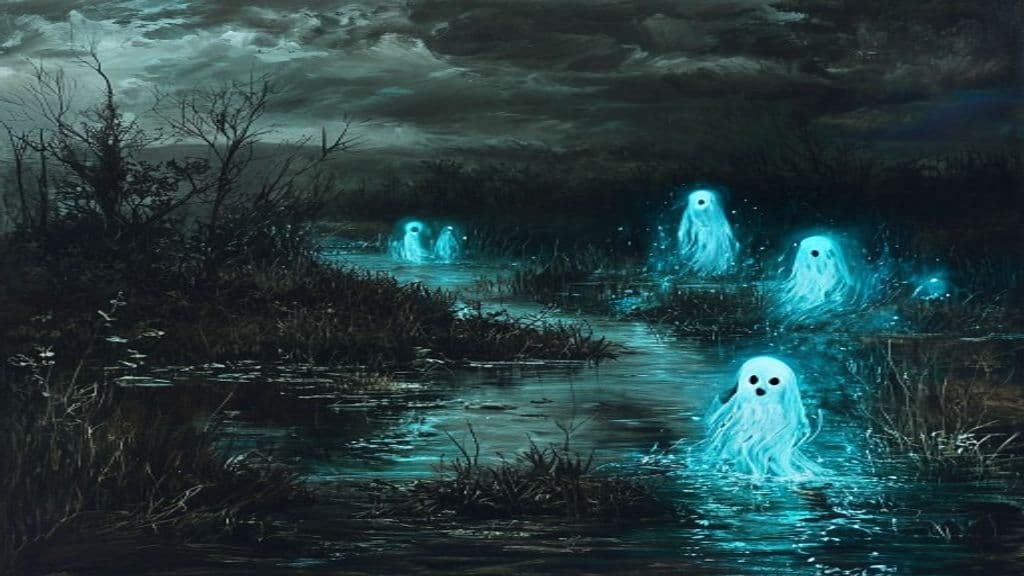
Will-o'-the-Wisp
A wandering light seen over marshy ground at night, leading travellers astray into bogs and fens. Possibly a spirit, possibly the soul of the unbaptised dead, possibly the devil himself.

Ghoul
A ghoul is a demon-like or monstrous humanoid originating in pre-Islamic Arabian religion, traditionally associated with graveyards and the consumption of human flesh. The concept later entered broader folklore and has been widely reused and transformed in modern fiction and popular culture.
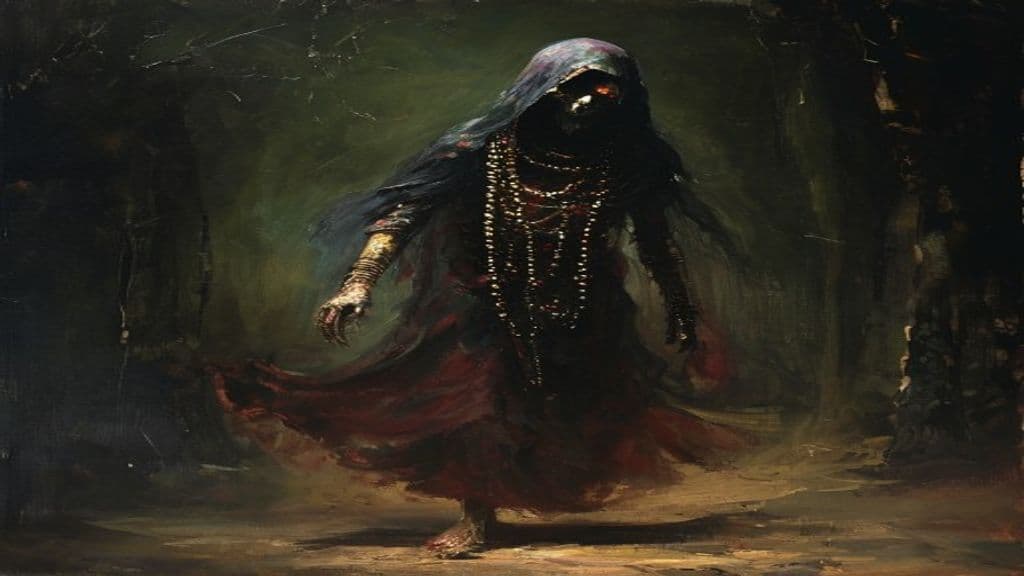
Bhoot (bhoota)
A bhoot (also bhoota, bhoot, bhut) is the culturally specific term across parts of the Indian subcontinent for a perturbed, restless spirit generally understood to be the ghost of a deceased person. Sources describe bhoots as arising when a person's death or post-death circumstances prevent them from moving on — for example violent death, unresolved affairs, or failures in funerary rites — and the term appears frequently in modern South Asian media and discussions.
Bloody Mary
A mirror-associated apparition invoked by chanting a female name in dim or candlelit conditions. Originating in catoptromantic divination practices, the figure functions in modern youth-lore and urban legend as an ambiguous ghost/witch who may reveal future information or enact violent harm on participants.
Candyman
A modern urban-legend ghost figure originating in Clive Barker’s short story and adapted into a film franchise; Candyman is a named, summoned presence bound to a violent historical death and sustained by stories, belief, and traumatic community memory. In the films he is most commonly invoked by speaking his name repeatedly into a mirror and appears as a violent, hook‑handed apparition tied to histories of racial injustice in an urban housing setting.
Frank Tower
Frank Tower is a 20th‑century urban‑legend figure alleged to have survived multiple major ship sinkings (Titanic, Empress of Ireland, Lusitania). Sources treat the story as a tall tale circulated in novelty and popular‑culture outlets; documentary research finds no evidence that a single person named Frank Tower was aboard and survived all three disasters.
Mormo
A Greek child-eating bogeywoman used to frighten children into obedience, sometimes depicted as a shape-shifting female phantom who bit naughty children.
Moroi
A moroi is a revenant or undead spirit in Romanian and neighbouring Central/Eastern European folklore associated with failed birth/death rites and nocturnal harm. Traditions variously describe it as a phantom, a kind of vampire or ghost, or the spirit of an unbaptized infant or malformed child born of supernatural conception.
Morphe (μορφή)
Morphe (Greek: μορφή) is a lexical term meaning "form," "shape," or "outward appearance" attested in ancient Greek and discussed in New Testament exegesis. The provided sources show no coherent folkloric or mythic entity named "Morphe"; modern uses of the sequence "Morphe" in brand and project names are likewise non-mythic appropriations of the word or signifier.
Moryana
In Slavic folklore, Moryana is a complex sea spirit who rules the winds and poses a threat to ships. (Note: - The power tier is incorrectly assigned (Ancient) given that it only rules the winds and poses a threat to ships, which would be more consistent with a Greater power tier. - Sensory cues: coastal reg)
Mot
Mot is the Ugaritic/Phoenician personification and divine power of death; in mythic texts he appears as a son of ’El whose residence is a pit and whose appetite for the living brings sterility and conflict with the storm-god Baal.
Mothra
Mothra (Japanese: モスラ, Mosura) is a moth-like giant monster (kaiju) originating in Japanese popular media. First appearing in a 1961 serial/novelization and Toho's 1961 film Mothra, the character is recurrently portrayed as a colossal, often heroic/protective kaiju associated with an island culture and featured across multiple Toho and later Monsterverse films.
Motoro
Motoro is a tribal god of the Ngariki people of Mangaia in Polynesia. In the available account he is called i'o ora ('god of the living') and is noted for a myth in which he was cast into the sea during a quarrel with his elder brothers; his spirit later arrived at Mangaia on a piece of hibiscus. His followers were exempt from being used as human sacrifices.
Motutaiko Island
In Māori tradition, Motutaiko Island is a culturally significant island within Lake Taupō, associated with the black petrel bird and reflecting the Māori worldview's emphasis on connection between natural features and human society. (Note: - Power tier: Minor Spirit (given its local significance and limited abilities) - Weaknesses: drought not mentioned in source material - Wards and weaknesses inconsistent with the provided information)
Mount Meru (Buddhist Tradition)
Sacred, five-peaked mountain at the center of all physical, metaphysical, and spiritual universes in Buddhist cosmology. (Note: 1. Power tier: Downgrade to "Primordial" to "Greater". A Primordial entity would be a fundamental aspect of the universe's creation or structure, rather than a specific geographical location. Mount Me)
Community Record
- [1]Mothman - Wikipedia. Wikipedia, 'Mothman' article (summary of press reports, folklorist and skeptical commentary)wiki
- [2]Jan Harold Brunvand on Mothman and modern legends. Jan Harold Brunvand, folklorist commentary as summarized in source notes (comparative tale elements, attacks on car roofs, modern legend formation)academic
- [3]Skeptical investigations (Joe Nickell, Benjamin Radford). Summarized skeptical analyses noting hoaxes (flashlights on balloons), misidentifications (birds, eyeshine), and secondhand reporting of red‑eye claims (Joe Nickell; Benjamin Radford as cited in source notes)other
- [4]Contemporary press: Point Pleasant Register (Nov 16, 1966). Point Pleasant Register, 'Couples See Man‑Sized Bird ... Creature ... Something' (headline cited in source notes; original local reporting of the sightings)folk
- [5]Cultural transmission and popularization (Gray Barker, John Keel, film, festival). Accounts of subsequent popularization by Gray Barker and John Keel, 2002 film adaptation, and annual Point Pleasant Mothman festival (summarized in provided material)literary
- [6]Reported modern sightings and photographs (local media). Examples noted in source material, e.g., a 2016 photo published by WCHS‑TV and later claimed sightings elsewhere (including a reported transposition to Moscow by UFOlogists) as indicators of the legend's spreadother