
Sources primarily present the jiangshi as an otherwise-dead human corpse that has become reanimated rather than a naturally born supernatural being. In film plots and genre summaries, causes for reanimation include improper funerary handling, malicious sorcery, or ritual mishap; the corpus emphasizes narratives in which human actions (neglect of burial rites, witchcraft) and the need for priestly intervention are central. The supplied materials do not provide a single canonical premodern origin myth or liturgical account, and some variation in cause is shown across cinematic narratives.
Descriptions in the provided sources stress a stiff, cadaverous body that moves by rigid hopping. Modern cinematic iconography frequently dresses jiangshi in Qing-dynasty official robes and associates them with yellow Taoist talismans (fulu) attached to the forehead; film-genre commentary and summaries identify these dress and prop elements as a standardized visual shorthand created by Hong Kong films rather than an exclusive traditional prescription. Traditional accounts as cited focus on the animated corpse and its stiff motion rather than a single standardized costume.
Across the cited corpus, the jiangshi is characterized chiefly as a reanimated corpse that can move and pose a threat to the living in narratives. Its distinctive locomotion is hopping, produced by a stiff, cadaverous body. Film and genre sources repeatedly depict the creature as something that must be restrained, contained, or exorcised by ritual specialists: Taoist priests use talismans and ritual implements to bind, control, or immobilize the corpse. Some modern descriptions (noted in the sources) add vampiric features such as blood-drinking, but at least one source identifies blood consumption as a later, Western-influenced accretion rather than an original, consistently attested trait.
Weaknesses
- symbolTaoist yellow talisman (fulu)
- ritualBinding/containment by a Taoist priest
- otherBells or ritual instruments (cinematic motif used to control or summon)
- substanceGlutinous rice (cinematic/folk motif)
Wards
- symbolTaoist yellow talisman (fulu)
- ritualHiring/commissioning a Taoist priest to monitor/control a corpse
- otherBells or ritual instruments (used in films to control the corpse)
- substanceGlutinous rice (appears as a folk/cinematic prop associated with jiangshi scenes)
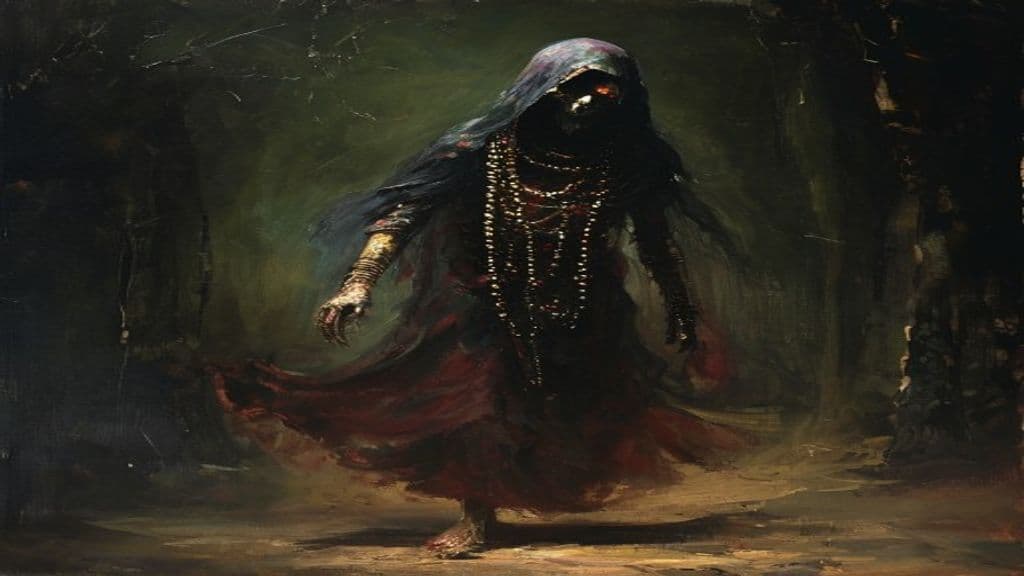
Báigǔ Jīng
The White Bone Demon of Journey to the West — a skeletal demoness who shapeshifts into innocent humans three times to attempt to capture and devour the monk Tripitaka.
Chi (螭)
Chi (螭) is attested in the provided sources only as an entry on a general disambiguation page identifying 螭 as "a dragon" within a Chinese lexical/mythological listing. No further mythological, ritual, or descriptive information about this entity is present in the supplied materials.
Dawn deities
A cross-cultural category of divine figures associated with dawn, morning, or the morning star; these figures personify the transition from night to day and may be integrated into local pantheons or syncretized with solar deities in some traditions.
Dragon (Long)
Long (龍, "dragon") is a pervasive cultural and artistic motif that appears in Taoist sacred-geographical contexts, Chinese literature, and modern exhibitions; the provided sources treat it as part of the broader mythic imagery present around Taoist sites and ritual scenes rather than as a single, consistently described doctrinal entity.
Huli jing (Fox spirit)
Huli jing (狐狸精), commonly rendered in English as "fox spirit," are shapeshifting supernatural beings from Chinese folklore and mythology. Classified among the broader class of yāoguài, they are morally ambivalent figures that may be benevolent, malevolent, or trickster-like depending on the tale and context.
Hùndùn
The primordial chaos of Chinese cosmogony — sometimes personified as a faceless deity of the center, sometimes as the undifferentiated void from which all things emerged and to which they return.
Jade
Jade is a material and cultural concept referring to two distinct groups of ornamental rocks—nephrite and jadeite—valued across many societies (not a supernatural being). It has deep historical, ritual, and symbolic significance especially in East Asia and Mesoamerica, and carries folk associations with health and social status.
Liminal deity (category)
A scholarly category of gods and divine figures whose proper sphere is thresholds, borders, and transitions — places and moments where one state gives way to another. The term aggregates culturally specific deities (e.g., Janus, Hecate, Charon, Cheng'huang, Menshen, Jangseung, Bes) that function as guardians, psychopomps, or mediators at crossings of space, time, or condition.
Moon Rabbit (Maya Tradition)
A mythical figure associated with lunar mythology, said to pound elixir or medicine for mortals and occasionally foodstuffs. (Note: 1. Power tier: Downgrade to Ancient, as while it's associated with lunar mythology, its abilities are not cosmic in scope. 2. Abilities: Add that the contents of the mortar differ among cultural tradi)
Qilin
A legendary hooved chimerical creature of Chinese literary tradition (麒麟, qílín) whose appearances in classical accounts function as auspicious omens tied to the birth, arrival, or death of sages and illustrious rulers. The creature is part of a broader East Asian set of correspondents (Japanese kirin, Korean girin) and was historically conflated with the real giraffe in Ming-dynasty court encounters.
Jhākri
Jhākri is the Nepali term for a shamanic practitioner or diviner found among several Himalayan ethnic groups (notably Tamang, Gurung, Magar) and in adjacent Indian regions (Sikkim, West Bengal). In the documented sources Jhākri are human ritual specialists who may act as channels or mediums (dhaamee) for Hindu gods or goddesses to provide answers and solutions to devotees.
Jiaotu
Jiaotu is a named member of the folkloric set known as the Nine Sons of the Dragon in Chinese decorative tradition, traditionally associated with secrecy and threshold protection and commonly represented as a carved motif on doors.
Community Record
- [1]Jiangshi (Wikipedia). Wikipedia: Jiangshi (hopping corpse)wiki
- [2]Jiangshi fiction (Wikipedia). Wikipedia: Jiangshi fiction (genre and cinematic conventions)wiki
- [3]Jiangshi fiction | Aesthetics Wiki | Fandom. Aesthetics/Fandom entry on jiangshi fiction (visual motifs, talismans, rice)other
- [4]Crazy Safari (Archive plot summary). Crazy Safari plot summary (descendant hires a Taoist priest to maintain control of the cadaver using a yellow talisman)other
- [5]Vampire-Club: Jiangshi. vampire-club.neocities.org: notes on jiangshi and the later addition of blood-drinkingfolk
- [6]Close Encounters Of The Spooky Kind (Archive). Film archive: Close Encounters Of The Spooky Kind (uses jiangshi alongside witches, spirits; cinematic settings)other
- [7]Mr. Vampire – All the Anime (blog). Mr. Vampire article (cinematic priest character and ritual motifs)other
- [8]MonsterTalk episode: Jiangshi 'Hopping Vampires?'. MonsterTalk S04E03 discussion of jiangshi in modern sourcesother
- [9]Hopping Vamps and Winter Scares - Jennifer Morrow. Jennifer Morrow essay on jiangshi and cultural contextsother
- [10]Chinese Beliefs and Folklore. Werner, E.T.C. 1922. Myths and Legends of China. George G. Harrap.folk
- [11]The Walking Dead in Chinese Belief. De Groot, J.J.M. 1907. The Religious System of China. E.J. Brill.academic