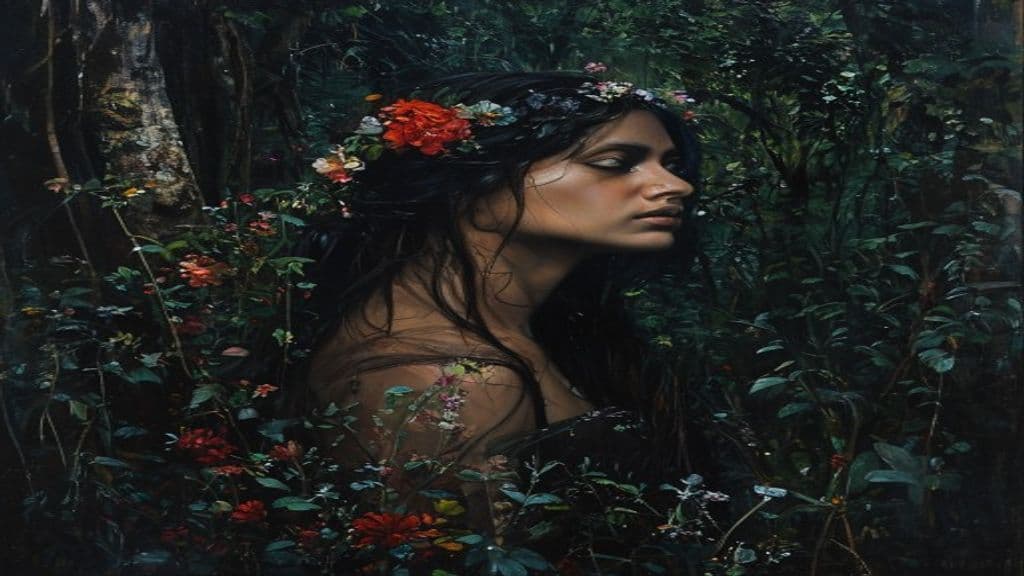
The Jokhini occupies a space in Assamese folklore analogous to the Churel in North India or the Mohini in South India — a female supernatural predator who uses beauty as a weapon. Her origin stories vary: in some accounts she is the spirit of a woman who died violently; in others she is a class of semi-divine being, perhaps distantly connected to the Yakshini family of nature spirits, who has gone feral in the deep forests of the Brahmaputra valley.
The forests of Assam — particularly the Kaziranga and Manas areas — have long histories of Jokhini association in the communities living at their edges. Forest workers who did not return are often attributed to Jokhini encounters in folk memory.
The Jokhini has two described forms. In her predatory hunting form, she appears as a woman of extraordinary beauty at the edge of the forest or along jungle paths at night. The beauty is described as slightly too much: excessive, uncanny.
When she reveals her true nature — when the encounter has progressed beyond the point of escape — she transforms into a crone-like figure with long teeth, matted hair, and an abnormal size. The transformation is described as sudden and complete.
The Jokhini's primary hunting method is attraction: she lures men off forest paths and into the deep forest, often by appearing to be a woman in distress. Once sufficiently isolated, she feeds on the victim — in some accounts consuming the flesh, in others draining the life force.
She is also associated with causing fever — the 'jungle fever' that afflicts those who have had close encounters and escaped. This fever is treated with specific forest herbs by Assamese traditional healers.
Weaknesses
- conditionRefusing to follow a beautiful woman met alone in the forest at night
Wards
- ritualPrayers to Kamakhya Devi before entering the forest
Bhunni
The female guardian-spirit of agricultural fields in Bihar and eastern UP — her presence ensures fertile soil and good harvest, but she is territorial and punishes those who plough without permission, steal crops, or use chemical methods that poison the soil she inhabits.
Bordoisila
The storm deity of spring in Assamese tradition — Bordoisila is the daughter of Brahma who visits her mother's home at the end of winter, and whose journey back creates the violent pre-monsoon storms of April and May. She is a goddess-spirit propitiated in Assam for thousands of years.
Dayan (Daayan, Ḍāin, Ḍāini)
A North and East Indian folkloric figure: a malevolent female revenant or vengeful spirit commonly associated with women who died in traumatic or unresolved circumstances. Dayans are described in popular sources as powerful life-draining entities with distinctive physical markers and as a label that also functions in social witch‑hunt practices.
Doyen
The Bengali witch — closely related to the North Indian Dayan but with Bengali-specific characteristics including the ability to steal livers, which the witch must periodically consume to maintain her powers. Doyen accusations continue to drive violence against women in rural Bengal and tribal districts of Jharkhand.
Luit Xuri
The spirit of the Brahmaputra river itself — 'Luit' being the Assamese name for the Brahmaputra and 'Xuri' meaning spirit or essence. One of the few major rivers in Hindu tradition that is male (Brahma's son), his spirit in Assamese folk belief is unpredictable, powerful, and must be addressed before any seasonal beginning.
Mahapreta
The 'great ghost' — in Bihar and UP folk classification, a Mahapreta is a preta of exceptional power, born from a death involving multiple injustices simultaneously: wrongful killing, incomplete rites, and unresolved family debt combined. It commands lesser spirits and can cause harm across an entire lineage.
Mamdo Bhoot
The ghost of a Muslim person in Bengali Hindu folk belief — 'Mamdo' deriving from 'Mahmood.' The Mamdo Bhoot occupies a unique place in Bengal's supernatural taxonomy: a cross-religious ghost in a deeply syncretic tradition, with its own distinctive characteristics and ward practices that follow the ghost's religious tradition rather than the observer's.
Nathiya
Ghost of a young bride who died before her first Diwali as a wife — still wearing her wedding nose ring (nath), she haunts the marital home she never truly inhabited, causing illness in subsequent brides and making the household unwelcoming to new marriages.
Pichal Peri
Shared across North Indian and Pakistani folklore — a female spirit with reversed feet who lures lone travellers off roads at night. One of the most cross-cultural supernatural figures in the subcontinent, appearing in Hindu, Muslim, and Sikh communities alike.
Stree
A vengeful female spirit from Chanderi who abducts men during festival nights. Warded off by the inscription 'O Stree, kal aana' — her legend, still practised on walls across Madhya Pradesh, inspired the 2018 Bollywood horror-comedy.
Johnny Cage
Johnny Cage (Jonathan "John" Carlton) is a fictional character from the Mortal Kombat video game franchise: a Hollywood action-film star and skilled martial artist who serves as one of Earthrealm's champions in inter-realm tournaments and wars. Though a mortal human in the fiction, his narrative repeatedly intersects with supernatural forces that kill, resurrect, or manipulate him.
Jonakr's sons (Hamdir, Sörli, Erpr)
Three brothers—Hamdir (Hamðr), Sörli (Sǫrli), and Erpr—of the Völsung lineage in Germanic heroic legend who, at their mother Guðrún's urging, attempt to avenge their half‑sister Svanhildr by attacking King Jörmunrekr/Ermanaric. Their deed and tragic deaths are attested across Norse poetic and saga sources and continental chronicles.
Yakshini is the Sanskrit-Puranic class — powerful, sometimes divine, associated with fertility and treasure. Jokhini is the folk tradition of Bengal and Assam: she appears as a beautiful woman near water and forests, luring men to their doom — more predatory and less divine.
Community Record
- [1]Folklore of Assam. Goswami, P.D. (1960). Folklore of Assam. National Book Trust, New Delhi.academic
- [2]Jokhini — Wikipedia. Wikipedia contributors. Jokhini. Wikipedia, 2024.wiki