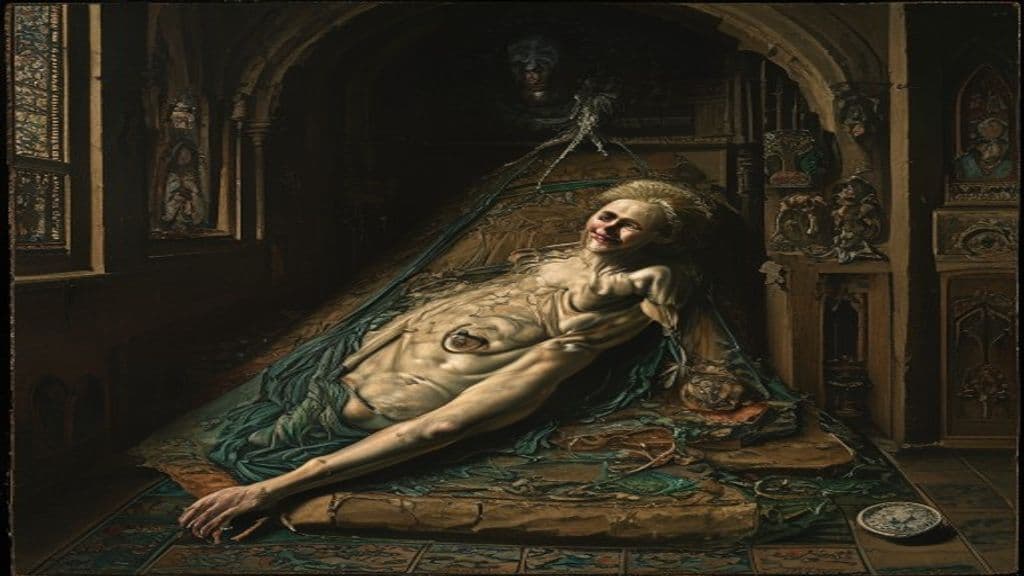
According to the local legend recorded in European print by Johann Weikhard von Valvasor and summarized in modern accounts, Jure Grando Alilović was an inhabitant of the village of Kringa who died in 1656. After his burial he is said to have risen at night and, for sixteen years, returned from his grave to make nocturnal visits that brought death to households and to assault his widow Ivana. The phenomenon was interpreted locally with the term štrigon (a Venetian/Istrian word glossed as resembling a vampire or sorcerer). In 1672, after persistent terror, villagers acting with the village priest conducted prayers of exorcism and a named villager, Stipan Milašić (with the priest present and after ritual speech), decapitated the corpse; after the head was sawed off and blood flowed, the visits ceased and the village had peace.
Reports in the recorded account describe the corpse as 'perfectly preserved' with a 'smile on its face' when exhumed; the widow Ivana described his nocturnal appearance as looking 'as though he was smiling and gasping for breath.' When his grave was opened and his head was sawed, the corpse reportedly screamed and blood flowed from the wound. These details present a buried body that appeared life-like and animated during the episodes related in the narrative.
The legend attributes a series of nocturnal behaviors to Jure: rising from his grave at night for sixteen years, knocking on village doors with the reported consequence that a person in the knocked-on house would die within days, and making repeated nocturnal visits to his widow in which she reported sexual assault. A described attempt to kill him by piercing his heart with a hawthorn stick failed in the account — the stick reportedly bounced off his chest — while confronting him with a Christian cross and invoking Jesus preceded the exorcism prayers and the eventual decapitation that ended his activity. When mortally wounded during the decapitation, the corpse is said to have screamed and bled.
Weaknesses
- conditiondecapitation (removal of the head)
Wards
- symbolChristian cross / invocation of Jesus Christ
Jumis
Jumis is a Latvian/Baltic agrarian figure and decorative motif associated with prosperity, the fertility of crops, and the household well‑being tied to the harvest cycle. Attested in folk context as a prosperity emblem in material culture and situated within the seasonal rites of spring and midsummer, Jumis functions as a positive agricultural agency rather than a hostile spirit in the supplied sources.
Juno
Juno is identified in the supplied sources as an ancient Roman goddess associated with marriage and described in one source as 'queen of the gods.' The provided materials are limited to encyclopedic identifications and modern uses of the name and do not supply detailed mythological narratives, rituals, iconography, or etymology.
Juoksáhkká
Juoksáhkká (also Juksakka, Joeksaahka; lit. 'bow woman' — Stäukedne lit. 'bow mother') is a female household deity in Sámi shamanistic belief associated with childbirth, the development and protection of children, and immediate postnatal rites. She is one of the daughters of Máttaráhkká, located in the ground under the goahti (often at the back), and was reported among Sámi in the Scandinavian parts of Sápmi but not universally across all Sámi regions.
Jupiter
Jupiter (Latin: Jove) is the chief sky-and-thunder deity of ancient Roman religion and mythology, serving as king of the gods and as the primary divine authority of the Roman state cult. He is presented in sources as controller of the heavens, a guarantor of civic religious norms, and a mythic progenitor of heroes and ruling lines.
Juracán
Juracán is the Taíno term for the violent storm-wind force — the destructive hurricane-force weather produced when the storm zemi Guabancex is displeased. In ethnohistorical accounts juracán names the meteorological violence itself; in some modern retellings it is personified as a storm spirit. The English word "hurricane" derives from this Taíno term.
Juraira
No reliable folkloric or mythological information for an entity named 'Juraira' appears in the provided sources. The materials only show (a) a Wikipedia page redirect/mention linking to the Persian epic character Farangis/Frigis, and (b) a Wikidata item for a modern researcher named Jurairat Rattanalertnavee; neither source supplies evidence that 'Juraira' is a supernatural being.
Jurōjin
Jurōjin (寿老人) is one of the Seven Gods of Fortune (Shichifukujin) in Japanese popular religion and art, functioning as the personification and auspicious deity of longevity and wisdom. A syncretic figure derived from the Chinese Taoist 'Old Man of the South Pole,' he appears in painting, sculpture, and small devotional objects from the Muromachi–Edo periods onward.
Justitia
Justitia (Lady Justice) is the classical allegorical personification of the moral force in judicial systems, commonly depicted in Western visual culture and used as an emblem in legal, institutional, and commercial contexts rather than as a supernatural being.
Juturna
Juturna (also Diuturna) is an ancient Roman divinity of fountains, wells, and springs. She appears in civic cult in Latium (temples at Lavinium and Rome, a festival on January 11) and in literary myth (notably in Virgil and Ovid) as a water-nymph who aids mortals and presides over specific sacred waters such as the Lacus Juturnae in the Roman Forum.
Jábmiidáhkká
Jábmiidáhkká (also Jabme-akka) is the female ruler of the Sámi underworld Jábmiidaibmu. She functions as gatekeeper and mediator for the dead, sometimes permitting them to affect the living and allowing captured souls to return in exchange for offerings; sacrificial burials of black animals are recorded as offerings to her.
Járnsaxa
Járnsaxa is a named jötunn (giantess) in Old Norse sources attested chiefly as a lover of the god Thor and the mother of his son Magni; she also appears in lists of giantesses such as a set called the 'Nine Mothers of Heimdallr' and functions as an onomastic reference in skaldic diction.
Jörmungandr
In Norse mythology, Jörmungandr is an unfathomably large sea-serpent, the Midgard Serpent or World Serpent, that dwells in the world sea and encircles Midgard, biting its own tail; Jörmungandr releasing his tail is described as one of the signs of the beginning of Ragnarök. The name has been reused in modern astronomy for near-Earth asteroid 471926 Jormungandr (provisional 2013 KN6), discovered 28 May 2013.
Community Record
- [1]Jure Grando. Wikipedia: 'Jure Grando' article summarizing the legend and its recording by Valvasorwiki
- [2]Jure Grando (Wikidata). Wikidata entry for Jure Grandoother
- [3]Caustic Soda - S04E43 - Vampires 01 (archive). Audio program referencing Jure Grando in modern vampire discussionother
- [4]VDM - Emision 29/11/13 (archive). Audio program listing a segment on Jure Grandoother