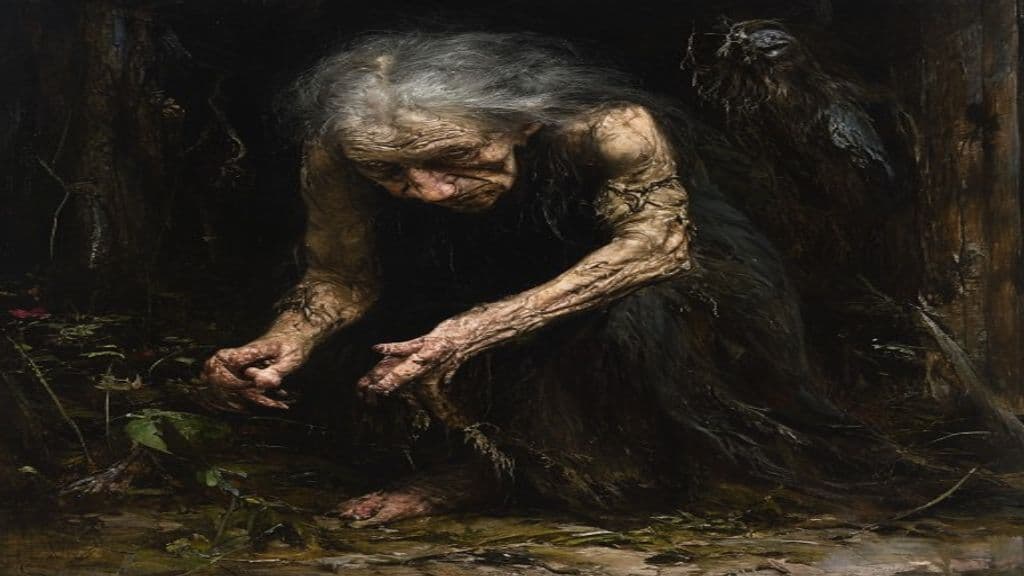
Kikimora is presented in Slavic folk belief as a longstanding household and local spirit rather than a single authored origin myth. Folkloric accounts place her within the family of small domestic and local spirits: the domestic form inhabits houses and complements or contrasts with the domovoy, while a marsh/swamp form (kikimora bolotnaya) is linked to wetlands and to the leshy in some variants. Etymological discussion in the tradition connects the suffix -mora to Proto-Slavic *morà, a term for a nightly oppressive spirit or bad dream (and notes cognates in other languages), which situates kikimora within the broader Slavic class of night‑spirits called mora or mara. Sources stress continuity of the belief through Christianization, after which the figure is sometimes interpreted in Christian terms (e.g., related to demonic forces).
Descriptions vary across sources and localities. The kikimora is always feminine in character and may appear as an old, hunchbacked, thin, scruffy woman with a pointed nose and dishevelled hair (especially the swamp variant), or as a young or beautiful girl in other accounts. Some traditions attribute animal features—parts of an animal face or body (examples cited include a dog snout, a chicken beak, or goat‑like horns and glowing eyes). She may also mimic a deceased family member in certain stories. Later literary treatments (e.g., program notes for Liadov's tone poem) present highly fantastic miniature images (thimble‑sized head, straw‑thin body) but those are artistic elaborations rather than widespread traditional descriptions.
Folk sources report a split role. In well‑kept houses the kikimora performs domestic tasks—tending chickens, doing housework, and spinning thread at night. When household order, discipline, or morality lapses (unclean house, undisciplined children, lazy or abusive husband), she is said to become disruptive: whistling, breaking dishes, making noises at night, and generally frightening occupants. The swamp kikimora is additionally associated with more dangerous behaviour in liminal wet places—leaving wet footprints, frightening travelers, drowning or attempting to drown people, and kidnapping children in certain bylichki. Some accounts assert that builders could be accused of bringing a kikimora into a house to cause harm and that such a spirit was then hard to remove; other accounts relate marital associations between the domestic kikimora and the domovoy and between the swamp kikimora and the leshy. The figure also serves an explanatory role for household misfortune and for environmental phenomena (e.g., fog over rivers in stories about bog witches).
Weaknesses
- symbolsign of the cross on the pillow (prekrstiti jastuk)
- ritualturning the pillow
- otherhousehold order and moral correction (cleaning, disciplining children, correcting abusive or lazy behavior)
Wards
- ritualleaving a broom upside down behind the door
- otherplacing a belt on top of the sheets
- mantrareciting an elaborate prayer‑poem before sleep
- symbollooking to the window (advice told to children to avert night spirits)
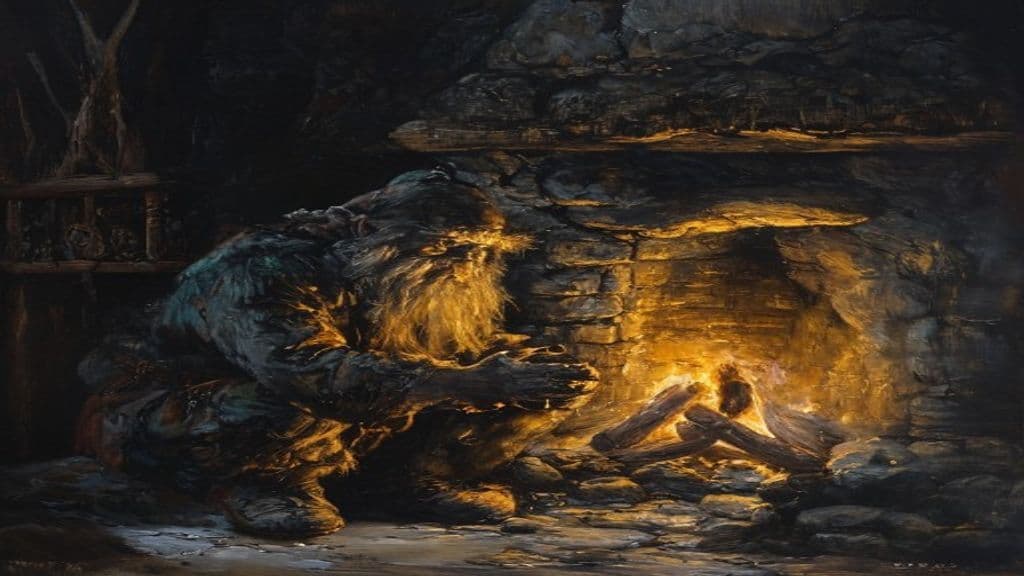
Domovoi
The house spirit of Slavic tradition — a small, invisible guardian of the home bound to a specific dwelling and its family. Protective when respected; dangerous when insulted or forgotten.
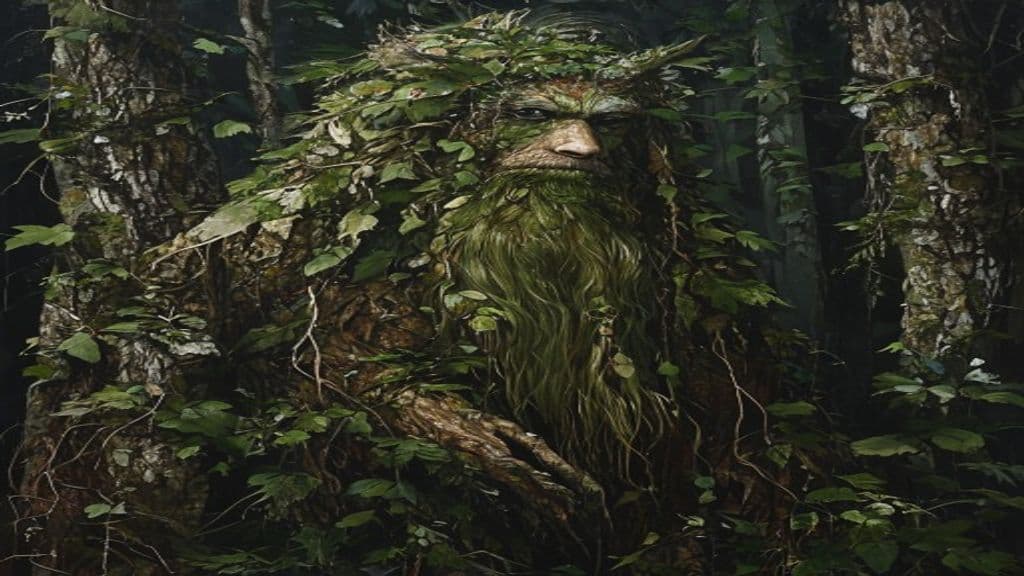
Leshy
A tutelary forest being in Slavic folklore; an embodied, territorial power of the woods that can protect, mislead, or punish humans depending on their behaviour toward the forest. Highly variable in form and described across many regional variants and names.
Baba Yaga
Baba Yaga is an ambivalent female figure of East Slavic folktale tradition, depicted variously as a fearsome, child-eating crone or as a helpful, maternal donor. She is associated with the deep forest, a hut described as standing on chicken legs, and the motific accoutrements of a mortar and pestle.
Bald Mountain (Slavic)
A location in Slavic folklore associated with witchcraft and the Witches' Sabbath. (Note: 1. Power tier should be Primordial since it's associated with witchcraft and has connections to deities (witches are often seen as having deity-level powers). Greater is too low of a power level. 2. A)
Bannik
A place-bound spirit of the Slavic banya (bathhouse) that inhabits the steam room and related spaces; he mediates divination, presides over births within the banya, and must be appeased by offerings or he may harm or otherwise vex users and the building.
Boginka
A Slavic/Polish female nature-spirit category: personifications of wild natural forces (forests, fields, mountains, fresh and sea waters) that appear in folklore as ambivalent beings—often hostile toward humans, especially pregnant women and infants, but also recalled in some sources with neutral or protective aspects.
Błędnica
A Slavic forest demoness who misleads travelers, abandoning them deep in the woods to die of exposure, starvation, or be taken by wild animals. She is typically depicted as a young, attractive woman and is countered in tradition by strong spells or by making sacrifices at home or during the hunt.
Cornflower Wraith
A Slavic field spirit associated with midday who enforces proper conduct in cultivated grain. Described as a young woman in azure with cornflowers in her hair, she punishes workers who trample crops or use sharp tools at the wrong time, often by inducing sleep followed by pain or by causing broken limbs.
Fiery Serpent (Slavic)
A supernatural entity from Slavic folklore, described as a manifestation of fire in the sky or air. (Note: 1. Power tier should be adjusted from Primordial to Ancient, as it appears to be a deity-level entity rather than a cosmic one. 2. Add sensory cues for sounds associated with the entity (e.g., roaring)
Firebird (Slavic folklore)
A marvelous luminous bird from Slavic folktales, the Firebird (zhar-ptitsa) is a glowing, often fire‑colored bird whose appearance initiates quests and whose possession brings both wonder and misfortune. It functions as a coveted wonder and a dangerous omen within tale cycles.
Geira
In Slavic tradition, Geira was a Wendish princess attested by Old Norse sagas who ruled over territory near the border of Germania and married a young Óláfr Tryggvasonr. (Note: * Power tier: Not provided in source material, but can be inferred as Primordial given the lack of detailed information and Geira's significance in Old Norse sagas. * Summary: Inaccurate; correct summ)
Hag
A hag is a folkloric figure typically depicted as an old, wizened woman who appears across European traditions in multiple roles: a nightmare spirit, a witch-like or fairy-type being, a river or household monster, or (in some cases) a form adopted by sovereignty or storm goddesses. The figure functions variously as a cautionary monster, an explanation for sleep paralysis and nightmares, and a liminal test-figure in myth.
Koschei the Deathless
Koschei (also Koshchei, Kashchei), commonly called "the Deathless" or "the Immortal," is an archetypal male antagonist in Russian and wider Slavic folklore. He functions in folk narratives as a legendary villain whose name and legend persist into modern cultural works and references.
Lady Midday (Poludnitsa)
Poludnitsa, often called Lady Midday or Noonwraith in English, is a Slavic field spirit personifying the dangers of the hottest part of summer days. She is associated with grain fields and midday heat and appears in diverse regional tales as a young woman, hag, or girl who harasses or injures people working or resting at noon.
Community Record
- [1]Kikimora — Wikipedia. Wikipedia, 'Kikimora' articlewiki
- [2]Kikimora — Wikidata entry Q2521847. Wikidata: Kikimora (Q2521847)other
- [3]Archive: Tamar — Symphonic Poem / Orchestral Music (Liadov program notes referenced). Archive recording notes including Anatoly Liadov's program notes for 'Kikimora, Op. 63' (literary/artistic elaboration)literary
- [4]Archive: Liadov — Eight Russian Folk Songs; Kikimora, Op. 63 (recording metadata). Archive entry including Liadov program material and notesliterary