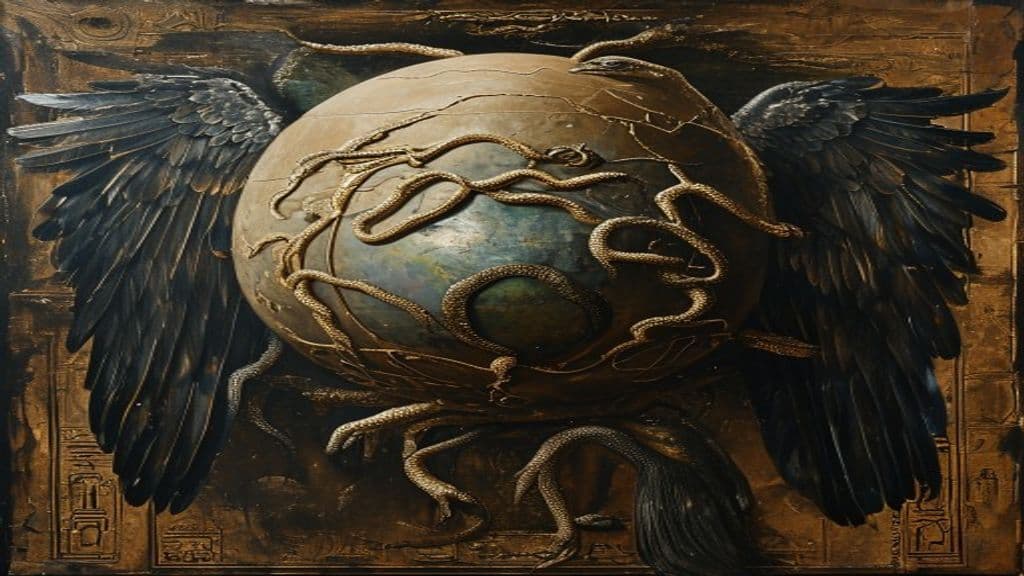
Kneph is a complex concept in ancient Egyptian mythology, representing creation and fertility.
Kneph can be represented as a winged egg, a globe surrounded by serpents, or under the Greek theonym Chnuphis as a serpent-bodied, lion-headed deity. Its connections to Khnum, Agathos Daimon, Serapis, and Pluto are syncretic interpretations.
As a motif of divinity, Kneph embodies aspects of creation, fertility, and spiritual growth, but its specific abilities and behaviors are not explicitly described in the source.

Achamōth
Achamōth is a feminine emanational figure in certain Gnostic systems, attested as a daughter or subordinate aspect of the divine Wisdom, Sophia. She appears in ophitic/Naassene mythic genealogies where she is named as motherly/filial to lower, problematic figures such as Ilda‑Baoth; beyond this genealogical role the supplied sources record little concrete description or ritual material specific to her.
Aeon (Gnosticism)
In Gnostic religious systems an Aeon is a divine emanation or hypostasis that issues from the supreme divine source and together with other Aeons composes the Pleroma, the realm or fullness of divine reality. Aeons function as personified principles or powers (e.g., Nous, Sophia) that mediate between the ultimate One and lower levels of existence; their names, numbers, and relationships vary across Gnostic schools (Valentinian, Basilidian, Sethian, etc.).
Archon (Gnosticism)
In Gnostic traditions, an archon (Greek ἄρχων, árchōn) is a cosmic ruler or architect of the visible, material cosmos. Archons function as intermediate powers that construct, govern, and limit the created world and are frequently depicted as obstacles to the soul's return to higher spiritual realms.
Demiurge
A craftsman-like cosmic artisan who fashions and governs the sensible, material universe. In Platonic traditions the Demiurge is a benevolent ordering intelligence that shapes preexisting matter by imitating eternal Forms; in Gnostic systems the Demiurge is a lower ruler of the material realm whose moral status varies from ignorant/foolish to oppressive.
Min
Min (Egyptian mnw) is an ancient Egyptian deity of male fertility, sexual potency, and agricultural renewal whose cult began in the predynastic period and was centered at Upper Egyptian cities such as Coptos (Koptos/Qift) and Akhmim (Panopolis). His worship involved public festivals (a "coming forth" and harvest-season rites), votive phallic offerings, and royal associations through syncretism with Horus and Amun and kamutef (self-fathering) imagery.
Qed-Her
Qed-Her is described in the cited reference material as an ancient Egyptian minor warrior and gate goddess of the underworld, functioning as a guardian placed at an entrance or threshold within the realm of the dead. The surviving record in the provided sources is minimal and consists chiefly of a brief encyclopedia-style entry and a linked data label.
Serapis
Serapis is a deliberately syncretic Graeco‑Egyptian deity formed from the fusion of the Egyptian Osiris‑Apis cult (Demotic wsjr‑ḥp / Coptic Userhapi) with Greek divine elements. Promoted in the Ptolemaic period as a civic cult figure, Serapis embodied chthonic rulership, healing, protection/asylum, and themes of abundance and resurrection, and his cult spread through the Hellenistic and Roman worlds.
Klagmuhme
A female supernatural figure in German-speaking folklore who heralds imminent death by wailing and whining; she functions as an omen-figure closely compared to the Irish banshee and appears in varied regional guises across Germanic areas.
Kleobule
Kleobule (Ancient Greek: Κλεόβουλη), also rendered Cleobule, is a historical Athenian woman known from classical Athenian legal speeches and later biographical anecdotes about her son, the orator Demosthenes. The surviving references situate her within Athenian family, dowry, and inheritance practices rather than within any supernatural framework.
Kludde
Kludde is a Flemish legendary tormenting spirit (kwelgeest) presented in modern sources as a shapeshifting, malign presence associated in contemporary accounts with woodlands around the Dender. Source material is fragmentary: descriptions emphasize its role in local storytelling and its capacity to frighten people who seek it out rather than a full traditional taxonomy.
Knocker
A small mine-associated spirit from British and American mining folklore, known for producing knocking sounds in underground workings that miners interpreted as warnings or communications. Variants and cognates appear across Cornwall, Devon, Wales, Staffordshire and in American mining communities (Tommyknockers).
Knucker
A type of water dragon in Germanic tradition, said to inhabit knuckerholes in Sussex, England. (Note: 1. Power tier should be changed to Lesser, as the Knucker is described as a local water spirit. 2. Add sensory cues from knuckerholes in Sussex, England (e.g., strange noises, eerie feelings). 3. Note)
Community Record
- [1]Wikipedia: Knephwiki