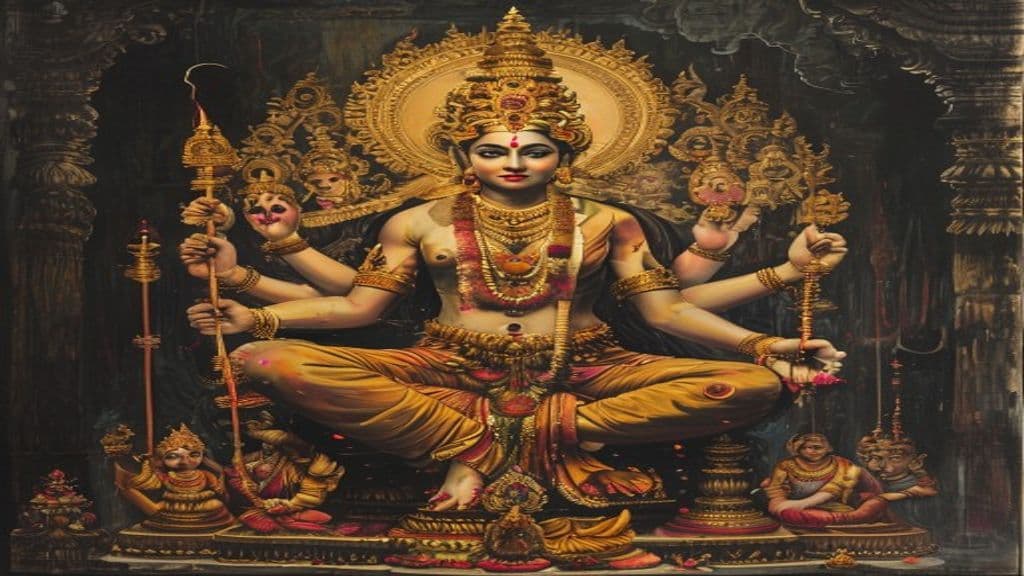
No single mythological origin unites all kuladevatas; the term denotes a category of lineage tutelary that may be occupied by classical gods, local mother‑goddesses, venerated holy persons (babas), ancestral spirits, or historical rulers. Specific communities trace particular kuladevatas to founding events or migrations (for example, Goud Saraswat Brahmin families who carried Mahalasa Narayani from Goa to Basrur), but such histories are documented case‑by‑case rather than presented as a universal origin narrative.
There is no canonical physical description: kuladevatas appear in forms appropriate to their identity. They can be male (kuladeva) or female (kuladevi) and take the iconography of classical deities (Shiva, Vishnu, Parvati, Lakshmi, Ganesh, Krishna, Murugan, Narasimha, etc.), local mother‑goddesses (e.g., Mahalasa Narayani), consecrated sacred persons, or ancestral/royal figures. Temple guides and festival accounts supply site‑specific images and temple iconography rather than a single typology.
Sources emphasize protective guardianship, intercessory and beneficent functions: kuladevatas are invoked to watch over the clan, ensure family prosperity and harmony, secure vow fulfilment, and ward off misfortune. They serve as the focus of clan devotion, preside over major family festivals, and are the recipients of sevas and offerings. The documentary sources describe ritual and social agency more than catalogued miraculous powers.
Weaknesses
None recorded.
Wards
- ritualRegular puja schedules and temple sevas
- ritualFestival participation and vow fulfilment (e.g., Navratri observance, Rathotsava/Brahmarathotsava, Rash‑Utsab sponsorship)
- conditionMaintenance of the moolasthana and continuance of clan rites (preservation of the lineage seat)
Abhinandananātha
Abhinandananātha is the fourth Tīrthaṅkara (ford-maker) of the current Jain cosmic age (avasarpini). Traditional accounts place his birth in Ayodhyā to the Ikshvāku (Solar) dynasty, describe his renunciation and attainment of omniscience beneath a priyangu tree, and record his liberation on Mount Śikharjī.
Adi (asura)
Adi is attested in modern reference works as the name of an Asura who 'appears in the Matsya Purāṇa.' Beyond this single-line citation in secondary sources, no descriptive material about the figure is provided in the supplied research notes.
Adi Shakti
Adi Shakti (also Adi Parashakti, Mahadevi, Adya Shakti) is the primordial feminine power in Hindu/Shakta theology, regarded as the ultimate reality (Para Brahman) and the source from which all goddesses and gods manifest. She is both an impersonal cosmic principle (Mulaprakriti) and a focus of devotional invocation in temples, mantras, and pilgrimage sites such as Shakti Peethas.
Adi Vinayaka
Adi Vinayaka (Ādi Vināyaka; also called Nara Mukha Vinayaka) is a named iconographic and devotional form of the Hindu god Ganesha portraying the deity with a human head, described in sources as the form before the episode of decapitation by Shiva. It is rarely worshipped and appears in a small number of South Indian shrines and in devotional/musical repertoires.
Aditi
Aditi is a major Vedic goddess in Hindu tradition who personifies the boundless, infinite cosmic principle and functions as the maternal matrix from which many celestial deities (the Ādityas and other groups) are born. In the Vedic hymns she is invoked as a protective liberator who guards petitioners, provides wealth and safety, and frees devotees from hindrances such as sin and sickness.
Agni
Agni is the Vedic personification of fire in Hindu tradition: a sacred, mediating principle that manifests as terrestrial fire, atmospheric lightning, and celestial sun, and that receives and conveys sacrificial offerings. Prominent in the Rigvedic corpus, Agni functions as sanctifier, witness of rites of passage, and a transformational inner principle in later Upanishadic literature.
Ahalya
Ahalya is a mytho-legendary woman of South Asian (primarily Hindu) narrative tradition, described as created by the god Brahma, married to the sage Gautama, seduced (or tricked) by Indra, cursed by her husband, and ultimately redeemed by Rama. Her tale is a locus for themes of creation, desire, curse/penance, and redemption and she is counted among the ritual-mnemonic panchakanya.
Aindri (Indrani / Shachi / Paulomi)
Aindri (commonly rendered in sources as Indrani, also called Shachi or Paulomi) is a Hindu goddess presented as the queen-consort of Indra. She is depicted in the available material as a courtly queen associated with beauty, pride and kindness who also appears in at least one account as an active martial participant in the devas' battles with asuras.
Ajitanātha
Ajitanātha is the second tirthankara of the current cosmic age in Jainism: an enlightened spiritual teacher who renounced worldly life, attained omniscience (kevalajñāna), and achieved liberation (moksha), and who is credited with establishing a large four-part monastic order in the tradition's hagiography.
Akshayavata
In Hindu mythology, Akshayavata is a sacred banyan tree and/or lake that symbolizes eternal life. It is mentioned in both Hindu and Jain traditions and associated with the Puranas. (Note: - The power tier should be "Greater" or at least "Ancient", as it is associated with the Puranas, which are considered ancient texts. - No specific physical description is provided, but that doesn't m)
Alakshmi
Alakshmi is an inauspicious female supernatural figure in Hindu tradition, presented as the negation or shadow-counterpart of the prosperity-goddess Lakshmi. She personifies poverty, grief, jealousy and social discord and is managed in domestic ritual and festival practice.
Alamelu
Alamelu (also Alamelu Manga / Alarmel Mangai) is a South Indian devotional name for the goddess Padmavati, identified in sources as an avatar of Lakshmi and the consort of Venkateswara; the name is also used widely as a female personal name and in titles of cultural works in Tamil and Telugu contexts.
Community Record
- [1]Kuladevata — Wikipedia. Wikipedia, 'Kuladevata' articlewiki
- [2]Sri Mahalasa Narayani Temple, Basrur, Udupi Dist; Karnataka (Temple Guide / Archive). Sri Mahalasa Narayani Temple guide (archive.org)other
- [3]Sri Venkataramana Temple, Katapady, Udupi, Karnataka (Temple Guide / Archive). Sri Venkataramana Temple guide (archive.org)other
- [4]Rash‑Utsab archive: Zamindari Rash‑Utsab Celebrations at the Mallick Bari Debottar Estate. Rash‑Utsab festival archive (archive.org)other
- [5]Wikidata: Bihar Rajya Ki kuldevi banni parmeshwari. Wikidata item: Bihar Rajya Ki kuldevi banni parmeshwariother