
In regional folk tellings (absent from the Valmiki text) Makaradhwaja is said to have originated when a drop of Hanuman's sweat fell into the mouth/body of a mighty Makara (sometimes rendered as a giant fish- or reptile-like aquatic creature). The creature gestated or sheltered the drop and was later cut open or gave birth, and the foundling was named after the Makara. He was subsequently raised by Ahiravana, the ruler of Patala, who made him guardian of the subterranean realm's gate. Multiple versions of the birth episode exist in the tradition but agree on the core motifs (sweat → Makara → birth).
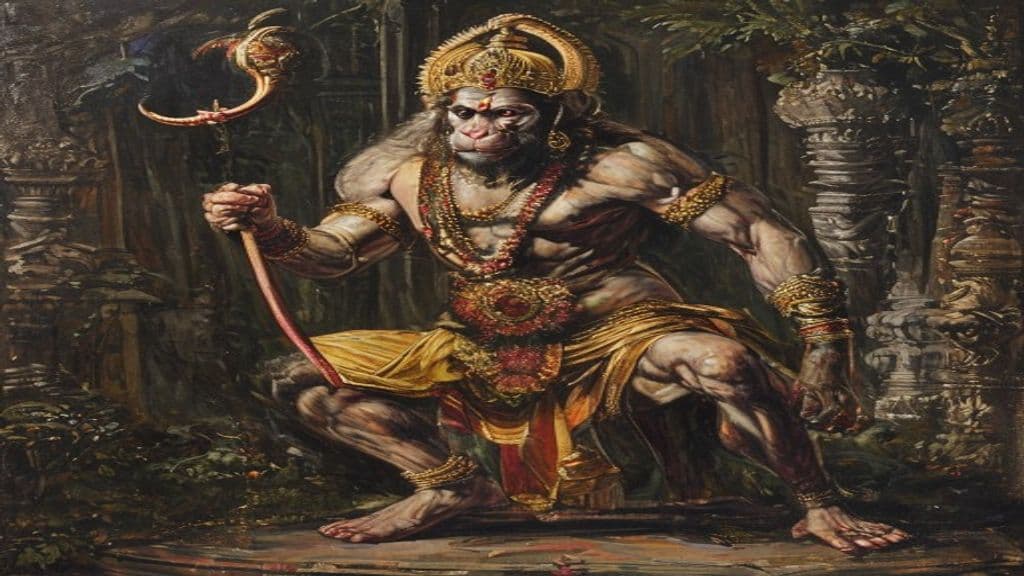
Narrative sources describe Makaradhwaja as a hybrid figure combining monkey/vanara features associated with Hanuman and reptilian/aquatic Makara traits; accounts present him as 'part Vanara and part reptile' or 'part Vanara and part Makara' when he confronts Hanuman at Patala's gate. Textual reports do not provide standardized iconographic details such as precise coloration or measurements, though temple imagery in some local contexts depicts him alongside Hanuman.
Sources emphasize martial strength, virility, and duty: Ahiravana assigns him the role of guarding the gates of Patala after noting his strength. In the key episode he challenges Hanuman and fights him; after being defeated he submits and is taken along by Hanuman. The tradition frames him as an exemplary devotee (bhakta) of Ahiravana. The supplied accounts do not enumerate distinct supernatural powers beyond his hybrid form, guardian role, and physical prowess.
Maikubi
Maikubi is a localized yokai from Manazuru in Kanagawa Prefecture associated in modern sources with maritime misfortune; summaries portray it as a three‑headed sea creature whose presence coincides with shipwrecks and other sea disasters.
Maina
The Maina (also spelled Meena) are an indigenous human group traditionally living along the north bank of the Marañón River in the upper Amazon. Historically they spoke varieties of the Omurano language (many now speak Urarina) and were among the first tribes in the upper Amazon to be evangelized by the Catholic Church, lending their name to colonial jurisdictions such as the province of Mainas.
Maine mac Darthacht
Primordial entity associated with darkness and light, connected to Celtic mythology's Tuatha Dé Danann pantheon. (Note: 1. "Primordial entity associated with darkness and light" - source material only mentions association with night/darkness, but not explicitly light. 2. Power tier should be reviewed as Maine mac Darth)
Mairu (Basque water spirits)
In Basque mythology, Mairu are a type of water spirit associated with the natural environment and regional folklore. (Note: * Power tier should be Lesser (as they are regional spirits associated with specific areas) * Appearance and Abilities sections need to be filled in based on more detailed source material * Weaknesses)
Maitreya
Maitreya (Pali: Metteyya) is the bodhisattva prophesied in Buddhist traditions to be the next fully awakened Buddha who currently resides in Tushita heaven and will be reborn on earth to re-establish the Dharma. In modern esoteric/Theosophical literature he is also depicted as an advanced spiritual teacher in a hidden hierarchy, a distinct framing from the classical Buddhist accounts.
Makara
A legendary aquatic hybrid creature in South Asian (primarily Hindu) tradition, the makara functions as the vehicle (vahana) of water deities, an emblem of Kamadeva, and a pervasive guardian motif in Hindu and Buddhist temple architecture.
Makedon
Makedon (Μακεδών; also Makednos, transcribed Macedon) is the eponymous ancestor and founding progenitor of the Makedones (ancient Macedonians) in fragmentary ancient Greek genealogical narratives. He functions as a legendary first man in etiological accounts that explain the origin of the Macedonian ethnonym and identity.
Makuragaeshi
A Japanese folkloric phenomenon literally meaning "pillow flip" (枕返し or 反枕), described as a bedside yōkai or nocturnal spirit that comes during sleep to turn over a sleeper's pillow or change the orientation of head and feet. Accounts vary: some depict a small-child or bōzu-like figure (makura-kozō), others describe the effect as produced by the spirit of someone who died in the room, domestic tricksters (zashiki-warashi), animal/tree spirits, or temple-associated apparitions.
Mala'ika
Mala'ika are angels — heavenly, created spiritual beings described in the supplied sources as created by God from a luminous origin and primarily known from Qur'anic and later Islamic literature; the provided materials do not supply Coptic-language forms or Coptic-specific folklore details.
Malebranche (Divine Comedy)
In Dante Alighieri’s Inferno the Malebranche are a squad of clawed, quarrelsome demons charged with policing Bolgia Five of the Eighth Circle (Malebolge). They act as vulgar, treacherous warders who seize sinners from the boiling pitch, prevent escape, quarrel among themselves, and interact deceptively with Dante and Virgil under the leadership of Malacoda.
Maleficent
A fictional, high-powered supernatural female figure from modern popular-media retellings of the Sleeping Beauty tale (notably Disney’s 1959 animated film and the 2014 live-action film). She is portrayed as a powerful fairy who issues binding curses, commands animal familiars and forces, and whose motives range from unambiguous wickedness (1959) to a morally complex protector seeking revenge (2014).
Malin Kundang
A figure from an Indonesian folktale, transformed into stone as a result of his disobedience and retribution. He represents the consequences of one's actions, emphasizing filial piety and obedience. (Note: 1. Power tier should be assigned based on the entity's abilities; since it doesn't have any mentioned abilities, this might not be applicable. 2. Appearance should be added to describe Malin Kundang's)
Community Record
- [1]Makaradhwaja. Wikipedia: Makaradhwaja (accessed via provided research notes)wiki
- [2]Pharmaceutical study of Triguna and Shadguna Balijarita Makaradhwaja. Kupipakwa preparation study (archive.org record of PMC3665097)academic
- [3]Standard manufacturing process of Makaradhwaja prepared by Swarna Patra - Varkha and Bhasma. Kupipakwa Rasayana manufacturing study (archive.org record of PMC3215406)academic
- [4]Who were Ahiravan and Mahiravan?. Hinduism Stack Exchange discussion on Ahiravana (referenced in research notes)other
- [5]RAMAKATHA RASAVAHINI-2 CHAPTER9. Vahini.org Ramakatha retelling (referenced in research notes)folk
- [6]Review on various experimental and clinical studies on Makaradhwaja. Annotated bibliography / review of experimental and clinical studies on Makaradhwaja (ABIM)academic
- [7]Preclinical HbA1c level studies of makaradhwaja and siddha makaradhwaja. Preclinical study on Makaradhwaja (IJBCP article referenced in notes)academic