In Mesopotamian religious language Mīšaru is not a late anthropomorphic invention but the divine hypostasis of the legal-administrative notion mīšaru, derived from the Akkadian verb ešēru 'to straighten up.' Textual evidence treats him as a member of the household of the weather god Adad and the goddess Shala, explicitly listing him as one of their children in god lists (An = Anum). He appears in the earliest attestations from the Ur III period and continues in Old Babylonian, Assyrian, Neo-Babylonian/Seleucid contexts; cult centers and temple placements include a temple near Dūr-Rīmuš, presence at Bad-tibira, Mari, Sippar, Babylon (Esagil context), Assur (Ešara), an akitu temple with Adad at Udada in Suhum, and later introduction into the Seleucid Uruk pantheon. A cognate deity named Mêšaru (mšr) is attested at Ugarit and is paired there with Ṣidqu, indicating a shared ancient Near Eastern tendency to personify 'rectitude' as a divine figure.
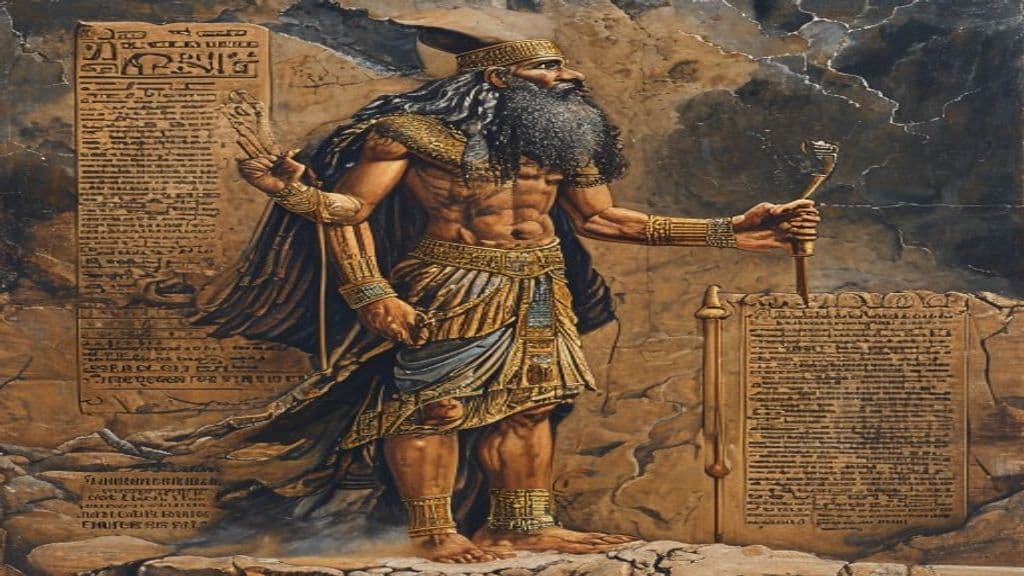
No secure iconographic description of Mīšaru is preserved in the cited sources. Scholarship has proposed — without conclusive proof — that cylinder seals might depict Mīšaru as a figure holding scales; this attribution is explicitly noted in the literature as unproven. Beyond that proposal, the supplied materials do not preserve a reliable physical portrayal or standardized iconography for the deity.
Mīšaru's primary function is as the personified principle of justice, rectitude, and the corrective activity implied by the Akkadian noun mīšaru. He is attested in textual ritual contexts as a divine judge and as one of groups of gods invoked in divination and state cult: he is named among seven divine judges in Assyrian/Old Assyrian lists, appears in the Extispicy Ritual I manual alongside Adad, Shamash, Aya and Kittu as a deity who could receive offerings during an oracle, and is listed in the Ashurbanipal version of the Tākultu ritual alongside Ea and Kittu. He is also present in offering lists, theophoric personal names (e.g., Puzur-Mīšar), and temple placements (e.g., 'seated in front of Shamash' with Kittu and Dayyānu in a Nabonidus cylinder inscription at Sippar), indicating cultic reception of offerings and participation in rituals connected to kingship, divination, and legal order.
Adad
Adad (also Hadad, Haddad; Sumerian Iškur) is the storm- and rain-deity attested in ancient Mesopotamian and Canaanite religious contexts. Sources identify him as a principal weather god whose domain is storms and rainfall and whose name appears across multiple Near Eastern languages and sites, including Ebla (as Hadda, c. 2500 BCE).
Shala (Šala)
Shala is a Mesopotamian goddess associated with weather and grain, known principally as the wife/consort of the storm god Adad (Ishkur). She appears in god lists, hymns and cylinder‑seal inscriptions from the Old Babylonian period onward and functions as a fertility and communal-protective figure tied to dew and agricultural well‑being.

Ishtar (Inanna)
Major ancient Mesopotamian goddess of love, fertility/sexuality, and war, worshipped originally in Sumer as Inanna and later in East Semitic cultures as Ishtar. She is a principal divine figure associated with political power, divine law, and seasonal cycles, and appears prominently in myths such as The Descent of Inanna/Ishtar.
Community Record
- [1]Mīšaru. Wikipedia, entry 'Mīšaru'wiki
- [2]Wikidata: Mīšaru. Wikidata entry Q115822154other