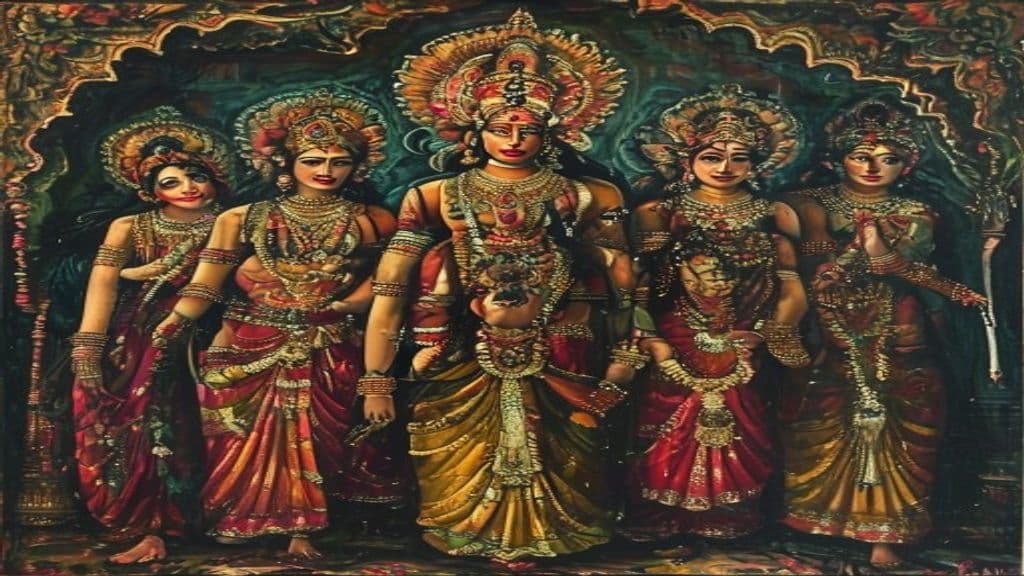
Sources trace Matrika motifs into early Indian religious history: some scholars note possible echoes in Vedic references to 'seven Mothers' and contested suggestions of prehistoric continuities, but clear textual references appear by the Mahabharata and iconographic evidence from the Kushana (1st–3rd c. CE) and Gupta (3rd–6th c. CE) periods. Historically they emerged from local and village mother-goddess practices and were gradually assimilated into mainstream temple and tantric/Shakta frameworks, where they are often presented as the feminine energies (shaktis) or attendants of major deities and as components of the great mother goddess's power (for example, Durga).
The Matrikas are typically depicted as a grouped set—commonly seven, sometimes eight—each associated iconographically with a particular male deity and bearing attributes that link her to that god (traditional correspondences include Brahmani, Vaishnavi, Maheshwari, Indrani, Kaumari, Varahi, Narasimhi, with Vinayaki/Chamunda appearing in some lists). Artistic treatments combine maternal femininity (in some archaic figures hands-on-belly gestures or 'mother' attributes) with threatening emblems and weapons; for example, Varahi is traditionally shown with a sow's head in some representations.
Matrikas personify particular feminine powers (shaktis) and operate across a spectrum from life-giving to dangerous: they are invoked for fertility, conception, protection of children, and village welfare, and are also feared as causes of disease, child mortality, and other perils. In Tantric/Shakta mythic contexts they act as the assistants or extensions of a principal mother goddess (notably Durga/Chandi) and join her in martial action against demons. Their dual role led communities to propitiate them to avert misfortune and to enlist their protective powers when integrated into temple and tantric ritual schemes.
Weaknesses
- otherritual containment and marginalization (placement of shrines beyond city boundaries)
Wards
- ritualBalagraha propitiation rites
- ritualIncorporation into temple/tantric schemes
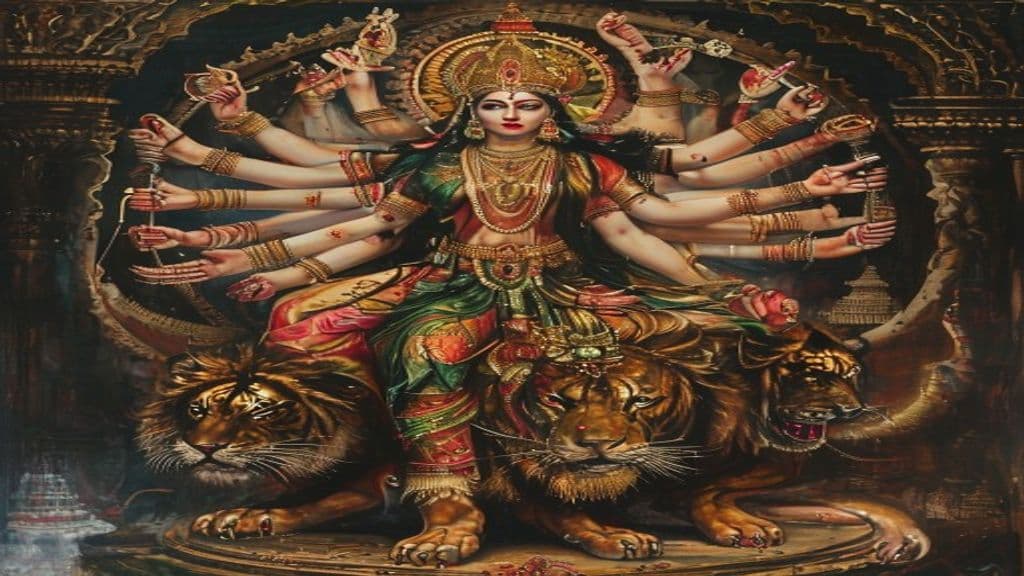
Adi (asura)
Adi is attested in modern reference works as the name of an Asura who 'appears in the Matsya Purāṇa.' Beyond this single-line citation in secondary sources, no descriptive material about the figure is provided in the supplied research notes.
Adi Shakti
Adi Shakti (also Adi Parashakti, Mahadevi, Adya Shakti) is the primordial feminine power in Hindu/Shakta theology, regarded as the ultimate reality (Para Brahman) and the source from which all goddesses and gods manifest. She is both an impersonal cosmic principle (Mulaprakriti) and a focus of devotional invocation in temples, mantras, and pilgrimage sites such as Shakti Peethas.
Adi Vinayaka
Adi Vinayaka (Ādi Vināyaka; also called Nara Mukha Vinayaka) is a named iconographic and devotional form of the Hindu god Ganesha portraying the deity with a human head, described in sources as the form before the episode of decapitation by Shiva. It is rarely worshipped and appears in a small number of South Indian shrines and in devotional/musical repertoires.
Aditi
Aditi is a major Vedic goddess in Hindu tradition who personifies the boundless, infinite cosmic principle and functions as the maternal matrix from which many celestial deities (the Ādityas and other groups) are born. In the Vedic hymns she is invoked as a protective liberator who guards petitioners, provides wealth and safety, and frees devotees from hindrances such as sin and sickness.
Agni
Agni is the Vedic personification of fire in Hindu tradition: a sacred, mediating principle that manifests as terrestrial fire, atmospheric lightning, and celestial sun, and that receives and conveys sacrificial offerings. Prominent in the Rigvedic corpus, Agni functions as sanctifier, witness of rites of passage, and a transformational inner principle in later Upanishadic literature.
Ahalya
Ahalya is a mytho-legendary woman of South Asian (primarily Hindu) narrative tradition, described as created by the god Brahma, married to the sage Gautama, seduced (or tricked) by Indra, cursed by her husband, and ultimately redeemed by Rama. Her tale is a locus for themes of creation, desire, curse/penance, and redemption and she is counted among the ritual-mnemonic panchakanya.
Aindri (Indrani / Shachi / Paulomi)
Aindri (commonly rendered in sources as Indrani, also called Shachi or Paulomi) is a Hindu goddess presented as the queen-consort of Indra. She is depicted in the available material as a courtly queen associated with beauty, pride and kindness who also appears in at least one account as an active martial participant in the devas' battles with asuras.
Akhilandeswari
Akhilandeswari (Akhilandeshwari) is a major South Indian manifestation of the Hindu Goddess Adi Parashakti/Parvati, venerated as the presiding goddess of the Jambukeswarar Temple in Thiruvanaikaval. In temple tradition she is portrayed as a penitent/student of Shiva and figures in local legends, ritual schedules, and festivals that emphasize both maternal and fierce aspects.
Akshayavata
In Hindu mythology, Akshayavata is a sacred banyan tree and/or lake that symbolizes eternal life. It is mentioned in both Hindu and Jain traditions and associated with the Puranas. (Note: - The power tier should be "Greater" or at least "Ancient", as it is associated with the Puranas, which are considered ancient texts. - No specific physical description is provided, but that doesn't m)
Alakshmi
Alakshmi is an inauspicious female supernatural figure in Hindu tradition, presented as the negation or shadow-counterpart of the prosperity-goddess Lakshmi. She personifies poverty, grief, jealousy and social discord and is managed in domestic ritual and festival practice.
Alamelu
Alamelu (also Alamelu Manga / Alarmel Mangai) is a South Indian devotional name for the goddess Padmavati, identified in sources as an avatar of Lakshmi and the consort of Venkateswara; the name is also used widely as a female personal name and in titles of cultural works in Tamil and Telugu contexts.
Amrita (Buddhist tradition)
In the context of Indian religions, particularly within Hinduism and Buddhism, Amrita is a divine elixir that grants immortality and eternal life. (Note: - Power tier should be Ancient (deity-level), not Primordial. - Origin story appears accurate but lacks specificity on when Amrita was first mentioned in the Rigveda; add more detail. - Abilities are )
Community Record
- [1]Matrikas. Wikipedia: Matrikaswiki
- [2]Varahi. Wikipedia: Varahi (notes Varahi's iconography including sow head)wiki
- [3]Mother Goddess (Matrika) (Metropolitan Museum Archive excerpt). Metropolitan Museum Archive commentary on Matrikas and marginal shrine placement; combined power embodied in Durgaother
- [4]Udayagiri Caves (iconographic evidence). Archive material on Udayagiri cave sculptures (c. 400–450 CE) showing early Matrika imageryother
- [5]Icons of the Matrix II (supplementary iconographic discussion). Iconographic and comparative discussion of mother-figure motifs and Matrika assimilationother
- [6]7 Mukhi Rudraksha Is Dedicated To The Seven Matrikas. Archive material linking devotional objects and the seven Matrikas (contextual)other
- [7]Viewpoints which Matter: Sapta Matrikas (blog summary of scholarship). Blog discussion summarizing historical and cosmological readings of the Saptamatrikas (used for contextual points; not a primary text)other