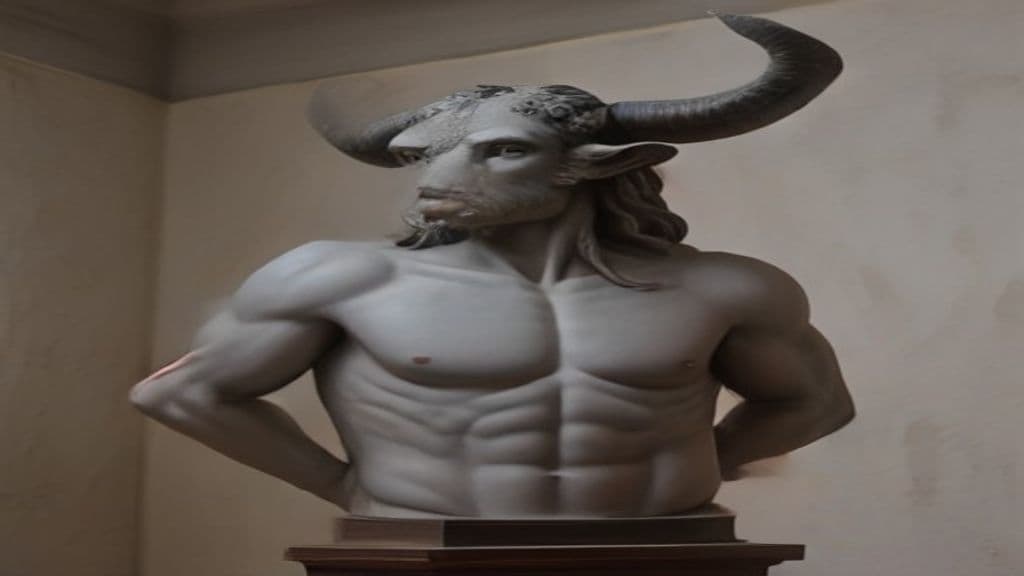
According to the classical tradition summarized in the provided sources, the Minotaur is the unnatural offspring produced when Pasiphaë, queen of Crete, mated with a bull sent by Poseidon after Minos failed to sacrifice it. The birth of the creature—named Minōtauros (literally 'Bull of Minos') and also called Asterion in some Cretan usages—is presented as the outcome of divine retribution for Minos's sacrificial failure and subsequent curse. The monster was nursed and grew in size and ferocity, becoming dependent on human flesh; Minos then confined it at the palace center, commissioning Daedalus to build the Labyrinth to contain the danger and to regulate its existence politically and ritually.
Classical iconography commonly depicts the Minotaur with the body of a man and the head and tail of a bull (human torso/limbs with a bovine head). This configuration is the prevalent Attic/Greek representation. Some later accounts and artistic traditions (in part due to Ovid's vagueness in Latin narrative and medieval/Renaissance reception) present variant forms, including depictions with a man's head and torso on a bull's body; these reversed configurations are chiefly later developments rather than the standard classical portrayal.
Classical narratives emphasize the Minotaur's monstrous size, ferocity, and carnivorous appetite: he devoured humans for sustenance. The creature functions as the focus of a ritualized political tribute (youths and maidens sent from Athens) and as the narrative obstacle whose existence motivates heroic action (Theseus's voyage, infiltration of the Labyrinth, and slaying of the beast). The cited sources do not ascribe explicit supernatural powers such as magical invulnerability or cosmic control; the emphasis is on physical menace, appetite, and threat to human communities.
Weaknesses
- conditioncontainment in Labyrinth
- othervulnerability to mortal hero (slain by Theseus)
Wards
- ritualarchitectural containment (the Labyrinth)
- otherAriadne's guiding thread
Cyane
Cyane (Ancient Greek Κυάνη, Kuánē, 'dark blue') is a Sicilian water-nymph (naiad) associated with a spring or pool near Syracuse. In myth she attempts to block Hades' abduction of Persephone, pleads by citing her own consensual relationship with the river-god Anapus, and—after failing—dissolves into the waters of her pool; the spring is thereafter sacred and named for her.
Minepa
Minepa is a name attested both as a Tanzanian place-name and, in a small number of modern compilations and database entries, as a spirit label associated with the Makua (Makuwa). Documentary evidence treating Minepa as a supernatural being is sparse and consists largely of secondary lists and a machine-readable database tag rather than ethnographic description.
Minhocão
Minhocão is a legendary monstrous animal in Brazilian folklore described variously as an enormous earthworm, fish-like, or serpentine creature. Folkloric accounts portray it as subterranean or amphibious and associate its passage with large-scale alterations to the landscape (e.g., sinkholes, terrain changes).
Minkah (Lakota)
No documented Lakota supernatural being named 'Minkah' is present in the supplied source set. The name appears in the provided materials only as the given name of a contemporary individual (Minkah Fitzpatrick); there are no ethnographic, linguistic, or folkloric sources in the corpus that describe a Lakota entity called Minkah.
Minnie Quay
A place‑bound apparition from Forester (present-day Forester Township), Michigan: Mary Jane "Minnie" Quay is a local ghost legend of a teenage girl who drowned in 1876 and whose spirit is said to haunt the pier, beaches, and cemetery. The tale survives in local oral tradition, regional ghost literature, and popular retellings; a customary practice of leaving offerings at her gravesite is associated with the legend.
Minoan Genius
A recurrent composite supernatural attendant in Bronze Age Minoan iconography, typically depicted as a libation-bearer and cultic supporter in sacrificial, processional, and ritual scenes. The label "Minoan Genius" is a modern scholarly convention; the figure appears widely on seals, sarcophagi and other ritual art in Minoan Crete and later in Mycenaean contexts.
Minos
Minos is a legendary Cretan king in ancient Greek myth, remembered as a lawgiver and founder of Cretan naval power in life and as one of the three judges of the dead in Hades after death. Classical sources present him as a semi-divine, politically powerful mortal (son of Zeus and Europa) whose authority is both terrestrial and judicial in the afterlife.
Miraz
Miraz is a human monarch and the principal antagonist of C. S. Lewis's Prince Caspian. A Telmarine king and usurper, he rules Narnia through oppression and seeks to suppress the older, enchanted history and sanctity of the land.
Misenus
Misenus is a figure from Greek and Roman mythic narrative traditions, chiefly known from Virgil's Aeneid as Aeneas's trumpeter whose death and required burial become a ritual hinge for the hero's descent to the Underworld. The name also appears elsewhere in Greek tradition as a friend of Odysseus.
Mishing Bura
The ancestor-spirit of the Mishing (Mising) people of Assam — a riverine tribal community whose spiritual world is centred on the Brahmaputra. The Mishing Bura are the elder-spirits who guard the river routes, bless the boats, and must be propitiated before any significant water journey.
Mishipeshu (Underwater Panther)
Mishipeshu, often rendered in English as the Underwater Panther or Great Water Lynx, is a major mythic water-being of the Northeastern Woodlands and Great Lakes region, especially in Anishinaabeg/Ojibwe-related traditions. Described as a hybrid feline–aquatic monster, it personifies powerful and potentially dangerous forces associated with deep lakes and is repeatedly cited in modern summaries as one of the most important regional water spirits.
Misizla
Slavic mythological figure described as a 'godlike hero' and warrior-musician, associated with restoring Slavic pagan faith. (Note: * Power tier: Greater (Misizla is described as "godlike" but not with cosmic powers) * Origin story: missing * Abilities: no specific details, but some mention of interactions with humans or his role )
Community Record
- [1]Minotaur - Wikipedia. Wikipedia: 'Minotaur' article summarizing classical tradition, etymology, appearance, creation myth, Labyrinth, tribute, and slaying by Theseus.wiki
- [2]Minotaur - Wikidata. Wikidata entry linked to the Minotaur concept and identifiers used in modern reference.other
- [3]Monsters. Archive entry listing (secondary literature on monsters referenced in the research notes).other