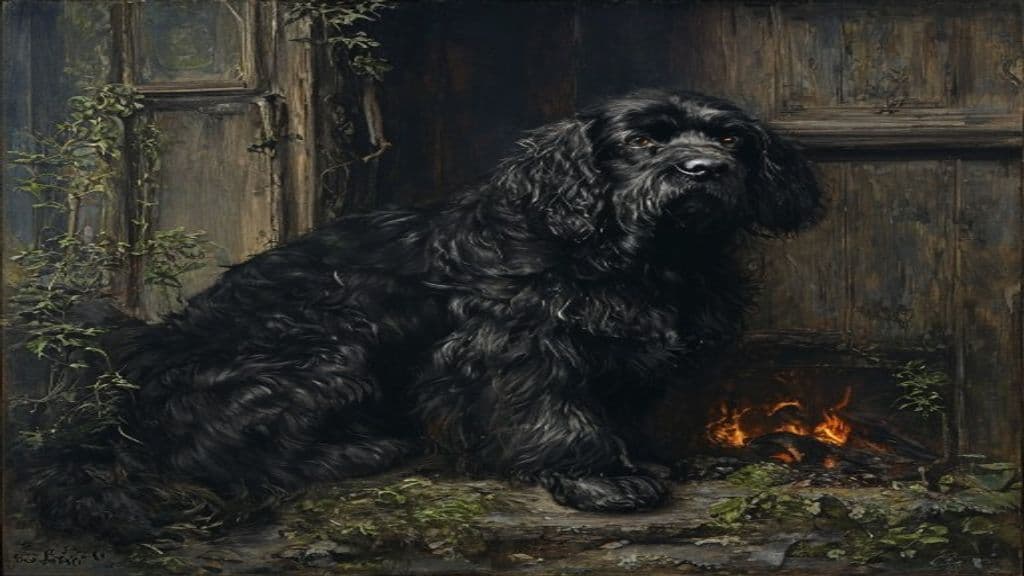
The primary written source for the Peel Castle story is an 18th‑century account by George Waldron, who records that an apparition called in their language the Mauthe Doog haunted Peel Castle and was frequently seen in the guard‑chamber. Waldron's narrative describes how soldiers grew accustomed to its nightly presence until a single incident involving a drunken watchman who took the keys alone ended with the man 'ghastly frightened' and dying three days later; after this event Waldron records the passage the dog used was sealed and an alternative route built. The tale was later popularized and adapted in 19th‑century literature (e.g. Sir Walter Scott) and expanded in 20th‑century folkloric collections (notably William Walter Gill), which preserved additional local sightings and variant details.
In Waldron's classic account the Moddey Dhoo appears 'in the shape of a large black spaniel with curled shaggy hair' and lies by the guardroom fire. Later collectors and modern reports record a range of sizes and variants: ordinary dog‑sized manifestations, accounts describing a creature nearly the size of a calf, and local versions that include a headless form noted in William Walter Gill's collection. Eye descriptions vary among sources, from 'bright' or 'coal‑like' eyes in modern witness reports to later borrowings such as 'eyes like pewter plates' found in some retellings.
Waldron portrays the Moddey Dhoo as a recurrent, place‑bound apparition with a regular schedule—emerging at dusk from a particular passage and returning there at dawn—and as largely non‑interventionist in routine sightings (soldiers observed it lying by the fire). The narrative records a single traumatic encounter in which a watchman, after seizing the keys alone while drunk, returned 'ghastly frightened' and died three days later; Waldron does not ascribe a specific supernatural causation beyond the account's sequence of events. Later modern reports expand behavioral notes to include roadside or lane sightings and lurking at corners near farmsteads, but these come from later folkloric collection rather than Waldron's original castle account.
Weaknesses
- conditionsealing or denial of access to its passage
Wards
- otherarchitectural avoidance (sealing the passage and constructing an alternative route)
Black Shuck
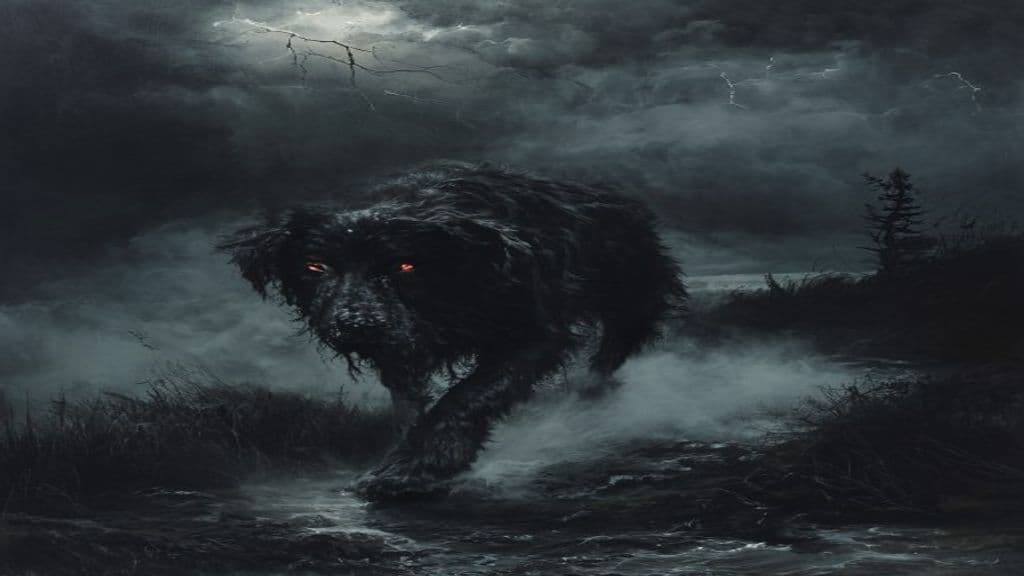
A spectral black dog of East Anglian legend, with glowing red or green eyes. Its appearance is an omen of death. Its howl has been heard on clifftops during storms for centuries.
Will-o'-the-Wisp
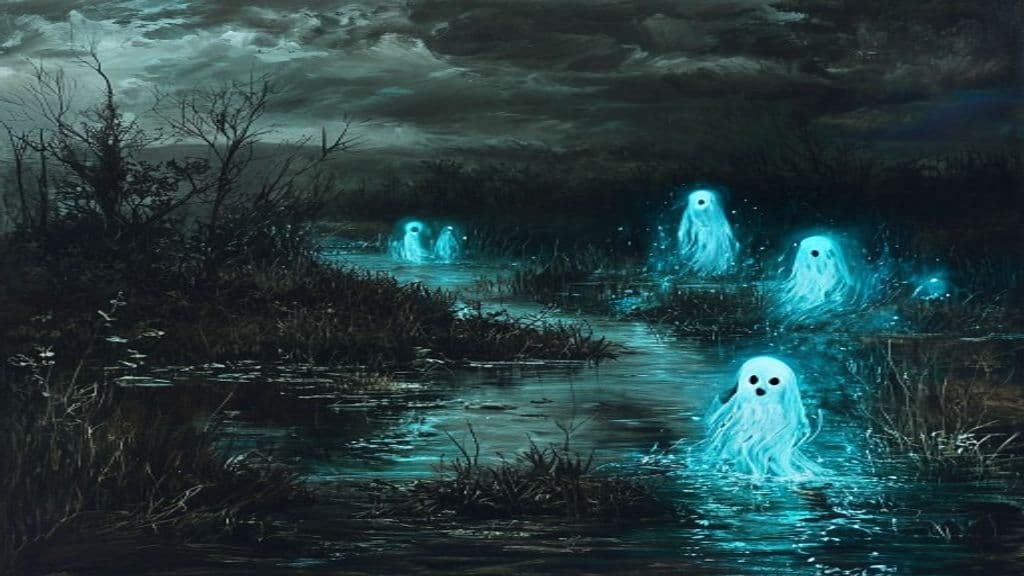
A wandering light seen over marshy ground at night, leading travellers astray into bogs and fens. Possibly a spirit, possibly the soul of the unbaptised dead, possibly the devil himself.
Kelpie
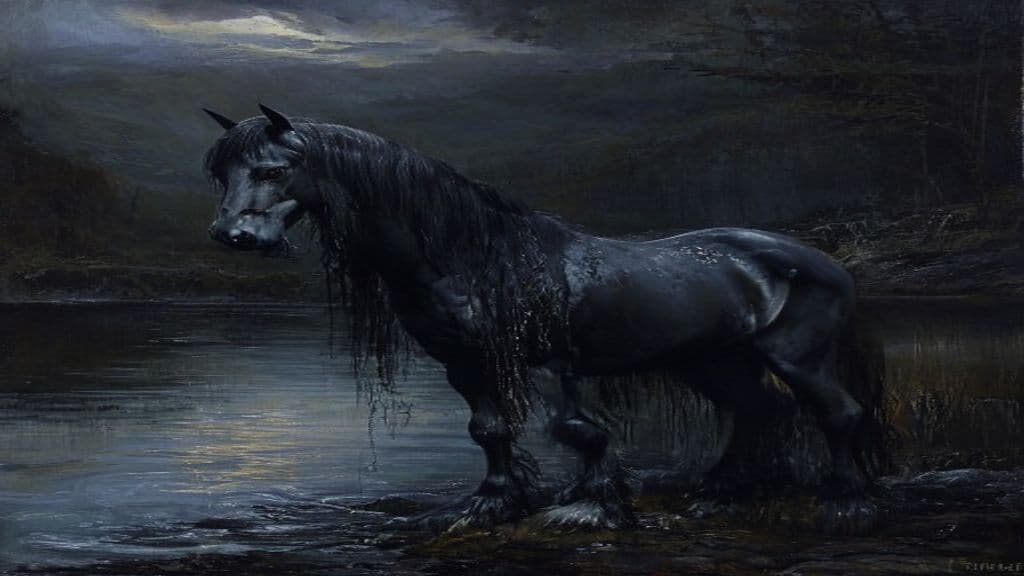
A Scottish shape-shifting water horse that appears as a beautiful tame horse near lochs and rivers, then drowns and devours any rider foolish enough to mount it.

Ghoul
A ghoul is a demon-like or monstrous humanoid originating in pre-Islamic Arabian religion, traditionally associated with graveyards and the consumption of human flesh. The concept later entered broader folklore and has been widely reused and transformed in modern fiction and popular culture.
Arkan Sonney
A Manx folkloric 'fairy animal' whose name is also the everyday Manx word for hedgehog; in tradition it appears as a white pig that brings good fortune to those who see or catch it but causes misfortune if held too long.
Buggane
A large, malevolent supernatural being from Isle of Man folklore, described in tales as ogre- or giant-like and sometimes a shapeshifter. Buggane stories depict it damaging buildings and livestock, attacking people, and appearing in coastal and farm contexts; some tales limit it by sacred or liminal boundaries such as water and hallowed ground.
Mneme
Mneme (Ancient Greek: Μνήμη, literally 'Memory') is recorded by Pausanias as one of a local triad of Muses at Mount Helicon (with Aoede and Melete) in Boeotian tradition; the name personifies memory within the Muse category and was later superseded in wider tradition by the canonical nine Muses.
Mnemosyne
In ancient Greek myth and cult Mnemosyne (Μνημοσύνη) is a Titaness-personification of memory who functions as the ancestral source of the nine Muses and as a presiding power in poetic invocation and certain initiatory/oracular rites. In Hesiodic and classical practice she underwrites poetic authority; in Orphic and oracle contexts she is associated with waters of memory that contrast with Lethe.
Mnesimache
Mnesimache (Ancient Greek: Μνησιμάχη) is a minor mortal figure in Greek mythic genealogies—an Olenian princess, daughter of King Dexamenus—noted chiefly as a victim of a forced betrothal/near-abduction by the centaur Eurytion and as a genealogical link (mother of Diores in one tradition; possibly named as mother of Menestheus in another variant). Her rescue by Heracles places her within Heraclean narrative cycles.
Mnestheus
Mnestheus is a legendary Trojan captain and lieutenant of Aeneas in Virgil's Aeneid, presented as the ancestral hero of the Roman gens Memmia and linked to the house of Assaracus. He appears in the epic's funeral-games (Book V) as a naval competitor and in military leadership scenes in Book IX, where he assumes command in Aeneas's absence.
Mnevis
Mnevis is the ancient Egyptian sacred bull cult of Heliopolis (On), regarded as the living manifestation or ba of the solar god Ra and later assimilated with Atum‑Ra. A single living bull served as an oracular and cultic presence, entitled to ritual attendants and embalmed and buried with honours in a dedicated necropolis; the cult persisted into the late Pharaonic and classical periods and was one of the few cults tolerated during Akhenaten's reign.
Modheshwari
Modheshwari (Gujarati: મોઢેશ્વરી) is a localized tutelary form of the Great Goddess worshipped as the clan deity (kuldevi) of the Modh communities of Gujarat. Described in source materials as a martial incarnation of the Goddess (linked variably to Parvati/Adi Parashakti and to the devi Matangi), she is credited in tradition with slaying a local demon and promising protection to her devotees.
Modthryth
Modthryth is a literary royal figure attested in the Old English poem Beowulf, presented as a princess who initially behaves violently toward men beneath her rank but is later depicted as a reformed and celebrated queen. The figure functions in the poem as a foil to other aristocratic women and as a commentary on ideals of queenship (freoðuwebbe) in Anglo-Saxon literary culture. The manuscript reading of her name and the precise sense of the compound are subjects of scholarly dispute.
Moehau
A creature of New Zealand folklore associated with Mount Moehau on the Coromandel Peninsula. In source materials the moehau is presented variably as a local wild/uncanny being linked by some to the Māori maero(maeroero), and by others treated as a modern folkloric label applied to alleged sightings, jokes, or misidentified objects and animals.
Moekākara
Legendary canoe in Māori tradition, used for migration to settle New Zealand. (Note: - Power tier should be "Primordial" since it's a legendary canoe used for migration to settle an entire country. - Summary: Add that Moekākara was captained by Tāhuhunui-o-te-rangi, an ancestor of Ngā)
Moggallāna (Mahāmaudgalyāyana / Maudgalyāyana)
Moggallāna (birth-name Kolita) is presented in early Buddhist texts as one of the Buddha's two foremost male disciples, famed for entering deep jhāna and using supernormal meditative powers to visit devas and observe the states of petas; his eyewitness reports form the narrative frame of the Vimanavatthu and Petavatthu and are used didactically to teach karma and ethical practice.
Community Record
- [1]Moddey Dhoo (Wikipedia). Wikipedia entry 'Moddey Dhoo' summarising George Waldron and later sourceswiki
- [2]Wikidata: Moddey Dhoo. Wikidata short description for Moddey Dhoowiki
- [3]Peel Castle: Moddey Dhoo And Other Manx Tales Of Terror (Spooky Isles summary). Modern summary of the Peel Castle tradition and variantsother
- [4]Archive: The iron wolf and other stories (listing). Archive listing referencing collected tales including the Moddey Dhooother
- [5]Peel Castle Official Guide (Craine, 1969) (archive listing). Guide material referencing castle lore and local traditionother
- [6]Transceltic: Manx castle haunted by the phantom hound 'Moddey Dhoo'. Popular retelling summarising Waldron and later folkloristsother