In popular mythological framing the nine forms are read as the nine stages of Durga enacted across the nine-day war with the demon-king Mahishasura; the sequence culminates in Vijayadashami (victory day). Scriptural and traditional lists vary (for example, popular devotional lists that name Shailaputri, Brahmacharini, Chandraghanta, Kushmanda, Skandamata, Katyayani, Kalaratri, Mahagauri, Siddhidatri contrast with variant enumerations such as the Agni Purana list: Rudrachanda, Prachanda, Chandogra, Chandanayika, Chanda, Chandavati, Chandarupa, Atichandika, Ugrachanda). Sources note that Navadurga are often treated collectively as a single deity among followers of Shaktism and Shaivism and are central to festival calendars (Navaratri, Durga Puja) rather than a fixed singular birth-myth detailed in the provided materials.
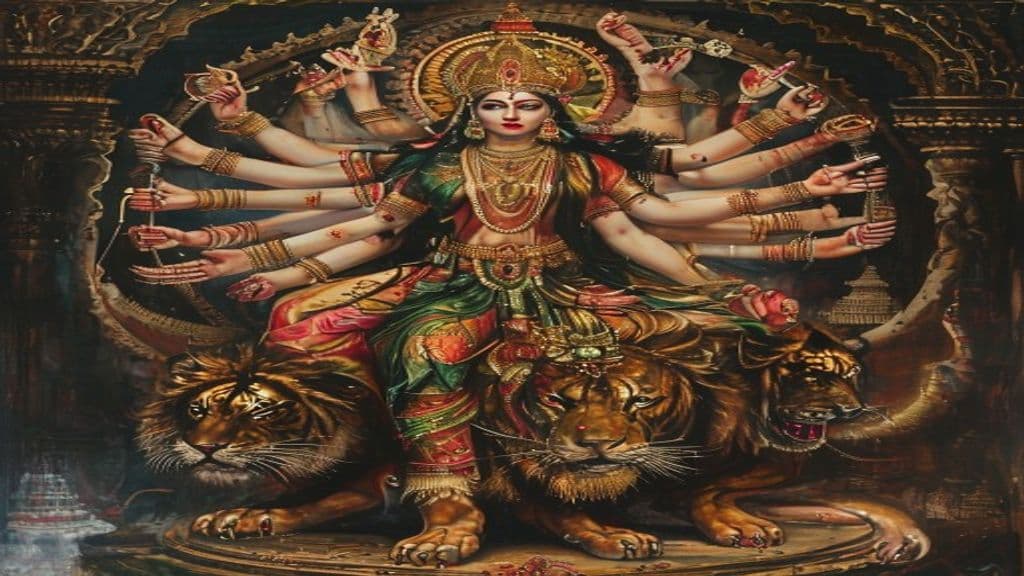
No single standardized iconography is universal across traditions in the provided sources. Devotional and scriptural lists supply names for the nine forms (commonly: Shailaputri; Brahmacharini; Chandraghanta; Kushmanda; Skandamata; Katyayani; Kalaratri; Mahagauri; Siddhidatri) used in popular devotional practice, but regional and textual variants alter emphases. In ritual practice the Navadurga appear as statues in temple puja, as living embodiments when nine young girls (Kumari/virgins up to age nine) are worshipped during Navaratri, and as costumed/masked performer-personae in Newar masked dances and Navadurga Naach (Bhaktapur) and Navadurga Dev Gana processions (Thecho, Lalitpur). Masks, costumes, and dancer-based personification are central to Nepalese enactments, while Durga Puja emphasizes iconographic images and the nabapatrika plant-assembly as a symbolic ensemble.
As mythic agent(s) the Navadurga represent Durga's martial prowess and protective power in the cosmic struggle against Mahishasura, culminating in the re-establishment of dharma; they are invoked for victory and communal protection. Ritually they function as embodiments of divine presence: they are propitiated in household and public rites (Navaratri, Durga Puja), embodied by living girls in domestic worship, and enacted by masked performers and deity retinues (dev ganas) in Nepalese jatras and naach that manage life-cycle, rebirth, and communal renewal. The sources do not represent Navadurga as malignant; rather, their cultic role is protective, regenerative, and celebratory.
Weaknesses
None recorded.
Wards
- ritualWorship during Navaratri (devotional puja and offerings)
- ritualWorship of nine young girls (Kumari-like practice) during Navaratri
- ritualNabapatrika (tying branches/leaves of eight plants with a banana plant during Durga Puja)
- ritualNavadurga Naach / Navadurga Jatra masked performances (enacting deity lifecycle and communal renewal)
Community Record
- [1]Navadurga (Wikipedia). Wikipedia, 'Navadurga'wiki
- [2]Navadurga Rural Municipality (Wikidata/Wikipedia). Wikidata entry for Navadurga Rural Municipalitywiki
- [3]Navadurga Jatra in Lalitpur's Thecho (OnlineKhabar). OnlineKhabar, 'Navadurga Jatra in Lalitpur's Thecho: After 12 years, local deities are reviving their energy for the next 12 years'folk
- [4]Bhaktapur’s Navadurga Naach: How a life cycle ends to be reborn after 2 months. OnlineKhabar, 'Bhaktapur’s Navadurga Naach'folk
- [5]Bhairab Nach and Navadurga: Masked Rituals of Nepal (HIMALAYA). HIMALAYA Research Article, 'Bhairab Nach and Navadurga: Masked Rituals of Nepal'academic
- [6]Tantric/Ritual scholarship: Tantra, Ritual Performance, and Politics in Nepal and Kerala: Embodying the Goddess-Clan (Matthew Martin). Matthew Martin, 'Tantra, Ritual Performance, and Politics in Nepal and Kerala: Embodying the Goddess-Clan'academic
- [7]Navadurga Detailed Significance - The Nine Forms of Goddess Durga (InsightState). InsightState, 'Navadurga Detailed Significance - The Nine Forms of Goddess Durga'other
- [8]Scriptural reference discussion for Navadurga/Navaratri (Hinduism StackExchange). Hinduism StackExchange discussion, 'Scriptural reference for Navadurga'other
- [9]Archive: shri_durga_book. Archive.org, 'shri_durga_book' (local shrine reference / devotional material)other
- [10]Navadurga Ganjifa — The World of Playing Cards. WOPC, 'Navadurga Ganjifa — The World of Playing Cards' (cultural/art-historical reference)other