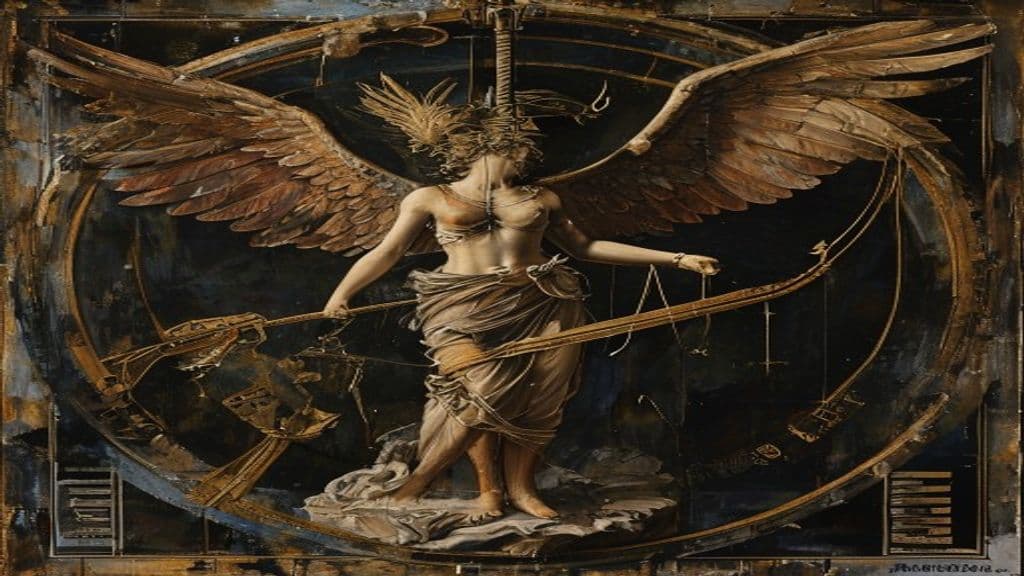
Sources present variant genealogies and statuses. In Hesiodic and early tradition Nemesis appears as a pre-Olympian or early divine power linked to primordial figures (the Hesiodic tradition associates her with Night/Nyx in some lines), while other accounts place her functionally alongside Olympian justice—interacting with Zeus’s dispensation of justice. Later mythographic traditions and epic fragments (e.g., Cypria and later authors) include narrative episodes in which she is involved in the births and destinies of mortals (for example, variants making her the mother of Helen in some stories). These differing accounts reflect her dual character as an ancient force of cosmic ordering and an active agent in literary myth.
Classical iconography portrays Nemesis as a winged goddess. Attributes commonly associated with her in literary and art-historical descriptions include instruments of measurement or restraint (a measuring rod or tally stick, a bridle, scales) and occasionally instruments of enforcement (sources describe depictions of a whip or dagger). Early visual types sometimes resembled mother/earth/fertility goddesses (for example, affinities with Cybele, Rhea, Demeter, or Artemis in certain periods and local cult imagery).
Nemesis embodies distributive justice: she 'gives what is due' by balancing fortune and meting out consequences when proper measure is violated. She is described as the avenger of hubris—implacable and inexorable (epithets such as Adrasteia, 'one from whom there is no escape,' and Erinys are applied). Literary examples of her active role include orchestrating the fate of Narcissus (Ovid) and arranging vengeance in episodes related in Nonnus’ Dionysiaca; she is also presented in epic fragments and mythographic tradition as involved in events surrounding Helen’s origin in some variants (Cypria and later accounts). Over time she is sometimes associated with Tyche (Fortune) as a balancer to chance.
Weaknesses
None recorded.
Wards
- conditionObservance of due measure / avoidance of hubris
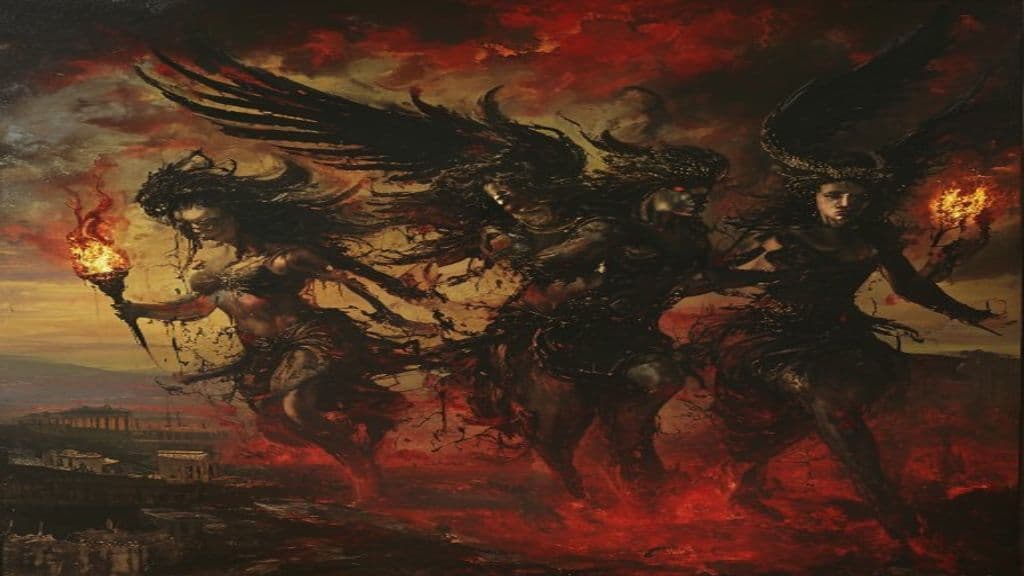
Erinyes
The three avenging Furies of Greek myth — Alecto, Megaera, and Tisiphone — who pursued and tormented those guilty of crimes against blood kin, especially murder of family members.

Tyche
Tyche (Greek Τύχη, Túkhē) is the personified deity of luck, fortune, and the collective prosperity or destiny of a polis. Originating in Classical Greek religion, she becomes especially prominent in the Hellenistic period as an explanatory and civic principle for unpredictable events and continues to appear in Roman iconography (often parallel to Fortuna).

Rhea
Rhea is a principal mother goddess of the Titans in ancient Greek religion and mythology, daughter of Gaia and Uranus, sister and consort of Cronus, and mother of major Olympian deities. In Roman reception she is identified with the Magna Mater (the Great Mother), reflecting continuity of her maternal and cultic role across Greek and Roman traditions.

Artemis
Artemis is an ancient Greek goddess of hunting, the wilderness and wild animals, transitions (especially childbirth and puberty), vegetation, and chastity. Twin sister of Apollo and daughter of Zeus and Leto, she functions as a protector of young children and maidens while also capable of inflicting disease or punishment for transgressions against her sacred laws.
Community Record
- [1]Nemesis — Wikipedia. Wikipedia contributors, 'Nemesis,' Wikipedia, The Free Encyclopedia.wiki
- [2]Nemesis — Wikidata. Wikidata entry Q3874565, 'Nemesis'.other
- [3]Archive mentions of modern uses of 'Nemesis' (name/handle) — audio files. Archive.org Episode 157 - High Stakes (modern usages of 'Nemesis' as name/handle).other
- [4]Archive mentions of modern uses of 'Nemesis' (name/handle) — audio files. Archive.org [Episode 0548] [#Covfefe Break] A Muslim, a Christian, and Two Atheists (modern usages of 'Nemesis').other
- [5]Archive entry referencing modern 'vtfedit_v133' (name reuse). Archive.org vtfedit_v133 (modern reuse of the name 'Nemesis').other