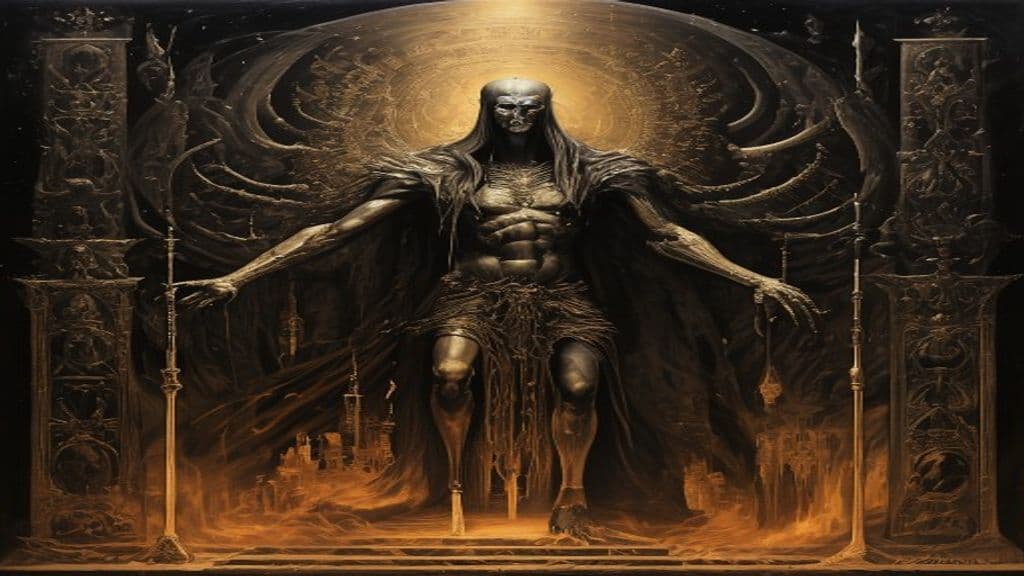
Nergal is attested across Mesopotamian periods and how he assumes underworld rulership is treated variously in literary traditions: in some narratives he rules the Land of No Return by marriage to the underworld goddess Ereshkigal, while other texts present him as a powerful underworld presence or as emerging from his cult place Meslam (hence the name Meslamtaea, "he who has come out of Meslam"). The name Erra, later applied to him, emphasizes his scorching, destructive aspect.
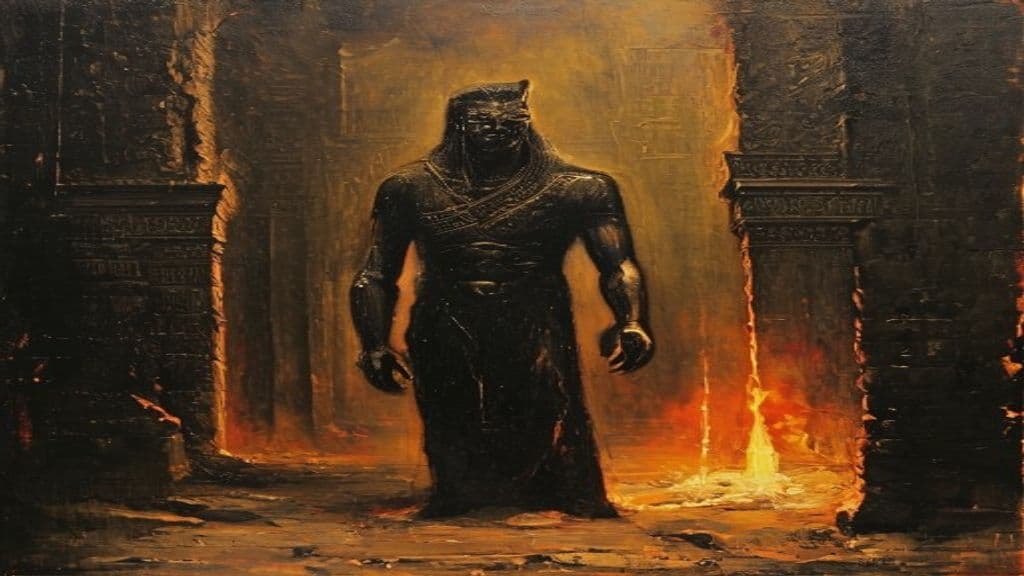
Specific, consistent bodily iconography is not preserved in the provided sources; however hymnic epithets present him as an awe‑inspiring, fearsome force: "furiously raging storm," "resplendent in the Land," and a "mighty quay of heaven and earth." These literary descriptions emphasize terrifying power, radiance, and stormlike fury rather than detailed physical features.
Nergal governs war, plague, and inflicted death and functions as a ruler or powerful presence linked to the underworld (Kur). In mythic narratives (e.g., the Epic of Erra) he is the destructive, raging force who unleashes devastation; in other compositions his marriage to Ereshkigal explains his authority in the Land of No Return. Hymns also depict him as a divine protector when formally invoked by kings and temple cult (e.g., lines calling him a lord who "guards the teeming people"), indicating cultic invocation as a means to harness or restrain his power.
Weaknesses
None recorded.
Wards
- ritualState and temple cultic invocation (adab, tigi) at E‑Meslam
Community Record
- [1]Nergal. Wikipedia, entry on Nergalwiki
- [2]An adab to Nergal for Shu-ilishu (Shu-ilishu A): translation. ETCSL: Adab to Nergal (Shu‑ilishu A)literary
- [3]A tigi to Nergal (Nergal C): translation. ETCSL: Tigi to Nergal (Nergal C)literary
- [4]Nergal and Ereshkigal (retelling). GatewaysToBabylon: Nergal and Ereshkigal retellingliterary
- [5]Nergal - www.GatewaysToBabylon.com. GatewaysToBabylon: overview of Nergal's cult and functionsother