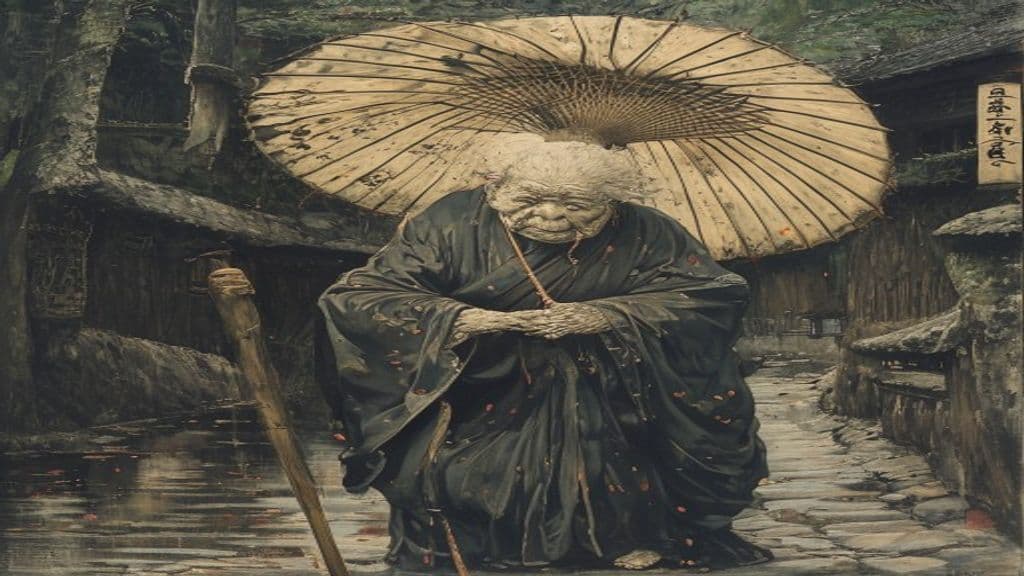
Two distinct strands appear in the sources. In Edo-period yōkai compendia (Konjaku Hyakki Shūi), Toriyama Sekien depicts an oshiroibabā and comments that she may be an attendant of a goddess of red and white oshiroi (Shifunsenjo), though Sekien's remark is ambiguous and the connection to local folklore is not established. Separately, a Hase-dera temple legend (Muromachi-period context) tells of an old woman with a powdered face who appears to painter monks during a time of scarcity; she provides rice that multiplies and is later enshrined at the temple, where a statue of the old woman was ritually powdered annually until around the Meiji era.
Commonly described as an elderly, very bent woman whose face is covered so thickly and messily with oshiroi that looking at her is said to be terrifying. Toriyama Sekien's Konjaku Hyakki Shūi image shows her wearing a large broken umbrella on her head, holding a walking stick in her right hand and a tokkuri (sake flask) in her left. Local accounts (Totsukawa river tradition) add that she may drag a mirror and make a jingling sound as she appears. Folklorists note parallels in imagery to mountain old-woman figures, but such identifications are treated as uncertain.
Sources emphasize striking visual presence and varied roles across accounts rather than explicit supernatural powers. In regional descriptions she appears at particular places and can terrify onlookers by her powdered face; Sekien's commentary places her within a ritual/cosmetic imagery network. The Hase-dera legend attributes a miraculous, beneficent episode to a powdered-old-woman figure (multiplying rice to feed painter monks) and the subsequent enshrinement of an image, indicating that in some localized tradition she can act as a protective or miraculous benefactor. Claims that she begs for oshiroi or seeks sake are suggested by comparisons to mountain-witch motifs but are not uniformly documented.

Yama-uba
A Japanese yōkai of the mountains variously depicted as an old mountain crone, a mountain mother/princess, or an ambivalent mountain spirit who may harm travelers or aid the kind. She appears across folktales, Noh drama, and ukiyo-e, occupying roles from man‑eating hag to guardian linked to household fortune in some regions.
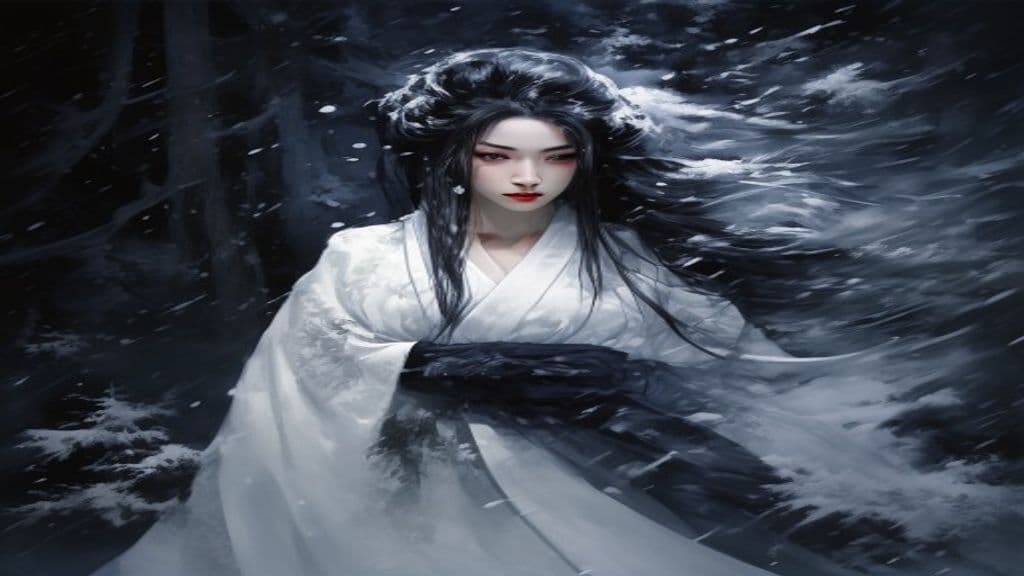
Yuki-onna
The Snow Woman of Japanese folklore — a spirit born of blizzards who appears to travelers lost in snowstorms. Beautiful and lethal, she can show mercy or bring death depending on her mood.
Orseïs
Orseïs (Ancient Greek: Ὀρσηΐς) is attested in Greek mythographic tradition as a Naiad — a freshwater nymph of a spring in Thessalia — who marries Hellen and becomes ancestress of the major Greek tribal progenitors (Dorus, Xuthus, Aeolus). Her attested role is primarily genealogical and place-bound rather than narrative or cultic in the surviving sources.
Orthrus
A monstrous multi-headed hound in Greek myth who guarded the red cattle of Geryon on the far-west island of Erytheia; slain by the hero Heracles during his tenth labour. Described as an offspring of Echidna and Typhon and placed in genealogies of Greek monsters.
Osaki
A class of small, pack-moving animal-spirit (a type of yokai) in Kantō-region Japanese folk belief that attaches to families or individuals, bringing material gain (gold, rice) while imposing social stigma and sometimes producing possession-like illness. The condition can be hereditary (osaki-mochi), shaping marriage and social practice in affected communities.
Osan Kitsune
A regional fox-spirit folktale from Hiroshima Prefecture in Japan. The Osan Kitsune appears in human guise (notably as a woman carrying an infant) to deceive passersby; after entrusting the child to a helper the figure vanishes and the child is revealed to be a stone. The tale is tied to place-names and a small public statue in the Eba area of Hiroshima.
Osangangan Obamakin
Osangangan Obamakin is attested in the provided sources as an early ancestral monarch in the Ife royal genealogy. He appears in lists of predecessors to Obalufon Ogbogbodirin and is invoked in local dynastic accounts as part of the foundational sequence of Oonis of Ife.
Ose
Ose appears in the supplied source corpus only as a listed entry labeled "Ose (demon)" on an English-language Wikipedia disambiguation page. No descriptive, ritual, linguistic, or cultural information about the entity is present in the available materials; the entry is therefore attested but unelaborated in the provided sources.
Oshun
Oshun (Ọṣun, Ochún, Oxúm) is a major orisha and Irunmole in the Yoruba religious corpus and its diasporic traditions, associated with freshwater (rivers), love, fertility, femininity, divination, prosperity and beauty. She is honored at the Osun-Osogbo Sacred Grove and in festivals and ritual forms across Yorubaland and Afro‑Atlantic religions such as Candomblé and Regla de Ocha/Santería.
Osiris
Osiris is the major ancient Egyptian god of fertility, vegetation, death, resurrection, and the afterlife. He functions as sovereign of the realm of the dead, a guarantor of postmortem renewal and agricultural fertility, and the archetypal divine figure with whom deceased kings and mortals ritually unite to gain continuity after death.
Oswald Bastable
Oswald Bastable is a fictional human character whose name appears in two distinct literary traditions: as a child narrator in Edith Nesbit's turn-of-the-century Bastable stories (1899–1905) and as a reused, reinterpreted adult military figure in Michael Moorcock's 20th-century alternate-history/speculative fiction. Moorcock explicitly reused the name to evoke a particular Fabian liberal-imperial milieu rather than to create a direct sequel to Nesbit's tales.
Otake Dainichi Nyorai
Japanese manifestation of Vairocana, embodying wisdom and compassion. (Note: 1. Power tier should be Ancient (deity-level) rather than Primordial (cosmic). 2. Appearance should be noted as "Not specified" due to lack of source material. 3. Abilities, sensory_cues, weaknesses, )
Otoroshi
Otoroshi is an Edo-period yōkai type known from painted emaki (picture-scrolls) and yōkai compendia. Primarily an image-and-name pairing with little classical explanatory prose, it is depicted as a fearsome, hair-covered creature that recurs across several visual catalogues of supernatural beings.
Otso
Otso is the sacred collective bear spirit in Finnish mythology, regarded as the king of animals and leader of the forest. Treated with deep fear and reverence, Otso functions as an animistic ancestral figure integrated into origin myths and communal ritual life (notably the Peijaiset).
Community Record
- [1]Oshiroibabā (Wikipedia). Wikipedia entry 'Oshiroibabā' (summarizes Toriyama Sekien depiction, Totsukawa river folklore, and Hase-dera legend)wiki
- [2]Wikidata: Oshiroibabā. Wikidata item for Oshiroibabāwiki
- [3]Toriyama Sekien, Konjaku Hyakki Shūi (commentary summarized in sources). Sekien depiction and commentary (as summarized in the cited Wikipedia article) linking oshiroibabā to a goddess of red and white oshiroi called Shifunsenjoliterary
- [4]Scattered popular retellings (e.g., 'Face Powder | Japanese Urban Legend' page). Modern popular/urban-legend retellings that present variants and embellishments (not used as primary evidence for classical/local traditions)folk