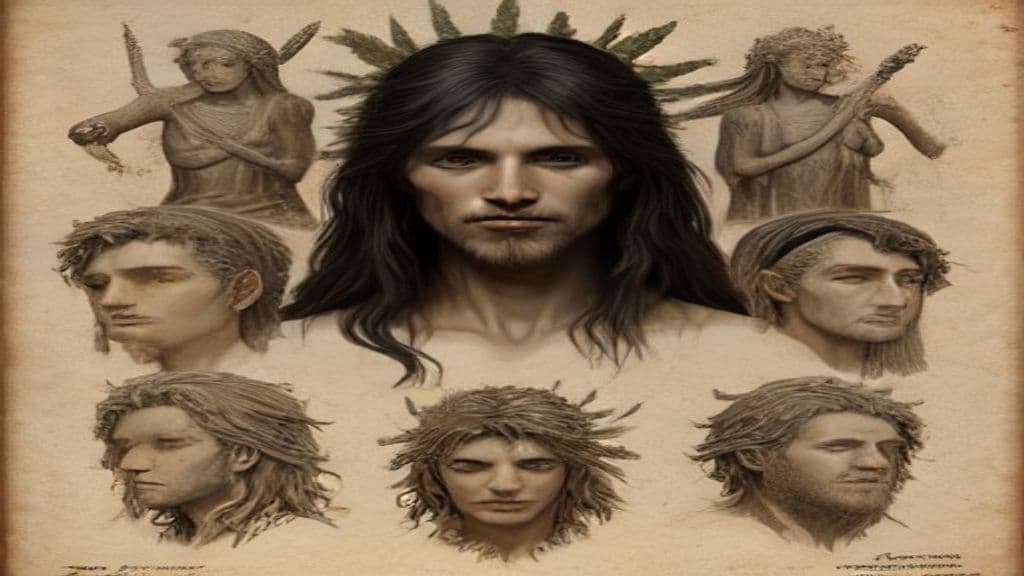
The name Oxylus is used for multiple related figures. In one strand he is a rustic mountain daimon (demi-god) associated specifically with mountain beech-woods, described as a son of a mountain-god (Oreios/Orius) and connected in kinship with Hamadryas; Athenaeus (via Deipnosophistae as cited in modern summaries) is given for the tradition that he fathered the Hamadryads with his sister Hamadryas. In other genealogical accounts Oxylus appears as a son of Ares and Protogeneia, placing him within heroic descent-lines. A separate set of traditions treats Oxylus as a mortal or mythic king originally from Aetolia (son of Haemon in some sources, or of Andraemon in others) who, after contest or conflict, received Elis as his domain. Ancient sources and modern summaries present these as variant and context-dependent traditions rather than a single continuous life-story.
Surviving summaries and reference entries do not preserve a descriptive, iconographic, or consistently attested physical appearance for the woodland Oxylus. Ancient testimonia recorded in the available materials emphasize his function, parentage, and kinship (son of Oreios, husband/sibling of Hamadryas) rather than bodily features. Likewise, the kingly Oxylus is treated as a human legendary figure in foundation narratives; the transmitted material focuses on his genealogy and political role rather than specific physical description.
The sources included in the research notes do not enumerate a catalogue of supernatural powers for Oxylus. For the woodland daimonic Oxylus, ancient summaries describe him functionally as a local spirit of mountain/beech forest and as progenitor of Hamadryads, indicating an immanent, place-linked role within the network of tree-spirits rather than listed magical faculties. For the kingly and genealogical Oxylus, the traditions attribute political and martial agency—winning or receiving Elis as a domain in foundation legends—consistent with human/regional founder-functions in Greek myth. No explicit magical abilities (e.g., shapechanging, compulsion, specialized curses) are attested in the provided material.
Abas
Abas (Ancient Greek: Ἄβας, gen.: Ἄβαντος) is not a single mythic being but a recurring personal name borne by multiple mortals and minor mythic figures in Greek epic and genealogical traditions — kings, founders, seers, warriors, attendants, a centaur, and a youth transformed by a goddess. The name is glossed in the sources as 'guileless' or 'good-hearted' and appears across Argive, Theban, Trojan, Euboean, and other local cycles.
Acheilus
Acheilus (also spelled Akheilos/Achilleus in some sources) is a minor figure of Greek myth described as a mortal son of Zeus who was transformed into a shark and thereafter called a 'shark-formed sea daimon.' Surviving summaries frame his story as a hubris metamorphosis: boasting about his beauty led a goddess to change him into a marine monster.
Achelois
Achelois (Ancient Greek: Ἀχελωίς, 'she who drives away pain') is an attributive name or epithet used in ancient Greek mythic contexts rather than a single, consistently characterized being. The term appears applied to several different figures — a surname of the Sirens, a general name for certain water-nymphs (Acheloides), and as the name of a daughter of Pierus — and functions within Greek naming practice as a descriptive label rather than a fixed ontological office.
Achilles (son of Zeus)
A minor figure in Greek myth named Akhilleus (Ancient Greek: Ἀχιλλεύς), presented in some traditions as a son of Zeus and the Lamia who was famed for irresistible beauty, won a beauty contest judged by Pan, and was transformed into ugliness by Aphrodite. This Akhilleus is distinct from the Homeric hero of the Trojan War.
Achiroe
Achiroe (variants Anchirrhoë, Anchinoë/Ankhinoe) is a minor Greek mythological figure: a Naiad associated with the river Nile, daughter of the river-god Nilus, who becomes the wife of the Egyptian king Belus and mother of mythic progenitors such as Aegyptus and Danaus (with some accounts also naming Cepheus and Phineus). She functions primarily as a genealogical link between river-divinity and royal lineages rather than as an active agent in surviving myths.
Acontes
Acontes (Ancient Greek: Ἀκόντην) is an Arcadian prince in Greek mythology, counted among the fifty sons of the impious King Lycaon. He appears in the Lycaon narrative as a participant in a sacrilegious meal prepared for Zeus (disguised as a peasant) and is destroyed by the god's lightning as punishment.
Actaea
Actaea is a named sea‑nymph in Greek mythic lists, identified in the provided sources as the personification or eponym of the seashore. She appears primarily in onomastic and catalogue contexts (lists of nymphs/Nereids) and has no surviving independent narrative or cultic rites attested in the cited material.
Acte (Akte)
Acte (Ancient Greek Akte, sometimes rendered Acme) is a divine personification in Greek myth: one of the Horae who embodies a particular hour of the day — specifically the hour of eating and pleasure, a designated afternoon work-hour — and functions chiefly as a temporal marker rather than an active mythic agent.
Adonia
The Adonia festival is a ritual mourning celebration for Adonis, the consort of Aphrodite in ancient Greek mythology. (Note: 1. The draft claims that the article is about a "ritual mourning celebration", but the source only mentions the festival as a mourning celebration. 2. Power tier should be Primordial or Ancient since )
Aega
Aega is attested in modern reference works as a mythological name from the Greek tradition; the string 'Aega' is used for more than one minor figure or entry in Greek mythic catalogs. Surviving provided sources give no coherent myth, iconography, or rituals tied to a single, identifiable deity or spirit named Aega.
Aegaeus
Aegaeus (Ancient Greek: Αἰγαῖος) appears in Greek myth as (1) a local river-god associated with the island called Scheria (traditionally associated with Corfu) and father of the nymphs Aigaiides and of Melite (who in some sources bore Heracles a son, Hyllus), and (2) as a toponymic surname/epithet of the sea-god Poseidon derived from the town of Aegae in Euboea.
Aegesta
Aegesta is an ancient place-name and eponym recorded in Greek and Roman sources as an alternate form of Segesta, an Elymian city in northwestern Sicily, and as a mythic personal name (Aegestus/Aegesta) tied to Trojan foundation legends rather than a supernatural being.
Community Record
- [1]OXYLOS (Oxylos) - Greek Demi-God of Mountain Forests. Theoi Project, entry 'Oxylos' (summary of ancient testimonia and etymological gloss)other
- [2]Oxylus. Wikipedia entry 'Oxylus' (summary of multiple traditions and variant parentages)wiki
- [3]Oxylus (son of Haemon). Wikipedia entry summarizing traditions that make Oxylus a king of Elis and noting variant fathers (Haemon or Andraemon)wiki
- [4]Athenaeus, Deipnosophistae (as cited in modern summaries). Ancient source cited in modern summaries (Athenaeus, Deipnosophistae) attested for the claim that Oxylus fathered Hamadryads with Hamadryas; citation appears in the collected summaries listed in research notesliterary
- [5]Who's Who in Classical Mythology (reference summary). Modern reference compendium summarizing variant traditions for Oxylusother