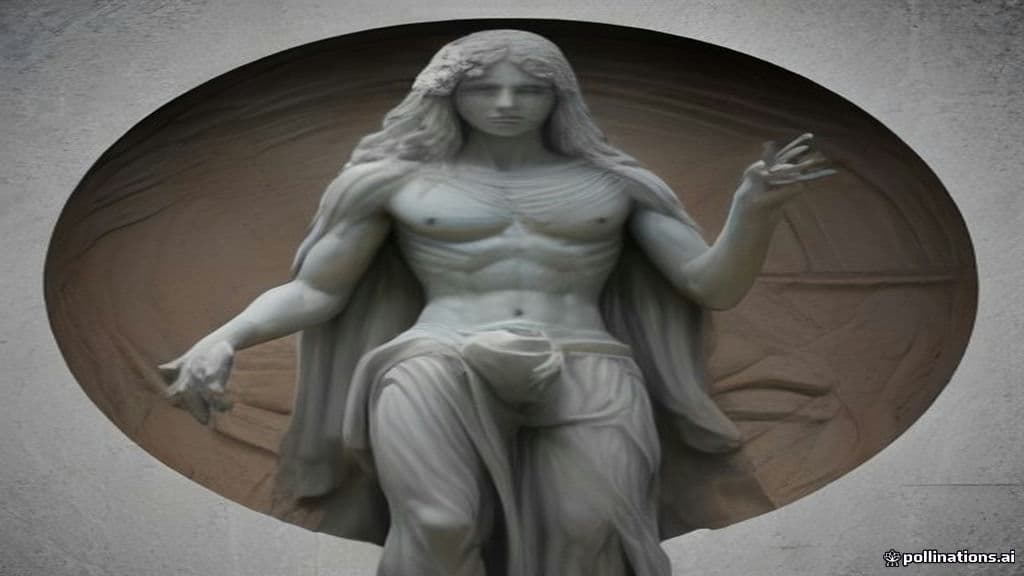
Palaechthon appears in Aeschylus' play The Suppliants as the father of Pelasgus: Pelasgus introduces himself as 'offspring of Palaechthon, whom the earth brought forth,' thereby presenting Palaechthon as an autochthonous progenitor. Within the play this filiation functions aetiologically and politically: the earth-born ancestor legitimizes Pelasgus' rule and the Pelasgian claim to the territory of Argos. Outside this passage the name is scarcely attested, and modern commentators note that Palaechthon appears only in Aeschylus and may be a literary/onomaic creation used to express native origin.
No physical description of Palaechthon survives in the primary literary evidence. The sole ancient characterization is genealogical and etymological: he is 'whom the earth brought forth'—an autochthon—so the only explicit descriptive trait in the sources is earth-born origin. No bodily attributes or iconography are recorded in the provided material.
The sources attribute no active supernatural powers or deeds to Palaechthon. His defining quality in the surviving evidence is autochthony—being 'brought forth' from the earth—which functions as a symbolic/aetiological attribute rather than a catalog of powers. He serves as an eponymous ancestral figure legitimizing lineage and territorial claim; no myths record actions, interventions, or cultic functions for him in the provided corpus.

Community Record
- [1]Palaechthon — Wikipedia. Wikipedia contributors, 'Palaechthon,' Wikipedia, The Free Encyclopediawiki
- [2]Pelasgus (king of Argos) — Wikipedia. Wikipedia contributors, 'Pelasgus (king of Argos),' Wikipedia, The Free Encyclopediawiki
- [3]Discussion: palai- + chthon etymology and onomastic commentary. Onomastic commentary and discussion (secondary online discussion)other
- [4]Discussion: Pelasgian origins and name-forms. Onomastic/genealogical discussion (secondary online discussion)other
- [5]Palaechthon and paleontological homonyms (example modern usages). Modern discussion noting taxonomic reuse of the name 'Palaechthon' (secondary popular science source)other
- [6]Tweaking Palaechthon (basal Volitantia) | The Pterosaur Heresies. Blog noting scientific uses of the name Palaechthon (secondary/source on homonymous usage)other