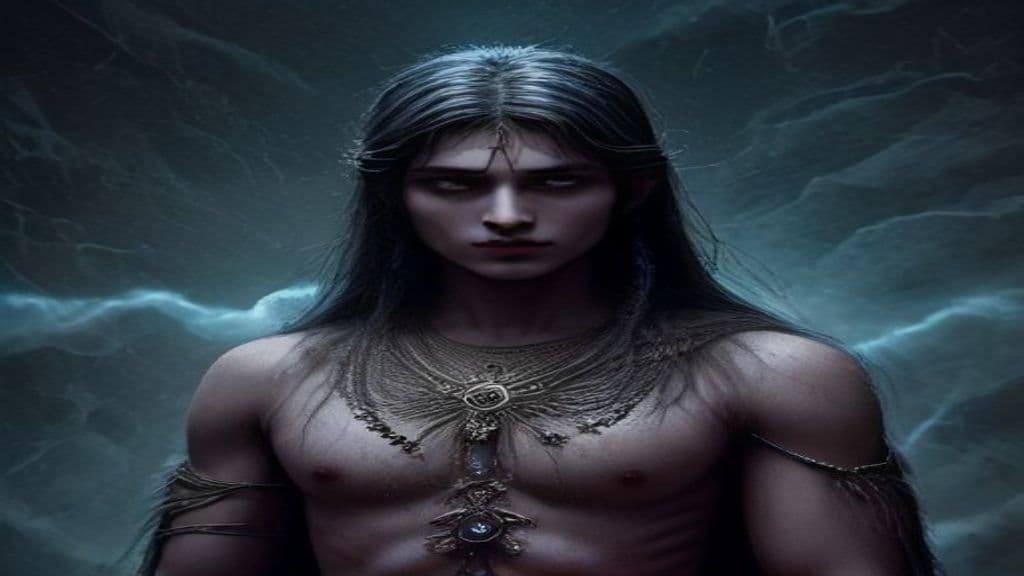
In comparative reconstruction, *Perkʷūnos is not an attested narrative figure but a hypothetical thunder‑deity posited by scholars studying recurring correspondences across daughter Indo‑European mythologies. The reconstructed pattern presents a storm/thunder hero who combats a multi‑headed water‑serpent that has confined or obstructed waters; the thunder‑deity’s victory releases these waters and restores fertility. This account summarizes a widely attested motif across descendant traditions rather than a single preserved Proto‑Indo‑European text.
No contemporary or iconographic descriptions from the Proto‑Indo‑European period survive; appearance is unknown. Any visual or bodily attributes attributed to *Perkʷūnos are inferred indirectly from later Indo‑European thunder deities (for example, attributes of gods like Thor, Perun, or Indra) rather than from direct evidence in the reconstruction literature.
Reconstructed attributes, inferred from comparative myth, assign *Perkʷūnos control over storm and thunder phenomena and a role in producing fructifying rains. He is also reconstructed as a combatant who defeats a multi‑headed water‑serpent to free obstructed waters, thereby restoring fertility. These abilities are scholarly inferences drawn from analogous functions of thunder‑gods in multiple Indo‑European daughter traditions rather than direct attestations from the Proto‑Indo‑European period.
'Ain Samiya Goblet
Silver cup from the Middle Bronze Age I, discovered in a tomb at Ain Samiya. (Note: 1. Power tier should be "None", but add a note explaining that historical artifacts don't fit into the typical power tier classification. 2. Add a description of its appearance based on it being a sil)
*Péh₂usōn (reconstructed)
Péh₂usōn is a hypothetical Proto‑Indo‑European pastoral guardian reconstructed by comparative scholars from parallels in Greek and Vedic traditions. Proposed as a Graeco‑Aryan ancestor‑figure, the reconstruction describes a protector of flocks, roads, and travellers rather than an attested historical cultic personality.
24 Themis
24 Themis is a large outer-main-belt asteroid and the parent body of the Themis collisional family. Scientifically notable for infrared detections of surface water ice and complex organics, it is a physical minor planet named after the Greek personification of natural law and order.
3-D Man
3-D Man is a Marvel Comics superhero identity associated with a 1950s-era origin in which the body of Chuck Chandler can materialize in three-dimensional existence when activated by his brother Hal via a pair of glasses. The mantle was later assumed by Delroy Garrett (formerly Triathlon) in modern continuity.
5 Ronin
5 Ronin is a 2011 Marvel Comics five-issue limited series that reimagines five Marvel superhero archetypes as rōnin (masterless samurai) in a fictionalized post‑Sekigahara feudal Japan. The work places Wolverine, Hulk, Punisher, Psylocke, and Deadpool analogues into period roles to explore displacement, revenge, and identity in an era of political upheaval.
57 Mnemosyne
57 Mnemosyne is a large main-belt asteroid (S-type) discovered in 1859 and named after the Greek Titaness Mnemosyne. It is a non-sentient astronomical body studied for its orbital and rotational properties and has been used in dynamical measurements related to Jupiter.
58 Concordia
58 Concordia is a fairly large main-belt asteroid orbiting the Sun, discovered in 1860 and named after the Roman goddess Concordia. Astronomical sources classify it as a C-type (carbonaceous) body with a multi-year orbital period and measurable rotation and pole orientations.
Community Record
- [1]Proto-Indo-European thunder god (Wikipedia summary). Wikipedia, entry on Proto-Indo-European thunder god, summary describing *Perkʷūnos as a reconstructed weather‑god associated with fructifying rains and resisting a multi‑headed water‑serpent; name probably invoked in times of drought.wiki
- [2]Wikidata: Perkwunos. Wikidata entry for Perkwunos describing the figure as a weather‑god in Proto‑Indo‑European mythology.wiki