
Phoroneus is presented in Argive tradition as one of the region's primordial men and an early king who links divine ancestry to human institutions. In variant genealogies recorded by ancient authors and summarized in the provided sources, he is the son of the river-god Inachus (himself son of Oceanus) and either Argia (an embodiment of the Argolid) or Melia (an Oceanid); different traditions record both maternal names. As a foundational figure he exemplifies the transformation of scattered, solitary families into an organized community and anchors Argive political and religious identity through his descent from local landscape deities.
Surviving summaries and sources offer no physical description of Phoroneus as an individual; he functions primarily as a genealogical, cultic, and civic founder rather than a descriptively portrayed hero. His material presence in the landscape is attested through cultic sites: ancient visitors (Pausanias, as summarized) were shown an eternal fire at his sanctuary in Argos and funeral sacrifices were offered at his tomb-sanctuary, indicating a tangible, ritualized locus for his memory even when narrative bodily description is absent.
Ancient sources attribute to Phoroneus a set of culture-bringing and institutional roles rather than supernatural powers in the sense of hostile monsters. Classical authors credit him with gathering scattered families into a community, introducing fire and the use of the forge to the people of Argos, instituting the worship of Hera in that city, and founding law. He is also represented as an early king whose descendants and successors continue Argive dynastic lines. These attributions are reported as the claims of ancient authors (e.g., Pausanias and Hyginus as summarized in the provided material) and function to explain civic, religious, and technological origins in Argive tradition.
Weaknesses
- otherNone attested in sources
Wards
- ritualVeneration and cult maintenance (eternal fire, funeral sacrifices)
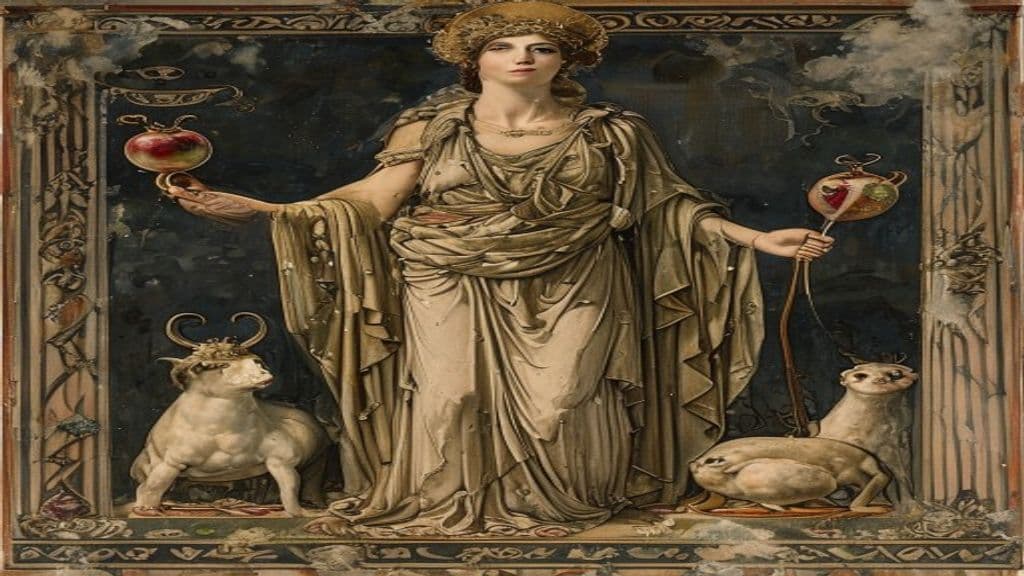
Hera
Hera is an ancient Greek goddess, queen of the Olympian gods, and a principal tutelary deity of marriage, women, and family. She functions in myth and cult as protector of lawful marriage and women in childbirth, a civic tutelary figure (notably of Argos), and a sometimes-jealous consort of Zeus with archaic fertility associations in certain local rites.

Inachus
Inachus (Ἴναχος, Inachos) is a mythic ancestral figure of Argos who functions both as the region's eponymous first king/priest and as a river-divinity descended in some accounts from the Titans Oceanus and Tethys. He appears in etiological narratives that tie Argive territory, cult, and seasonal hydrology to a pre-Olympian generation of river-gods and founders.
Community Record
- [1]Phoroneus (Wikipedia). Wikipedia entry 'Phoroneus' summarizing ancient sources including Pausanias and Hyginus; accessed in provided research notes.wiki
- [2]Phoroneus (Wikidata). Wikidata item for Phoroneus referenced in provided research notes.other
- [3]Pausanias (summary reference via Wikipedia). Summary of Pausanias' account as cited in the Wikipedia entry; Pausanias's 2nd-century CE description is the basis for the report of an eternal fire at Phoroneus' sanctuary (as summarized).literary
- [4]Archive: LP0004a The Nemean Lion (contextual archive). Contextual archive material included in the research packet; does not itself provide direct information on Phoroneus in the provided excerpts.other
- [5]Archive: LP0069 Timaeus & Atlantis (contextual archive). Contextual archive material included in the research packet; not a direct source for Phoroneus in the supplied excerpts.other