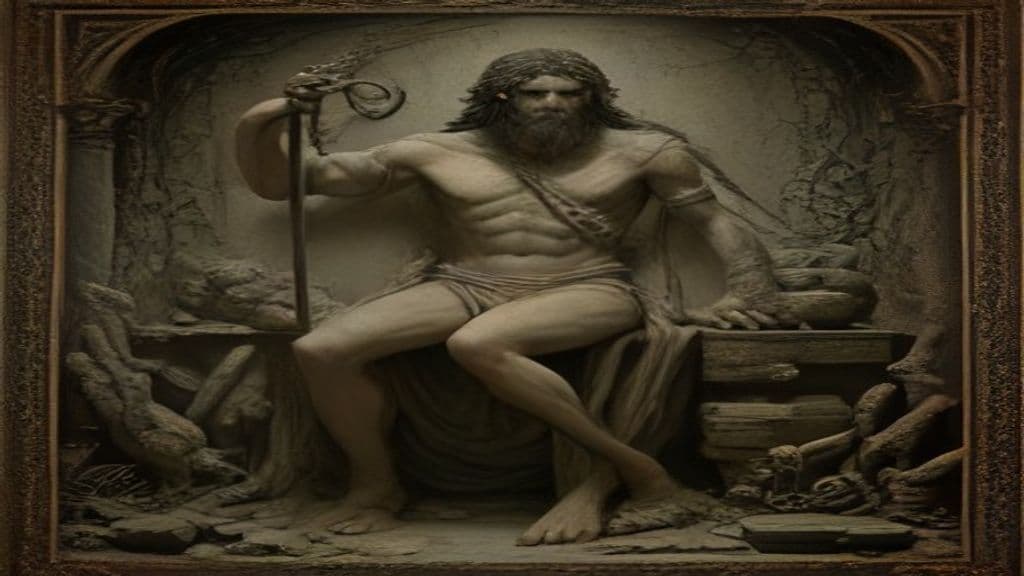
Poeas is presented in Greek narrative tradition as a son of King Thaumacus of Thaumacia and as a member of the generation of heroes associated with the Argonauts. Sources vary on local details: he is described in some traditions as king of Meliboea or of Malis (Maleae). Variant accounts also shift certain roles between Poeas and his son Philoctetes (for example, who served as Argonaut or who lit Heracles' pyre), reflecting the fluid genealogies and episodic attributions common in the mythic corpus.
Ancient sources and the provided summaries do not record a detailed physical description of Poeas. He is characterized by role and attributes rather than bodily particulars: narrators identify him as an archer and as the recipient of Heracles' bow and poisoned arrows, so typical iconographic attributes in later imaginings would center on bow and arrows rather than described bodily features. No specific clothing, stature, coloration, or portrait-type is attested in the cited material.
The consolidated trait recorded in the sources is martial skill in archery: Poeas is described in some accounts as the greatest archer among the Argonauts. Narratives attribute to him the act of accepting Heracles' request to have his funeral pyre lit, for which Heracles rewarded him with his bow and poisoned arrows. In variant traditions Poeas (or his son Philoctetes) is credited with delivering the arrow that causes the death of the bronze giant Talos, often in tandem with Medea's role in disabling Talos. These accounts present Poeas as a skilled mortal archer and participant in heroic reciprocity rather than as a supernatural agent with magical powers.
Weaknesses
- otherno traditional weaknesses/wards recorded in sources
Wards
- otherno traditional weaknesses/wards recorded in sources
Philoctetes
A mortal Greek hero and famed archer, son of Poeas, who inherits Heracles’ bow and arrows; abandoned because of a festering, foul-smelling wound and later recalled because possession of Heracles’ weapons is prophesied as necessary for Greek victory at Troy. His story appears across epic and tragic traditions (Homeric cycle references; Sophocles’ Philoctetes) and explores themes of suffering, divine causation, healing, and communal obligation.
Argonauts
A band of human heroes in Greek myth who sailed aboard the ship Argo under Jason to Colchis to retrieve the Golden Fleece. Their identity is defined by membership in the celebrated voyage and by shared heroic lineages; membership lists and details vary by source.
Abderus
Abderus (Ancient Greek: Ἄβδηρος, romanized Ábdēros) is a mortal heroic figure in Greek myth closely associated with Heracles, remembered as the youth left in charge of the Mares of Diomedes who was killed by them. He functions as an eponymous local/divine-hero ancestor for the city of Abdera and received funerary commemoration and athletic agones at his tomb.
Acamas
Acamas (Ancient Greek: Ἀκάμας) is a personal name recurrent in ancient Greek narrative traditions applied to multiple human characters (warriors, princes, suitors), once to a Cyclops, and once as a hound's name. Rather than a single supernatural entity, bearers of the name appear episodically across the Trojan War, Theseid, and Theban cycles as mortal actors whose deeds intersect with gods and fate.
Acarnan
Acarnan (Ancient Greek: Ἀκαρνάν) is an anthroponym attested in Greek mythic and epic tradition as the name of at least two distinct mortal figures: a son of Alcmaeon and Callirrhoe, and a human suitor of Penelope from Dulichium. The lexical form also appears adjectivally/ethnically (Acarnanian), linking the word to the region Acarnania; etymologically the name is reported as derived from a Greek fish-name (akarnan).
Acastus
Acastus is a mortal heroic figure of ancient Greek tradition: son of Pelias who became king of Iolcus, an Argonaut who sailed with Jason, and an actor in the post-Argonautic cycle involving Medea, Peleus, and the aftermath of Pelias’s death. He is attested as performing civic and ritual actions (burying Pelias, instituting funeral games, purifying Peleus) and as a participant in vendetta episodes that end in violent reprisals.
Acmon
Acmon (Ancient Greek: Ἄκμων, 'anvil') is a polyvalent personal name in Greek myth borne by several distinct minor figures — a Dactyl (artisan), a Phrygian eponymous king, a mischievous woodland creature, companions in epic cycles (one companion of Diomedes transformed into a bird; an Aenead), and in some brief traditions an alleged father of Uranus. The name therefore functions across artisanal, topographical, trickster, and metamorphosis motifs rather than denoting a single unified supernatural species.
Acrisius
Acrisius (Ancient Greek: Ἀκρίσιος, Akrisios) is a mythic-historical king of Argos in Greek tradition whose narrative is defined by an oracular prophecy foretelling his death by his daughter's son. He is portrayed as a mortal ruler entangled with dynastic rivalry, oracular authority, and the eventual accidental fulfillment of fate.
Aeacidae
The Aeacidae are a dynastic lineage in Greek myth and historiography descended from the hero Aeacus, son of Zeus and the nymph Aegina. The name functions as a patronymic designation for those 'of Aeacus' and is used to claim genealogical legitimacy and political prestige in regions such as Aegina and Molossian Epirus.
Aegipan
Aegipan (Αἰγίπαν / Αἰγίπανος) is an ancient Greek mythological figure associated with goat attributes and with the sea‑goat imagery of the constellation Capricornus. He appears in classical myth as a semi‑divine helper (notably in the Typhon episode) and, in later natural‑history and medieval bestiary reception, the name is applied to satyr‑like or ape‑like wild men in distant lands.
Aegisthus
Aegisthus (Greek Αἴγισθος, Aigisthos) is a mortal member of the House of Atreus in Greek myth who, born of incestuous circumstances and raised by shepherds and a goat, participates in dynastic murder and usurpation — notably the slaying of Atreus in some accounts and the conspiracy (with Clytemnestra) that results in Agamemnon's death — and is later killed by Orestes, an episode that figures in narratives about inherited guilt, vengeance, and the transition from private retribution to public justice.
Aenete
Aenete (Ancient Greek Αἰνήτη) is a mythological human figure recorded in Greek epic genealogies as the mother of Cyzicus, king of the Doliones. She appears in brief genealogical notices in the Argonautic tradition and is otherwise unattested as an active character, cult figure, or supernatural agent in the surviving citations.
Aepytus
Aepytus (Ancient Greek: Αἴπυτος, Aíputos/Aípytos, lit. 'steep, high, lofty') is a personal name in Greek myth borne by several legendary kings tied to Arcadian and Heraclid genealogies. The figures named Aepytus function as ancestral/dynastic nodes in literary genealogies and later literary receptions rather than as supernatural beings.
Aeson
Aeson (Ancient Greek: Αἴσων) is a legendary mortal king of Iolcus in Thessaly in Greek myth, best known as the father of the hero Jason. His fate—imprisonment by his half-brother Pelias and either suicide or a miraculous restoration performed by Medea—provides the dynastic and moral background for the Argonautic cycle.
Community Record
- [1]Poeas — Wikipedia. Wikipedia entry 'Poeas'wiki
- [2]Poeas (Wikidata). Wikidata item for Poeasother
- [3]LP0031 Intro to the Argonauts (archive recording/transcript). Archive recording/transcript: Intro to the Argonautsother
- [4]LP0031 Intro to the Argonauts (alternate archive link). Archive recording/transcript: Intro to the Argonauts (alternate link)other
- [5]Poeas in Greek Mythology — Greek Legends and Myths. Popular summary of classical traditions concerning Poeasfolk